
Sangha sisters join rebel monk ranks


An all-female monastery in Nakhon Pathom offers another gentle nudge to Thai men’s monopoly on Buddhist ordination
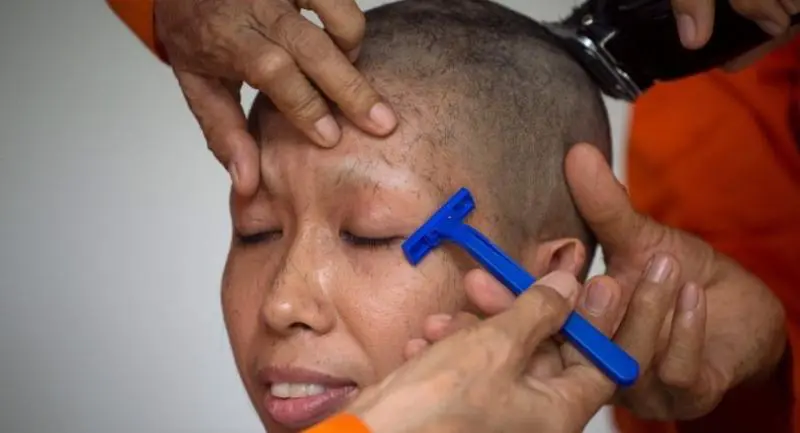
Scissors fly as families surround their daughters to shear off tufts of hair until they are nearly bald – a ritual preparation for the women’s new future as rebel female monks.
Taking on the spartan lifestyle is a subversive choice for the two dozen women, who are the latest to buck tradition in Thailand’s male-dominated Buddhist order.
The Buddhist kingdom’s clergy refuses to officially recognise female monks as legitimate.
But their ranks are gradually growing under the leadership of Dhammananda Bhikkhuni, an abbess who founded the all-female Songdhammakalyani Monastery in Nakhon Pathom province outside Bangkok.
On Thursday she inducted 24 more women into what is known as the bhikkuni – female monk – tradition.
The hair-cutting ceremony was an emotional moment for many of the incoming monks, whose ages spanned the spectrum – from their twenties to their sixties.
Some were amused while others struggled to hold back tears.
After most of their hair was snipped off, the women’s heads – and eyebrows –were shaved and rinsed.
They then donned rust-coloured robes, sat through a series of prayers, and received their first round of alms as they stepped into new, austere lives shorn of romance and most forms of excess.
Dhammananda took her vows as a bhikkhuni 16 years ago, in a country where Buddhism remains a male bastion. The Lord Buddha endorsed the monastic ordination of women, but Thailand’s Sangha Council will accept no female order.
Nevertheless, over the years, Dhammananda – through her religious activities and writings – has inspired many women to devote themselves to the lifestyle. She firmly believes they can share in nirvana.
“It’s a small number but we’re spreading out – we have bhikkhunis in 10 provinces now,” she told The Nation in 2012.
Dhammananda realised she might have a religious vocation after presenting a paper on the future prospects female monks at a 1983 Harvard University conference on women, religion and social change. She was preparing for her master’s degree at the time.
“That conference marked a turning point in my life. I realised that I needed to be more than an academic to bring about change. So I became an activist and started a newsletter, which helped me connect with bhikkhunis. I had no idea that I’d be ordained one day as a monk. Now, since we’re sprouting like mushrooms everywhere, it dawned upon me that we have to write our own history.”
Dhammananda wore the robes of a novice for two years before being ordained as a monk, in a ceremony presided over by five male and five female monks. It took place not in Thailand but Sri Lanka, since there weren’t enough female monks here to perform the rituals.
The path to Buddhahood is particularly difficult for women but possible nevertheless, she affirms. Like the monks of Theravada Buddhism in general, Dhammananda rises early to pray and meditate before going on her morning alms rounds.
“If you understand the Buddhist teachings, it’s not hard to be a bhikkhuni,” she says. “I’m just doing my job as a bhikkhuni.”
While her busy schedule serves to illustrate her devotion, she’s often encountered strange reactions. Unlike her male counterparts, Dhammananda is not allowed to change the title on her ID card from Mrs to Bhikkhuni.
“It’s funny when you look at my ID card bearing my image with a shaven head and the title Mrs, when I’m a monk! The ID card still goes by ‘Mrs so and so’.
“The officials at my district office told me they need a computer code to change my title. ‘And how do you get the code?’ ‘You have to go to a particular department to get permission, then permission from the Sangha Council.’ And the Sangha said, ‘We do not yet accept the female order.’”
Those who question her religious path are mostly senior Buddhist monks with “high positions”.
“This is a part of our culture that hasn’t been questioned for a long time. But we shouldn’t be unhappy about it. Otherwise it becomes negative energy working against us. Buddha talks about change. This also has to change.”
