
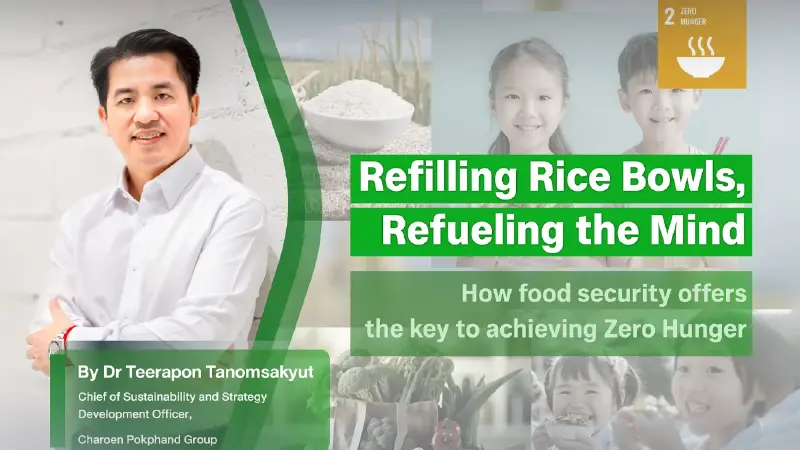
Refilling Rice Bowls, Refueling the Mind: How food security offers the key to achieving Zero Hunger


The lives of 280 million people are in extreme jeopardy because of acute hunger, while a further 733 million experience chronic hunger, being regularly deprived of safe, nutritious food.
These were the stark figures that captured headlines upon the publication of SOFI 2024 (State of Food Security and Nutrition in the World report for 2024) by the Food and Agriculture Organisation (FAO). But this entirely reasonable focus on the most vulnerable may have risked a broader concern escaping the attention of many: that an estimated 2.33 billion people regularly lack access to adequate food, which means almost 30% of the world's population is moderately or severely food insecure.
Furthermore, according to a 2024 report by UNICEF on global child poverty, one in four children suffers from severe food shortages, with their daily intake confined to no more than two food groups, and of those affected 200 million are aged below five. In Thailand, this applies to 10% of children in that age group, prompting the country's UNICEF Representative, Ms Kyungsun Kim to voice her concerns over the irreversible consequences this situation poses for children, to the detriment of not only their physical growth and wellbeing but also their cognitive and emotional development.
Such concerns were compounded by the results of the Multiple Indicator Cluster Survey (MICS), conducted in Thailand three years ago by the National Statistical Office and UNICEF. It found that only 29% of infants were breastfed, and among children under five, 13% experienced stunted growth and 7% were classed as being wasted as a result of poor nutrient intake or disease. Such data is especially liable to shock most Thais: in a country often referred to as 'the kitchen of the world', there is an appalling paradox when inequality is so pervasive as to determine whether children will receive any breakfast or lunch.
"No one can be wise on an empty stomach."
In 2015 Thailand joined 192 other United Nations member states in committing to 17 Sustainable Development Goals (SDGs) for 2030. Taken together these goals are intended to spur countries into better addressing the social, economic and environmental challenges facing the world. The second of the SDGs is concerned with food, setting the following targets for the end of the decade: ending hunger, achieving food security, improving nutrition standards, and promoting sustainable agriculture practices.
As a means of addressing the harsh realities of food insecurity as well as the ambitious demands of SDG #2, please consider the following as potential starting points for a collective approach to taking decisive action:
- Economic inequality and insufficient access to food. While Thailand has a relatively affluent middle-income economy, there continues to be a vast gulf separating rich and poor. This leaves the poorest households priced out of the market for quality food, so children are fed cheap, starch-based diets that lack minerals, vitamins and proteins essential for their physical and cognitive development. At the heart of the matter is the absence of a welfare system for which the universal right to nutrition is enshrined as a dictum.
- Imbalanced food distribution and inadequate nutrition policies. Even though Thailand is a source of varied food produce with a high export value, a 'nutritional gap' in its domestic production and distribution means that the needs of many Thai children are not being met. Those in remote areas or in under-resourced parts of the education system are especially prone to being served school meals of poor quality, variety and nutritional value. At the same time, the increasing consumption by children in urban areas of processed foods high in fat and sugar is fast becoming a silent epidemic and another facet of the malnutrition crisis facing the nation. This is something consistently overlooked and ignored due to the absence of a nationwide body responsible for monitoring consumption habits against nutritional standards.
- Failure to make Early Years a priority. The World Health Organisation (WHO) designates the first 1,000 days of life - from conception to the age of two - a period critical for cognitive and emotional development as well as for the refinement of a wide array of motor skills. And yet, as mentioned above, only the 29% of Thai babies are fed breastmilk. Poverty and inequality undoubtedly lie at the heart of maternal and infant malnutrition, but it is surely worth considering whether a better-funded and more robust healthcare infrastructure. Extensive enough enough to ensure rural and marginalised communities are better served, would it alleviate matters by improving the extent and the standard of support and guidance available?
Turning our attention to possible solutions, the credo "Full stomachs mean full minds" inspires my faith in the private sector's capability to help ensure future generations grow up with the spectre of hunger consigned to the past:
- Making food accessible to all. Government investment in community support programmes is needed to ensure that the poorest, the most remote and the most vulnerable members of our society receive access to supplies of nutritious food. This may include food banks, fresh food distribution centres at subdistrict level, and a standardised procurement system for locally sourcing school meals that meet age-specific nutritional guidelines. This is where the private sector can support the adoption of a food distribution system for schools in which supplies are fresh, clean and healthy, prices are controlled, and new markets are opened for local farmers.
- Raising the status of Early Years to national priority. Is it time for the first 1,000 days of life to be accorded a status that facilitates a raft of essential initiatives being implemented? These could include community child nutrition centres; schemes entitling vulnerable children to free or subsidised food supplies; and digital platforms and mechanisms enabling schools and village health volunteers (VHVs) to track nutrition levels.
- Encouraging investment rather than aid by reforming how agriculture serves nutrition. As an private sector employee involved in agriculture - and in a country with a strong agricultural foundation - I have a firm belief that this sector can make a decisive contribution to ending world hunger by improving the nutritional standards of produce and helping to expand accessibility. Could the Thai government oversee the creation of a network of agricultural collectives or smallholder groups working in direct contact with local early childhood development centres? This could guarantee children's access to food through the principle of 'investment rather than aid'. For example, early childhood centres could benefit from a procurement system that promotes the supply of fresh, locally produced food suited to local preferences and dietary and nutritional requirements, rather than unsuitable imported or processed foods.
A successful example of this kind of collaboration is the Eggs for Lunch project led by Charoen Pokphand Foods (CPF) with the Charoen Pokphand for Rural Lives Development Foundation. This provides schools with chicken coops to teach students to view the hens as assets, laying eggs that are sent to the school kitchen to be ingredients in school lunches. They learn important farming practices as well as the management skills necessary to ensure the supply of enough eggs to meet the school's needs. Excess eggs can be sold to local shops or to the general public, with the income being invested back into the project. Now in its 37th year, there are 1,018 schools participating in the scheme, benefiting over 220,000 students. Moreover, it has helped the average annual consumption of eggs - as well as the vital proteins they contain - to increase from 156 to 276 per person, a rise of 77 per cent.
This is clearly a matter for which resolution will only be possible by addressing the root causes of hunger and child malnutrition, and specifically by seeking ways of increasing food security in every corner of the world. Responsibility for this should not lie with just one person, body or agency, but rather in the formation of a collective mission. Within this, every sector would be represented through a close collaboration between public bodies and private businesses. Such a concerted approach has the potential to devise, implement and monitor the necessary mechanisms to connect farms with communities and schools.
Genuine, lasting solutions to our biggest challenges require us to look beyond the provision of aid as a response to suffering. We will most likely need to come to terms with the greater level of investment this entails, but the prospect of laying a pathway towards food security for every child makes this a truly worthwhile cause.
Never going without a meal lets us look to the future with an undiminished capacity.
References:
https://www.sdgmove.com/2024/08/09/fao-food-security-and-nutrition-report/
https://www.sdgmove.com/2024/06/07/child-food-poverty-unicef/
