
Organisations that refine the profit motive with moral imperatives will never run on empty
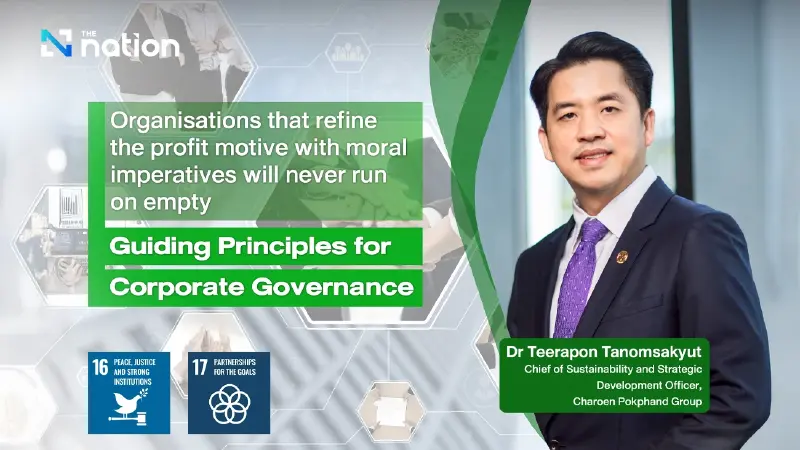


Guiding Principles for Corporate Governance
The modern-day corporate organisation operates in service to the interests of a broad church of internal and external stakeholders.
The days when executive decisions were made in single-minded pursuit of increased profits and share prices or growth at all costs are becoming rapidly fading memories. Now more than ever, purely economic considerations must be hewn to align with a host of other factors. These range from local legislation, international commitments and industry-specific standards to consumer expectations as ever-changing as the economic, societal, environmental and technological conditions that inform them.
Businesses have long been required to produce transparent, auditable financial statements in accordance with International Financial Reporting Standards (IFRS). In more recent times, the monitoring of organisational sustainability - the conceptual framework for which revolves around three main aspects, Environmental, Social and Governance (ESG) - has started to be conducted with a similar degree of rigour.
Both evaluative frameworks are examples of external forms of governance that place modern organisations under ever-increasing scrutiny. They far surpass the scope of earlier legislation designed to protect shareholder interests above all else. This is in keeping with growing expectations - among specific consumer groups and across society as a whole - for businesses and their entire value chain to operate in a manner deemed to be 'acceptable', based on parameters that span ethics, transparency and social responsibility.
Nevertheless, while external regulations offer important protective safeguards, the true source of a company's strength and its capacity for growth derives from an inner impetus: corporate governance.
Resources like Investopedia and MetricStream distil the key principles of governance into constituent parts: accountability, transparency, fairness, risk management and responsibility toward stakeholders. It was notably defined as the "system by which companies are directed and controlled" in the Cadbury Report (1992), which proceeded to espouse the function of governance as something far beyond a box ticking exercise that checks if rules are being followed. Instead, an approach was put forward in which the oversight of management activity would permeate the entire organisation.
Seen in this light, governance is a wellspring for moral courage, rather than just a conduit for the checks and balances that prevent corporate decision-makers from running afoul of regulatory authorities. Governance ideally bestows organisations with an innate compulsion to act properly; to do something not because it is required but because it is right.
Meanwhile, the United Nations Global Compact defines governance as "the systems and processes that ensure the overall effectiveness of an entity – whether a business, government or multilateral institution". Viewing the matter through this lens helps to align it with the UNs' Sustainable Development Goals (SDGs), and specifically:
- SDG #16 Promote peaceful and inclusive societies for sustainable development, provide access to justice for all and build effective, accountable and inclusive institutions at all levels
- SDG #17 Strengthen the means of implementation and revitalize the global partnership for sustainable development.
By consolidating mutual trust and accountability within the public, private and civil sectors, the groundwork is laid for effective collaboration between relevant organisations from each.
Good governance is not therefore limited to compliance; it is the manifestation of a culture that values ethical conduct and lets good people thrive. At the same time, governance becomes a catalyst for the values and ethics of an inspirational leader to become the driving force that propels every aspect of organisational activity.
All of this reaffirms the sheer impossibility of extricating governance from morality. Indeed, corporate governance should be understood as 'systematised virtue', while business ethics are effectively a form of 'governance over a leader's soul'. Informed by these interpretations, here are four pillars upon which modern leadership should be based:
- Self governance
As an inner guiding force this is invisible, but when any behaviour is infused with discipline or integrity, its fundamental importance becomes apparent to all. Standing firm and remaining true to one's values despite widespread resistance is an example of effective self-governance, but so is a receptiveness to criticism when justified. Ideally, somebody assuming leadership of an organisation and its staff will have already gained a high level of self-control. This will allow the organisation's purpose and mission to be infused with his or her principles, providing it with an unwavering focus, direction and momentum.
- Work governance
As is the case with society, justice forms an integral component of governance, and all leaders serve as a bellwether for fairness. Ethical work governance means ensuring that behaviour and decision-making do not succumb to any of the 'four biases':
- affection bias – Favouritism stemming from fondness for particular individuals,
- anger bias – Prejudiced judgement or action informed by an emotional response such as resentment,
- delusion bias – A form of misjudgement caused by a misunderstanding or disinformation,
- fear bias – Decisions driven by considerations producing fear, such as protecting oneself from harm.
Organisations earn trust by 'judging the work, not the person', and that trust constitutes an invaluable form of social capital.
- People governance
At the heart of good governance is a culture that truly values people, in which they are not only granted rights but dignity too. Any organisational culture would benefit from a leader referring to the brahmavihārā (four sublime states) as a moral bedrock:
- loving kindness – Goodwill to others,
- compassion – Helping those who are suffering or in trouble,
- sympathetic joy – Delighting in the successes of others,
- equanimity – Approaching all matters with an open mind and calm impartiality.
A team that is led with kindness and compassion is likelier to stay strong and face even the most difficult challenges together as a unit.
- 'Governance governance'
Effective governance transcends appraisal paperwork and KPI spreadsheets; it is the environment in which upstanding individuals are given a platform on which to realise their potential. Any well-governed organisation will meet the following criteria:
- operates with transparency,
- maintains auditable records,
- remains honest in all forms of communication,
- shows willingness to admit and learn from any mistakes made,
- uses facts and data to inform decisions, rather than emotional responses,
- displays receptiveness to different views,
- approaches innovation and change with courage and boldness.
These are the characteristics of a workplace that attracts talented people keen to learn and develop and which retains its best performers.
Effective corporate governance bolsters an organisation's foundations, enhancing its strength and stability. Moreover, it frequently provides - whether in a direct or indirect capacity - further benefits, particularly with regard to its value chain.
For example, a study of 160 British companies between 2005 and 2018 found a direct correlation between higher governance and improved financial indicators such as return on equity (ROE). The Organisation for Economic Cooperation and Development (OECD) has also reported that effective governance has a tangible effect on long-term investor confidence, bringing improved access to patient capital and thereby supporting sustainable economic growth.
Therefore, because governance represents a structural foundation closely interwoven with an ethical dimension, it compels private sector entities to resolutely embrace and promote a business culture which is steeped in values marked by moral courage. In such environments, leaders and employees do what is right, rather than what is asked of them. One might even consider this 'Dhamma in action'.
When governance instils fairness in the workplace,
Good employees remain motivated and driven,
And when staffed by committed workers,
Organisations never lose their way.
