
Bosch Unveils Revolutionary Automotive Technology at Bangkok Mobility Summit
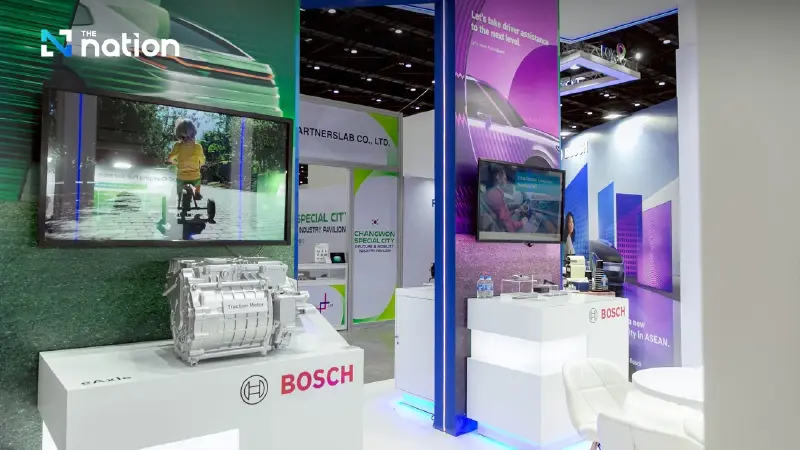


German engineering giant showcases autonomous driving systems and cloud-based solutions to accelerate sustainable transport
- Bosch introduced a "Battery in the Cloud" service that uses AI to monitor EV battery health in real-time, aiming to increase transparency, improve resale value, and support battery reuse.
- The company presented a new vehicle architecture concept that integrates powertrain, steering, and braking systems through centralized software, featuring "Vehicle Dynamics Control 2.0" for enhanced safety and agility.
- Bosch showcased advanced technology for autonomous driving, including new-generation AI-powered video cameras and ultrasonic sensors for improved object detection and automated parking.
- Innovations such as steer-by-wire systems were unveiled, which remove the mechanical link to the steering wheel, allowing for new vehicle interior designs and advanced functions.
German technology and engineering company Bosch has demonstrated its commitment to revolutionising the automotive industry at the recent "Mobility Tech Asia Bangkok 2025" exhibition, presenting cutting-edge innovations designed to accelerate the transition to electric vehicles and sustainable transport solutions.
The Bosch experience focused on two key areas: next-generation autonomous vehicle technology and groundbreaking cloud-based solutions that promise to transform how electric vehicles are maintained and valued throughout their lifecycle.
Future Vehicle Architecture
Bosch outlined its vision for tomorrow's vehicles, where traditional separate systems for powertrain, steering, and braking will be integrated through centralised mobility software.
This unified approach will enable new cross-domain functions whilst allowing customisation to match each vehicle's unique characteristics.

At the heart of this transformation is the company's "Vehicle Dynamics Control 2.0" concept, an intelligent control system that can predict vehicle behaviour and intervene proactively to enhance safety, comfort, and agility—particularly crucial in constantly changing driving conditions.
The company's steer-by-wire electric steering system eliminates the mechanical connection between steering wheel and rack actuators, opening possibilities for entirely new interior design concepts whilst adding advanced functionality.
Bosch's electric drivetrain solutions promise powerful and efficient performance, with electric motors serving dual roles as both drive units and generators, enabling both hybrid and pure electric operation.

AI Integration and Sensor Technology
Bosch has integrated artificial intelligence across various vehicle components to maximise driving efficiency. The company's new-generation front-facing video cameras play crucial roles in driver assistance systems, enabling vehicles to detect objects and people with continuous accuracy.
These cameras combine classical image processing algorithms with AI methods for flexible object detection, making them increasingly suitable for autonomous driving applications.
The cameras feature 8-megapixel resolution with maximum detection range of 300 metres, horizontal viewing angles of ±60°, and vertical viewing angles of 54.8°.
Ultrasonic sensors facilitate comfortable parking in very small spaces, narrow driving conditions, and automated/remote parking.
These sensors can detect objects up to 5.5 metres away and as close as 15 centimetres, supporting low-speed emergency braking functions through rapid response to obstacles such as pedestrians or posts.

Revolutionary cloud-based solutions
Perhaps the most significant innovation presented was Bosch's "Battery in the Cloud" service, addressing growing concerns about battery health as electric vehicles enter the second-hand market.
This solution provides real-time insights into battery condition and lifespan, offering transparency and confidence to both buyers and sellers.
The service combines big data from vehicle fleets with cloud technology and artificial intelligence. Current battery data is initially collected and pre-filtered by vehicle telematics control units before transmission to Bosch's cloud systems.
All data undergoes analysis in the cloud using sophisticated software algorithms. Self-learning systems predict individual battery conditions and calculate optimal parameter configurations.
Results including recommendations, condition reports, and new operating parameters are then transmitted from the cloud to vehicles or relevant end devices such as smartphones or PCs.
These insights reduce uncertainty, increase resale values, and create new opportunities for insurance services and warranties. The system also helps assess which batteries are suitable for reuse or recycling, supporting sustainability goals.

Environmental Impact and Sustainability
The intelligent cloud-based solution serves as both a market accelerator and environmental responsibility tool.
For automotive manufacturers, the solution reduces warranty costs through continuous battery data collection and extended battery lifespans, resulting in fewer compensation claims and reduced repair and replacement costs.
Continuous battery data collection from internet-connected vehicles represents a valuable resource for future battery technology development. Data exchange between cloud and vehicles creates continuous feedback loops to improve battery design and usage strategies.
The detailed recording of battery conditions enables "second life" concepts, allowing electric vehicle batteries to be reused for applications such as stationary energy storage. Digital twin data from batteries also facilitates recycling decisions, contributing to a sustainable circular economy.

Industry Transformation
As the world transitions to clean energy, electric vehicles play increasingly important roles. However, widespread EV battery adoption faces significant challenges due to limited lifespans requiring frequent replacements. EV batteries contain rare minerals including lithium, manganese, and cobalt, raising environmental concerns.
Current practices conflict with global sustainability goals and remain insufficient to support widespread electric propulsion. Major transformation is needed from raw material extraction to sustainable recycling.
Bosch Rexroth leads this transformation by focusing on automated battery recycling systems, aiming to create more sustainable and scalable solutions for the EV industry.
The company's comprehensive approach demonstrates its commitment to serving as a trusted partner in the regional automotive industry, providing technical consultation and solution services to accelerate the transition to sustainable mobility.
