
GULF Secures 60 Billion Baht ($1.9 Billion) Loan to Power 939 MW Renewable Expansion
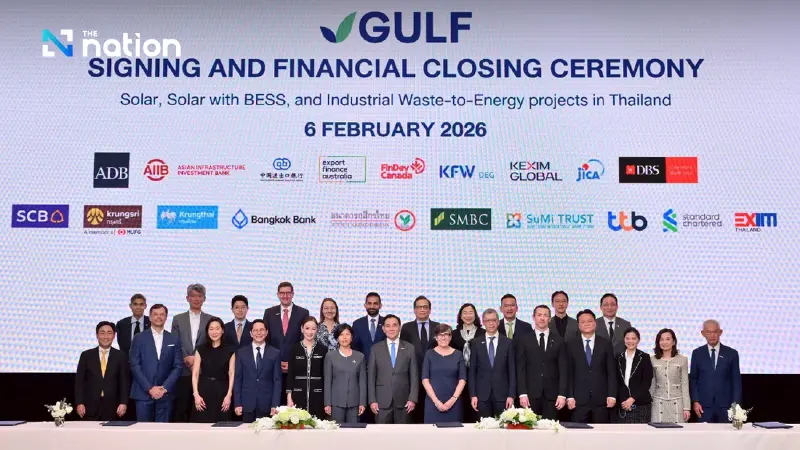


Thai energy giant finalises massive green financing for 27 projects, spanning solar farms and waste-to-energy plants, to meet 2050 Net Zero goals
- Gulf Energy Development (GULF) has secured a 60 billion baht ($1.9 billion) loan to finance a 939 MW expansion in its renewable energy portfolio.
- The funding will support 27 green projects, primarily consisting of 15 solar and battery storage facilities (843 MW) and 12 industrial waste-to-energy plants (96 MW).
- The financing was arranged by the Asian Development Bank (ADB) and supported by a syndicate of major international and Thai financial institutions.
- This expansion is a key part of GULF's strategy to meet its Net Zero emissions goal by 2050, with the new projects scheduled to come online between 2024 and 2027.
Thai energy giant finalises massive green financing for 27 projects, spanning solar farms and waste-to-energy plants, to meet 2050 Net Zero goals.
Gulf Energy Development Public Company Limited (GULF) has successfully secured a loan facility of 60 billion baht (approximately $1.9 billion) to develop 27 renewable energy projects.
With a combined contracted capacity of 939 megawatts (MW), the move marks a significant milestone in GULF’s decarbonisation strategy and its commitment to achieving Net Zero emissions by 2050.
The financing, managed through subsidiaries Gulf Renewable Energy and Gulf Waste to Energy Holdings, supports two primary green initiatives:
Solar Power & Storage: 15 projects consisting of solar farms and solar-plus-battery storage systems, totalling 843 MW.
Industrial Waste-to-Energy: 12 projects with a combined capacity of 96 MW.

Solar Dominance and International Backing
The 15 solar and storage projects, representing an investment of over 43 billion baht ($1.3 billion), are scheduled for commercial operation between 2024 and 2026.
This segment has garnered extensive support from a syndicate of leading domestic and international financial institutions.
The Asian Development Bank (ADB) served as the mandated lead arranger and bookrunner. The consortium includes high-profile lenders such as the AIIB, JICA, Export-Import Bank of China, DEG (Germany), and FinDev Canada, alongside Thailand's major commercial banks including Bangkok Bank, Kasikornbank, Krungthai, and SCB.
Currently, 12 of these projects (649 MW) are already operational, with the remaining three (194 MW) slated for completion in 2026.

Circular Economy through Waste-to-Energy
GULF is also addressing industrial waste management through 12 waste-to-energy projects.
These facilities, expected to go online in 2027, aim to divert industrial waste from landfills by converting it into sustainable power.
This initiative received a long-term loan of 17 billion baht ($550 million) from a group of development finance institutions including the ADB and AIIB, as well as commercial partners such as SCB, Krungsri, ttb, and Standard Chartered.

Leadership Perspectives
Sarath Ratanavadi, CEO of Gulf Energy Development, expressed his gratitude to the multilateral development banks and commercial partners.
"This support reflects the deep confidence the financial community has in GULF. Our portfolio now spans solar, wind, hydro, and waste-to-energy. This confirmation from the financial sector aligns perfectly with Thailand’s decarbonisation policy as we head toward Net Zero by 2050."

Aaron Batten, ADB Country Director for Thailand, added: "As the lead arranger for the renewable group and environmental coordinator for the waste-to-energy projects, the ADB is proud to support this transaction. It underscores the vital role private investment plays in helping Thailand meet its renewable energy targets and building a sustainable energy system for the region."

Kris Chantanotoke, CEO of Siam Commercial Bank (SCB), remarked: "We are delighted to support GULF in these comprehensive sustainability projects. This financial structure serves as a blueprint for future environmental initiatives, proving that industrial sustainability and financial returns are now inextricably linked within the rapidly evolving Thai energy market."
