
Strategy 2030: Bosch plays to its innovative strengths


Advancing Thailand’s transformation through innovation and local partnerships
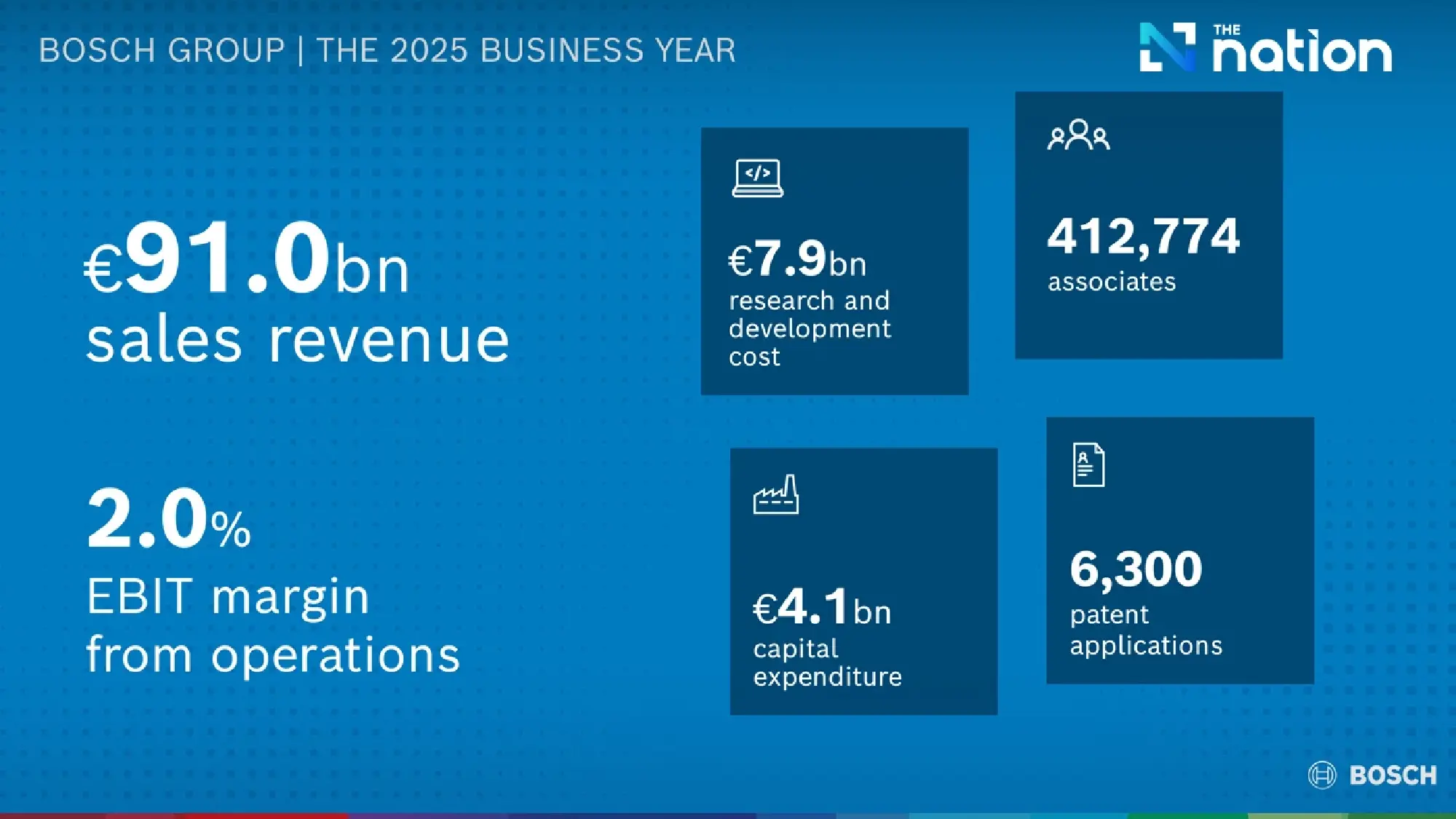
- The 2025 business year: sales revenue of 91.0 billion euros / EBIT margin from operations of 2.0 percent / free cash flow of some 300 million euros.
- Outlook for 2026: sales growth of 2–5 percent / EBIT margin from operations of 4–6 percent / positive free cash flow.
- Driving Thailand’s transition through software-defined mobility, electrification, and advanced manufacturing.
- Joseph Hong: “Positive business momentum in 2025 reflects Bosch’s commitment to long-term growth in Thailand.”
- Innovation leadership: high upfront investments in areas of future importance secure a technological edge and strengthen growth opportunities.
Stuttgart, Germany, and Bangkok, Thailand – In the face of geopolitical tensions and trade barriers, the Bosch Group intends to exploit the growth prospects in its global markets with full innovative strength in the 2026 business year. The necessary upfront investments in areas of future importance are set to remain at the high level of previous years. In 2025 alone, Bosch devoted some 12 billion euros to investments in research and development and to capital expenditure. The supplier of technology and services is planning sales growth of 2–5 percent and an EBIT margin from operations of 4–6 percent for 2026. Referring to the presentation of the company’s annual figures, Stefan Hartung, chairman of the board of management of Robert Bosch GmbH, said: “As a global technology leader, we are committed to shaping the trends of automation, digitalization, electrification, and artificial intelligence, as this also paves the way for profitable growth in our business. When it comes to innovative strength, Bosch is one of the strongest industrial companies in the world and one of the most prolific patent applicants in Europe. Bosch registered around 6,300 patents in 2025 and was once again the leader in Germany. Despite considerable challenges, Bosch was able to achieve sales revenue of 91.0 billion euros in the 2025 business year, slightly up on the previous year (2024: 90.3 billion euros). After adjusting for exchange-rate effects, this was equivalent to 4.1 percent growth. At 2 percent, the EBIT margin from operations was below the previous year’s figure (2024: 3.5 percent).

Business development in Thailand
Despite a challenging economic environment, Bosch Thailand demonstrated continued growth in 2025. Consolidated sales to third parties reached 463 million euros (17.2 mTHB), reflecting an increase of 1.3 percent compared to the previous year. As of December 31, 2025, Bosch Thailand increased its number of associates to around 1,850, further reinforcing its role as a reliable contributor to the local economy. Underscoring its strong organizational culture, the company was also recognized as a “Great Place to Work” for the third consecutive year. This certification is awarded by Great Place to Work Institute, an independent organization that evaluates workplace culture through rigorous assessment, including confidential employee feedback via its Trust Index™ survey and a review of company people practices. The recognition highlights the company’s continued commitment to fostering a positive and engaging workplace for its associates.
“Our positive business momentum in 2025 reflects our continued commitment to growing with Thailand. By expanding our local presence, strengthening partnerships, and investing in future technologies, we are proactively building a robust foundation that is well-equipped to support industry transformation and sustainable economic growth, even as the market evolves,” said Joseph Hong, managing director of Bosch in Thailand. Bosch Thailand looks ahead to 2026 with a forward-looking perspective, driven by continued investments, strong local capabilities, and a focus on capturing emerging opportunities across key growth sectors.

In 2025, Bosch marked the 10 years of its Power Solutions Research and Development Engineering activities in Thailand – highlighting the country’s growing role not only as a global manufacturing base, but also as a location for advanced engineering and technology development. The Power Solutions business also achieved significant production milestones, having supplied a cumulative 500 million connectors and 50 million gasoline injectors to customers since its establishment.
Looking ahead, Bosch continues to advance user-centric vehicle software solutions that respond to evolving market needs for enhanced safety and comfort, with key focus areas including advanced driver assistance systems (ADAS) and Vehicle Motion Management. Through multi-actuator control, Vehicle Motion Management enables a range of motion features – such as Easy Turn Assist – that personalize driving experiences and support the transition toward software-driven mobility. In parallel, Bosch is expanding its Electrified Motion portfolio in Thailand. To support growing demand for electrified powertrain technologies, the company is localizing production, with start of production planned for 2026.
The Mobility Aftermarket division recorded strong growth in the independent aftermarket, driven by demand for key maintenance parts such as wiper blades, batteries, spark plugs, and filters. This growth was supported by the continued expansion of its dealer network, including Bosch Diesel Centers and Part and Battery Shop concepts, enhancing service accessibility and nationwide coverage. The Original Equipment Services (OES) channel maintained steady performance through strategic partnerships with OEM customers.
In the Consumer Goods sector, Bosch Home Appliances launched premium products, including the Series 8 washing machine and dryer, as well as the Unlimited 10 vacuum cleaner.
The Bosch Power Tools division further reinforced its market position through growth in the cordless segment, new product launches, and expansion in industrial solutions. Successful introductions such as the L-Boxx Contractor storage system and the GVD 1000-17 non-contact voltage tester further strengthened its offering. Enhanced digital engagement, combined with targeted marketing campaigns and anti-counterfeit measures, further accelerated its online business and nationwide customer reach.
In the Industrial Technology sector, Bosch Rexroth Thailand operated in a stabilizing yet evolving environment, driven by demand for automation, digitalization, and sustainable manufacturing across industries such as automotive, electronics, and logistics. The company continues to strengthen its core hydraulics business while accelerating growth in factory automation through software-driven solutions. Partner development remains a key focus to expand market reach and deliver localized, high-quality solutions.
Bosch Industrial Heat is strengthening its focus on energy-efficient boiler solutions to support customers in achieving their net-zero emission targets. This commitment is further reflected in its memorandum of understanding with Thai Union, which was signed last year to explore energy-efficient and low-carbon steam solutions in support of the company’s sustainability goals.
In 2025, Bosch Thailand launched the “Innovision Young Gen with Bosch” campaign to inspire young talent, providing a platform for students to showcase their ideas and innovation. As an additional opportunity, selected participants were invited to share their experiences on stage at the Global Compact Network Thailand Expo, engaging with a broader community of like-minded innovators.
Strategy 2030: innovation and differentiation to boost growth
In the automotive industry, China is currently setting the standard for price levels. Hartung therefore sees the expansion of innovation leadership as a key success factor for expanding business, particularly in the automotive market, and implementing the company’s Strategy 2030, which foresees Bosch being one of the three leading suppliers in its key markets. Trade barriers and different user expectations are currently both a challenge and an opportunity for regionally adapted solutions. “In international competition, it’s not just about costs, but above all about differentiating ourselves,” Hartung said, referring to Bosch’s global footprint, which he sees as a competitive advantage. “We can adapt our offerings and supply chains to regional conditions and at the same time deliver global-level quality.” As Bosch approaches its 140th anniversary in 2026, this long-standing commitment to innovation continues to shape its strategy and reinforces its ambition to remain a leading technology partner in a rapidly evolving world.
Business outlook 2026: generate financing for areas of future importance
Bosch believes that the weak economic development of 2025 will continue in the current business year. High levels of uncertainty, primarily due to geopolitical developments with the as yet unpredictable effects of the war in the Middle East, are likely to continue to affect inflation and global economic output. Moreover, price and competitive pressure remains high. Nonetheless, in the first three months of the year, Bosch was able to keep its sales more or less at the previous year’s level; after adjusting for exchange-rate effects, revenue was some 5 percent higher. Bosch expects the global economy to achieve only moderate growth, at the level of recent years. “The foundation for profitable growth is our competitiveness – which is why we’re working hard to increase it further,” said Markus Forschner, member of the board of management and chief financial officer of Robert Bosch GmbH. “This strengthens our resilience in the face of upcoming challenges and at the same time boosts our investment capacity for the future.”
Sensor technology as an innovation field: automation and robotics secure sales
Bosch is driving forward numerous innovations in microelectronics and sensor technology and expects its consistent focus on technology that is “Invented for life” to provide considerable growth impetus. Experts suggest that the global market for sensors could be worth more than 440 billion U.S. dollars by 2031. Bosch stands to benefit from growth in the potential applications: the company’s sensors are playing an increasingly important role in robotics. The BMI5 sensor platform, for example, creates artificial environments extremely realistically and helps robots find their way around even under difficult conditions. With this, its most powerful sensor solution to date, Bosch considers itself well positioned for a rapidly growing segment. In the field of automated driving, inertial sensors are regarded as a key component of the future and offer additional sales potential. They enable cars to maintain full awareness of their whereabouts even when camera or GPS signals aren’t available. “These sensors work for an automated car in much the same way as the sense of balance does in the human inner ear,” Hartung said. According to analysts, the market for intelligent sensors in automotive applications is set to almost double to more than 80 billion U.S. dollars by the middle of the next decade.

Innovations in the field of mobility: algorithms and powertrains boost growth
Bosch expects the market for automotive software to be worth around 200 billion euros by 2030. As a result, Bosch chairman Hartung sees great growth opportunities in software-defined mobility. “Bosch is at the forefront in this area and is now literally bringing AI into the driver’s field of vision,” Hartung said. The new Bosch AI Extension Platform is an AI-capable high-performance computer that, in conjunction with an interior sensing solution, turns driving into a highly personalized experience. “The vehicle recognizes who’s at the wheel and detects whether there are any other passengers on board, then adjusts everything: from the exterior mirrors and vehicle handling to optimized airbag deployment in the event of an accident.” Product innovations in intelligent driver assistance solutions are also generating new business across all regions of the world: together with sensor technologies and central vehicle computers, Bosch secured orders worth 10 billion euros in 2025. “Of course, the cars of the future will need not only algorithms but also powertrains,” Hartung said with regard to the growing business with electromobility. “This year alone, we will deliver more than 7 million solutions and components for electric driving.” Just recently, Bosch announced a joint venture with Tata AutoComp Systems in India. Starting in the middle of the year, it will focus on the development, manufacturing, and sale of electric axles and motors in the Indian market.

Innovations in the field of consumer goods and services: AI is driving business forward
AI is providing significant growth opportunities in the services and product business as well. For example, a new oven model with an AI-based voice function is securing new sales potential for the BSH Hausgeräte division. No external loudspeakers or additional apps are required. Overall, the worldwide business with home appliances in the luxury and premium segment is expected to continue to grow, particularly in North America. Market experts estimate that global sales of home appliances will reach around 5 billion units by 2030. The use of AI is also driving product innovations in the Power Tools division. Since the start of the year, the first 30 tools in the Expert product line have been on the market and setting new standards for professional power tools. These include a new wall scanner that locates objects in different types of wall and uses Bosch radar technology in combination with AI object detection for the first time. Bosch’s services business is also benefiting from AI: The Bosch Global Service Solutions division also expects double-digit average sales growth by 2030 thanks to AI-based applications. Its service portfolio includes solutions for digital mobility services such as eCall and breakdown assistance as well as offerings for fleet operators and logistics providers.
The 2025 business year: stable financial strength, liquidity, and R&D ratio
Bosch achieved a positive free cash flow of some 300 million euros in 2025 (2024: some 900 million euros). The R&D ratio stood at 8.7 percent of sales (2024: 8.6 percent). Expenditure on research and development amounted to 7.9 billion euros. “Even in difficult times, Bosch is prepared to make substantial upfront investments,” Forschner said. “Capital expenditure remained at a high level." Bosch made considerable upfront investments in areas such as electromobility, semiconductors, and state-of-the-art braking control systems. At 41.6 percent, the equity ratio also remained high (2024: 44.3 percent). The Bosch Group continues to be financially solid, even though liquidity as per the consolidated statement of cash flows fell to 7.4 billion euros (2024: 8.2 billion euros).
The 2025 business year: development of headcount
At the end of 2025, worldwide headcount in the Bosch Group stood at 412,774 associates (2024: 417,859), a reduction of around 1 percent (5,085 associates). This had the greatest impact on the Mobility business sector and regionally on Germany.
