
CP Group and WBCSD Call on Business Leaders to Treat Sustainability as Core Growth Strategy, Not a Sideshow
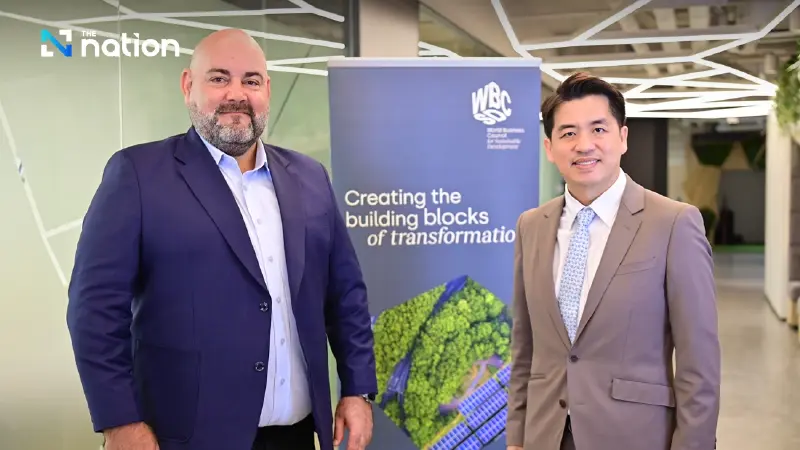


The Bangkok workshop brought together over 30 global companies to drive integrated action on climate, nature and social agendas — with CP Group sharing its own blueprint
- CP Group and the World Business Council for Sustainable Development (WBCSD) hosted a workshop urging businesses to embed sustainability into their core strategy for growth and competitiveness.
- They advocate for an "integrated sustainability agenda" that addresses climate, nature, and social inequality as deeply interconnected priorities, not separate issues.
- CP Group presented its own blueprint as an example, stating that sustainability is a "global licence to operate" and must be inseparable from corporate strategy, driven by top leadership.
- The organizations argue that this integrated approach is the defining growth opportunity for the next 30 years, enabling businesses, society, and the planet to thrive together.
The Bangkok workshop brought together over 30 global companies to drive integrated action on climate, nature and social agendas — with CP Group sharing its own blueprint.
Charoen Pokphand Group (CP Group) co-hosted a landmark sustainability workshop with the World Business Council for Sustainable Development (WBCSD) in Bangkok on Tuesday, bringing together executives from more than 30 organisations across Thailand and the Asia-Pacific region to advance what both groups describe as an "integrated sustainability agenda" — one that tackles climate change, nature loss and social inequality not as separate priorities, but as deeply interconnected priorities.
The full-day event, held at True Digital Park under the theme Advancing an Integrated Sustainability Agenda, centred on the argument that corporate sustainability strategies which address only one dimension — such as carbon reduction — are inherently incomplete and leave businesses missing opportunities and exposed to systemic risk.
Participants engaged in case-study analysis, scenario planning and collaborative workshops designed to help companies embed sustainability across entire value chains.

Sustainability as Competitiveness
Joe Phelan, executive director for Asia Pacific at WBCSD, set the tone by bridging sustainability as corporate competitiveness and sustainability as a strategic priority.
"Without addressing climate, nature and inequality together, corporate strategies are incomplete and fragile," Phelan told attendees. "But by addressing them together, companies understand the trade-offs that need to be made and where there are synergies that can allow them to achieve business transformation much more effectively."

He went further, framing the integrated approach as directly tied to business competitiveness and national security.
"Achieving sustainable businesses and a sustainable society actually means more competitive businesses and more security for society," he said. "Sustainability is competitiveness, and sustainability is security."
Phelan identified three ways in which WBCSD supports its 240 member companies: building capabilities to progress towards net zero, nature-positive and more equitable outcomes; running platforms to bring transparency across value chains; and connecting this work with capital markets to ensure that finance flows to the companies making the most credible progress.

CP Group's Blueprint
CP Group was invited to present its own approach as a working example of integrated sustainability in practice.
Dr Teerapon Tanomsakyut, chief sustainability officer and head of Strategy Development at CP Group, acknowledged that the operating environment has fundamentally shifted — and that standing still is no longer viable.
"Change is no longer optional. It has become something that everyone has to adapt to," Dr Teerapon said. "Sustainability is now the global licence to operate."

He outlined a three-pillar approach that the Group has developed over years of iteration: establishing a clear Group-wide direction anchored in CP's "Heart, Health and Home" framework; building a robust governance structure with executive-level committees spanning human rights, environment and education; creating cross-business execution platforms to attract talent and drive collaborative problem-solving; and deepening partnerships beyond the organisation through bodies such as the UN Global Compact and WBCSD itself.

"Sustainability cannot be separated from corporate strategy — they must be one and the same," Dr Teerapon said. "Tone from the top is critical, and every senior leader at CP Group takes that seriously."
He was candid about the difficulty of delivering on these commitments. With 90 per cent of CP Group's net zero targets tied to its supplier network — spanning more than 30,000 partners worldwide — the challenge of transforming entrenched habits across the supply chain is substantial.
"In agriculture, transitioning to a burn-free supply chain requires farmers to change long-standing practices — habits inherited from their parents," he said. "Sustainability cannot come at the cost of livelihoods. We need training, technology and long-term partnerships to ensure that environmental progress also creates economic benefit."

From Principle to Practice
The workshop highlighted a number of initiatives through which CP Group is translating its integrated commitments into measurable outcomes.
The group's traceability system for agricultural raw materials now enables end-to-end tracking across its supply chain, reducing risks associated with open burning and deforestation while opening access to higher-quality markets for smallholder farmers.
In northern Thailand, CP Group's participation in the Sob Khun model — which combines forest restoration with sustainable coffee farming — has generated more than 1.2 million baht in farmer income while simultaneously reducing PM2.5 pollution through the collection of over 1,000 tonnes of biomass across 3,000 acres.
In the south, more than 500 aquatic sanctuaries have been established around Songkhla Lake, supporting the release of 125 million specimens across five species to restore local biodiversity.
CP Group was recognized as one of the top performers in Reporting Matters by WBCSD for the third consecutive year, reflecting the group's performance on sustainability disclosure standards across all dimensions.

Thailand's Moment
Both organisations framed Tuesday's workshop as part of a broader effort to position Thailand as a hub for sustainability leadership in the region — and to demonstrate that the transition to a more equitable, nature-positive, and low-carbon economy need not come at the expense of growth.
"The integrated sustainability agenda is not just about doing less harm," Dr Teerapon said. "It is about redesigning how we grow — so that business, society and the planet can thrive together. The future belongs to organisations that think in systems, not in silos."
WBCSD's Phelan echoed the point, arguing that the shift towards integrated strategies represents the defining growth opportunity for business over the coming three decades.
"This is the growth strategy for business for the next 30 years," he said. "It is about creating sustainable outcomes for society."
CP Group said it will continue to share updates on its sustainability progress and expand its collaboration with global partners to raise standards across the Thai business community and the wider region.
