
Thailand pushes for climate change legislation to address rising weather extremes


The Thai government is moving ahead with the Climate Change Act, which aims to reduce emissions and tackle the growing risks of extreme weather events like floods.
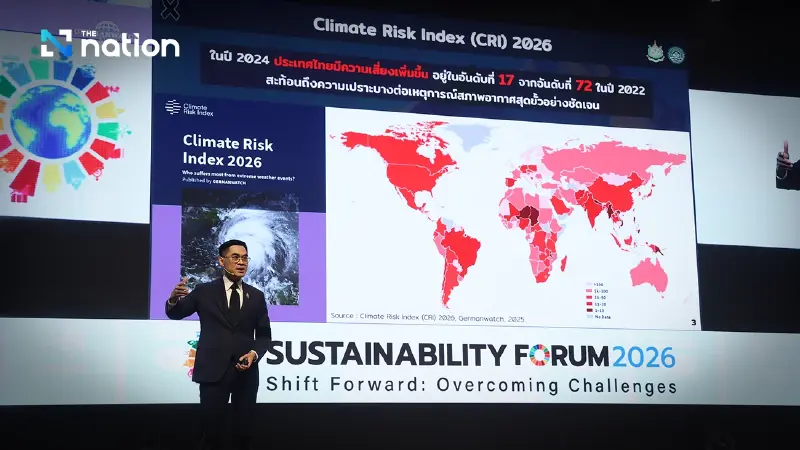
During the recent Bangkok Biz Sustainability Forum 2026: Shift Forward, Pirun Sayasitpanich, Director-General of the Department of Climate Change and Environment, emphasised the urgent need for Thailand to push forward with the Climate Change Act. He noted that this legislation is not just about environmental protection, but also about creating a “new economy” that will make Thailand more competitive on the global stage. Pirun also highlighted the growing climate risks in Thailand, particularly concerning floods and extreme weather events.

"The increasing frequency of extreme weather worldwide is no longer an anomaly. Global temperatures have already risen 1.5°C, and we are seeing more frequent and intense rainfall events that would have once been rare, such as once-in-300, 500, or even 1,000 years," he said. "If the global temperature rises by 2.5°C, research from WMO and the IPCC suggests that sea levels could rise by as much as 2.5 metres, which would lead to severe flooding in Bangkok."
The report from German Watch in 2026, an international NGO, revealed that Thailand’s climate risk has worsened significantly, with the country now ranked 17th globally, up from 72nd in 2022.

Pirun updated the forum on the outcomes of COP30, revealing that only 122 out of 197 countries have submitted their 2035 greenhouse gas reduction targets, which complicates the Global Stocktake process to see if the world can meet the 1.5°C target.
However, Thailand has submitted NDC 3.0, adjusting its Net Zero target to 2050, aligning with other ASEAN nations such as Vietnam, Cambodia, Malaysia, Singapore, and Brunei. The NDC 3.0 target is to reduce greenhouse gas emissions by 109.2 million tonnes and increase carbon sequestration by 118 million tonnes through forest management and technology. This would leave Thailand with a net emission of 152 million tonnes CO2e by 2035, with the goal of reaching Net Zero by 2050, similar to Carbon Neutrality.
Pirun stressed that while policy collaboration could help Thailand meet its 2030 targets, achieving the 2035 and Net Zero 2050 goals will require new tools, such as the Climate Change Act.
“This legislation has been designed to create new economic opportunities while ensuring that climate policy remains consistent, regardless of changes in government,” he said.
The Climate Change Act will establish mechanisms for managing climate adaptation and reducing repetitive losses, like those seen in the recent Hat Yai flooding. The department will no longer rely solely on past data but will support the creation of high-resolution climate prediction data.
The goal is to improve resolution from 100x100 km grids to 25x25 km grids, and for high-risk areas like Hat Yai, the department will aim for a 100x100 m grid. Having more detailed data will improve the accuracy of flood management, early warning systems, and help mitigate economic disruptions.

Pirun explained that the Climate Change Act contains five key elements, with particular emphasis on financial mechanisms and market instruments:
- Climate Change Fund: This is Section 4 of the draft bill, which has already received approval from the Ministry of Finance. The fund will use money collected through various carbon mechanisms to support the private sector, local communities, and research initiatives aimed at reducing carbon emissions and preparing for disasters. It will serve as a financial gap-filler for high-cost carbon-reduction technologies.
- Reporting and Emission Control: The bill will require approximately 3,000-4,000 legal entities to report their greenhouse gas emissions (Scope 1 and Scope 2). A cap and trade system (ETS) will be implemented for around 300 entities, setting emissions ceilings for these organisations.
- Thailand CBAM (Carbon Border Adjustment Mechanism): This mechanism will be introduced to create a level playing field, allowing Thai producers to compete with products from neighbouring countries, such as Laos, Cambodia, and Malaysia, by imposing a fee on imports similar to the EU CBAM.
- Carbon Tax: This financial tool is critical, as even if the industrial sector reduces carbon emissions, Thailand may not reach Net Zero if consumer behaviours do not change. The introduction of an actual carbon tax (not the existing excise tax) will allow Thai exporters to offset costs under the EU CBAM. The World Bank recommends a carbon price of 25 USD per tonne to meet the Net Zero 2050 target by 2030.
- Thailand Taxonomy: The law will prioritise collaboration with the Bank of Thailand to categorise investments (green, yellow/transition, red) and will emphasise support for the yellow (transition) phase to ensure that no one is left behind during the transition process.
The Climate Change Act contains 205 provisions across 14 sections and has already received approval from the Cabinet. The Department is now working with the Council of State to review the draft, with the aim of submitting the law to the House of Representatives immediately after the election and the opening of the new parliament. It is expected that the bill will pass through the Senate and be implemented in early 2027.
Pirun concluded by saying that while mechanisms and technologies are important, the cheapest yet most challenging solution is changing consumer behaviours and attitudes, a challenge that Thailand and the rest of the world must face together.
