
Siemens Thailand Chief Warns of Climate Urgency as Nation Faces Extreme Weather Events
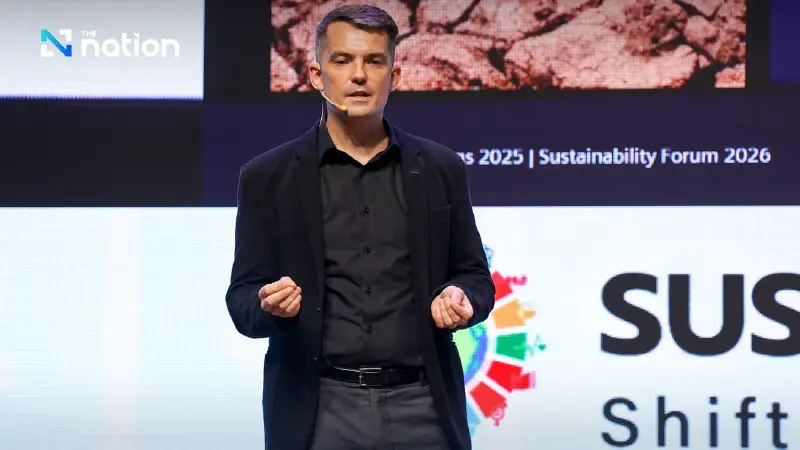


Technology integration and digital twins key to achieving net-zero targets, says Ross Colon at sustainability forum
Thailand's increasingly severe weather patterns underscore the urgent need for industrial transformation to combat climate change, according to Ross Colon, president and CEO of Siemens Thailand, speaking at the Sustainability Forum 2026 on Wednesday.
Addressing attendees at the event organised by Krungthep Turakij, Colon highlighted how recent extreme weather events have demonstrated the immediate impact of climate change on the kingdom.
The country has experienced its heaviest rainfall in over 300 years, with flash floods in the south affecting nearly 3 million people in Hat Yai. Meanwhile, temperatures reached an unprecedented over 45°C in Phuket and Bangkok, accompanied by devastating floods and extreme monsoons that impacted more than 100,000 households earlier this year.
"Climate change is making these events more extreme, more frequent, more intense, and more destructive," Colon emphasised during his presentation on sustainable business practices.

Industry's Carbon Challenge
Colon noted that whilst manufacturing serves as a key economic driver, industry contributes at least 30% of global CO₂ emissions whilst consuming approximately 38% of global energy.
This reality, he argued, necessitates fundamental transformation across industrial sectors.
At the heart of Siemens' approach is the concept of combining "the real and the digital worlds" – using technology to solve real-time problems more sustainably and efficiently.
Central to this strategy is the digital twin, a virtual representation of physical objects such as factories, production lines, buildings, or energy systems that can be simulated, tested, and optimised before any physical construction begins.
Unlike traditional Building Information Modelling (BIM), digital twins continue functioning beyond the design phase. When connected to real-time operational data, they can continuously learn, optimise processes, and reduce carbon emissions throughout a facility's operational life.

Ambitious Corporate Targets
Siemens currently maintains a carbon footprint of 121 million tonnes of CO₂ across its scope 1, 2, and 3 emissions.
The company has set an ambitious target to reduce 90% of its scope 1 and 2 emissions by 2030 – just over four years away – and achieve net-zero by 2050, aligning with Thailand's revised target.
Colon praised Thailand's decision to advance its net-zero target from 2065 to 2050, noting the importance of clear pathways to achieving these goals.
The company is already demonstrating results, with its technologies enabling customers to avoid approximately 144 million tonnes of CO2 – equivalent to removing every car in Thailand from the roads for three years.
Notably, Siemens is helping customers reduce more emissions than it generates across its entire supply chain.

Thai Success Stories
Several Thai projects illustrate the practical application of these technologies.
For a leading sugar producer, Siemens has fully automated the entire value chain, preventing over 3,000 tonnes of annual sugar loss whilst reducing energy consumption by 10% and ensuring more stable, higher-quality output.
At another facility, integrating information technology (IT) and operational technology (OT) systems has boosted productivity and energy efficiency whilst empowering workers through digital workflows that map and track all processes.
The company has also deployed medium-voltage switchgear at wind and solar substations, including Ubon Ratchadamnoen Dam, supporting Thailand's renewable energy integration and enhancing grid stability and supply resilience.
Supply Chain Focus
Colon stressed that decarbonisation of direct operations represents only part of the journey, as over 90% of most companies' emissions lie within supply chains.
Siemens employs a "green digital twin" to actively track and reduce the environmental footprint of suppliers from raw materials through product end-of-life.
This initiative currently reduces approximately 9% of the company's scope 3 emissions, with an ambitious target of 30% reduction by 2030.

Colon outlined four key priorities that could deliver quick wins for Thai industry:
First, manufacturing requires a comprehensive digital upgrade, incorporating more digital twins, IT-OT integration projects, and artificial intelligence to optimise processes, increase yield, reduce downtime, and cut energy usage.
Second, quality must be redefined through circularity by design – shifting from disposable to circular economy models that emphasise reuse over waste.
Third, Thailand must strengthen its digital industry backbone. With substantial data centre investments planned, these facilities require reliable, clean power. Digital substations and advanced automation will facilitate greater integration of solar, wind, and other renewables onto the grid, reducing outages and creating the stable infrastructure international investors expect.
Finally, combining these priorities with on-site renewable generation can enhance resilience, reduce operational costs, and significantly decrease carbon emissions.
"The technology that we need, it is already here today," Colon concluded, suggesting Thailand has a clear path forward to build a cleaner, stronger, and more competitive industrial sector.
