
Thai Energy Minister Fast-Tracks Net Zero to 2050 with New Gas and Green Power Push
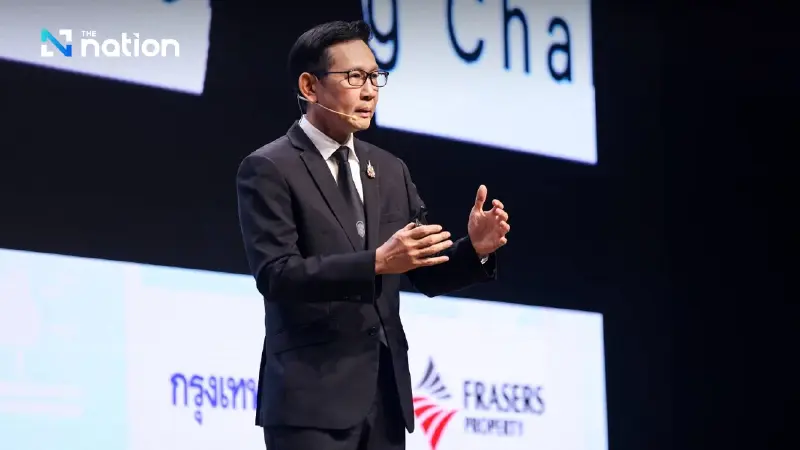


Auttapol Rerkpiboon unveils 'Quick Big Win' plan: Andaman exploration, solar revolution, and SMRs to balance security, price, and sustainability by 2050
Thailand's new Energy Minister, Auttapol Rerkpiboon, has announced an aggressive new energy strategy, including the fast-tracking of the national Net Zero target to 2050 and a controversial push to open up new gas exploration in the Andaman Sea.
Speaking at the "SUSTAINABILITY FORUM 2026 Shift Forward: Overcoming Challenges," on Wednesday, Auttapol stressed the urgency of adjusting Thailand's energy sector to meet the 2050 net-zero greenhouse gas emissions goal, citing global environmental risks and increasing trade pressures such as the European Union's Carbon Border Adjustment Mechanism (CBAM).
"Clean energy is not just an environmental solution," he stated. "It is a crucial issue affecting our business system, trade, and national competitiveness."

2050 Target and the 'Triple Balance'
The government has formally brought forward the Net Zero deadline from 2065 to 2050 to remain competitive with regional rivals like Malaysia, Singapore, and Vietnam.
The energy and transport sectors, responsible for over 60% of Thailand’s carbon output, are the primary focus of this pivot.
Auttapol outlined a three-pronged policy approach to manage the transition: maintaining a balance between Security, Sustainability (Clean Energy), and Economic Factors (Price).
He cautioned that an overemphasis on security or sustainability would inevitably lead to higher energy prices, impacting the public and national competitiveness.

New Gas Exploration for Security
To address declining gas reserves in the Gulf of Thailand and a pause on the Thai-Cambodian overlapping maritime area, the minister confirmed plans to open new energy exploration blocks in the Andaman Sea.
This domestic area is considered highly prospective, particularly following major gas discoveries in nearby Indonesian waters.
He stressed that finding a new source in the Andaman would be a crucial element of securing the nation's energy future.
The 'Quick Big Win' Plan
The Minister detailed a series of Cabinet-approved 'Quick Big Win' measures designed to lay a long-term foundation for the energy sector while delivering immediate economic and environmental impacts.
1. Solar for the People
The plan includes five key solar initiatives expected to stimulate 40 billion baht in annual investment and reduce carbon emissions by nearly 1.2 million tonnes per year:
• Community Solar Farms: 1,500 MW of capacity will be developed in collaboration with local communities, moving away from large-scale auctions.
• Household Tax Relief: A tax deduction of up to 200,000 baht for homeowners installing rooftop solar (targeting 90,000 households until Dec 2028).
• Agricultural Solar: Installing solar systems for water pumping in farming areas.
• Floating Solar: The state-owned Electricity Generating Authority of Thailand (EGAT) will invest in 1,600 MW of floating solar projects across three dams.
• Village Waterworks: Replacing existing pumps in rural waterworks with solar systems.

2. Infrastructure and Investment
Key infrastructure measures are focused on attracting major investment, particularly for data centres:
• Direct Power Purchase Agreements (Direct PPAs): Allowing high-volume users, such as data centres, to negotiate power purchases directly with producers. EGAT will act only as a transmission provider. This measure supports 2,000 MW of new capacity and is expected to generate 60 billion baht in investment.
• EEC Grid Development: Accelerating investment in transmission lines in the Eastern Economic Corridor (EEC) to support a surge in electricity demand, especially from data centres, potentially stimulating 500-600 billion baht in investment.

3. Long-Term Planning
The government is moving swiftly to update its energy blueprint:
• New Power Development Plan (PDP): An accelerated schedule aims to finalise the new PDP by early 2026, serving as the essential "manual" for the next 15-20 years.
• Future Fuels: Hydrogen has been formally designated a fuel source for Thailand, paving the way for new product, transport, and safety standards.
• Small Modular Reactors (SMRs): The Minister expects SMR technology (200-300 MW capacity) to be included in the new PDP due to its safety and smaller footprint compared to conventional nuclear power.
• Carbon Capture Storage (CCS): Thailand is working with Japan to survey geological structures in the Gulf of Thailand for carbon storage potential.
This initiative is a high-value prospect, with Singapore's Prime Minister having expressed interest in regional storage services, potentially leading to a project worth 400-500 billion baht.
Collectively, these three pillars are projected to inject approximately 1 trillion baht into the economy, create 29,000 jobs, and reduce carbon emissions by about 10 million tonnes per year.
