
Atlantic cold blob fuels fears of weakening AMOC and climate tipping point
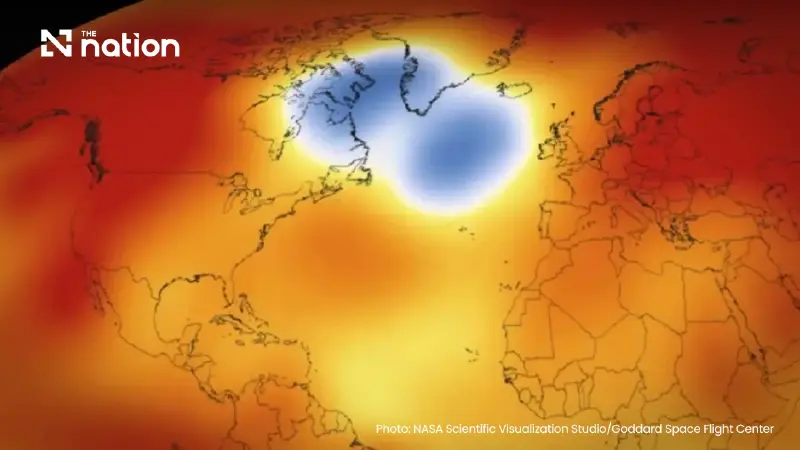


Unusual cooling south of Greenland strengthens evidence of weakening AMOC circulation, raising fears of long-term climate tipping risks
- An unusually cold ocean area south of Greenland, known as the "cold blob," is increasingly viewed by scientists as a physical sign of a weakening Atlantic Meridional Overturning Circulation (AMOC).
- The weakening of this crucial heat-transporting ocean current is linked to freshwater from melting Greenland ice, which disrupts the circulation process, with the system now considered its weakest in at least 1,000 years.
- Scientists are concerned that the weakening AMOC may be approaching a critical tipping point, which could lead to an abrupt and potentially irreversible collapse.
- An AMOC collapse would trigger severe global climate consequences, including drastically colder winters in Europe, accelerated sea-level rise on the U.S. East Coast, and displaced monsoon systems in Africa.
A persistent area of unusually cold sea surface temperatures south of Greenland and Iceland is drawing renewed scientific attention, with researchers warning it may signal changes in a key Atlantic circulation system that helps regulate the global climate.
While most of the world’s oceans continue to warm under climate change, this region — widely known as the “cold blob” — has shown a long-term cooling trend that contrasts sharply with global ocean patterns.
Scientists increasingly link the anomaly to changes in the Atlantic Meridional Overturning Circulation (AMOC), a vast system of ocean currents that transports heat from the tropics towards the North Atlantic.
Atlantic Meridional Overturning Circulation (AMOC) plays a central role in regulating climate by carrying warm surface water northwards, where it releases heat into the atmosphere, cools, sinks, and returns south at depth in a continuous global loop.
However, increasing freshwater from melting Greenland ice is believed to be weakening this process by reducing the salinity and density of surface waters, making it harder for them to sink and sustain circulation.
A peer-reviewed study published in Geophysical Research Letters suggests the cooling signal is not simply driven by atmospheric surface conditions, but instead reflects reduced heat transport from deeper ocean circulation.
The findings strengthen the hypothesis that the “cold blob” may be a physical fingerprint of a weakening AMOC rather than a short-term weather-driven anomaly.
Lead researcher Prof Stefan Rahmstorf of the Potsdam Institute for Climate Impact Research said multiple lines of evidence suggest the system is currently at its weakest in at least 1,000 years.
Meanwhile, René van Westen, a researcher in oceanography and atmospheric science at Utrecht University who was not involved in the study, said that while earlier research had suggested atmospheric conditions alone could potentially generate the “cold blob”, the latest findings draw on a broader range of datasets that show consistent results.
He added that this convergence of evidence strengthens the credibility of the conclusion that ocean circulation processes are playing a significant role in the phenomenon, making the case for an AMOC-related influence more robust than in previous studies.
However, uncertainty remains. Prof David Thornalley of University College London has cautioned that gaps in historical observations mean the evidence is not yet conclusive.
UK Met Office scientist Dr Jonathan Baker also said the study adds weight to the AMOC-link hypothesis, but does not fully resolve the question of causation.
Climate risks and tipping point concerns
If the “cold blob” is indeed a warning sign of a weakening Atlantic Meridional Overturning Circulation (AMOC), scientists caution that the system may be approaching a critical tipping point — a threshold beyond which it could undergo abrupt and potentially irreversible collapse.
Such a scenario would carry severe global consequences. Climate models suggest that Europe could experience significantly harsher winters, with temperatures in some regions falling by 10–15°C under extreme scenarios. In Iceland, the potential collapse of the circulation system is considered a national security concern, as winter temperatures could plunge to around -45°C, posing major challenges to infrastructure, livelihoods and economic stability.
At the same time, the disruption would not be confined to the Northern Hemisphere. Parts of the Southern Hemisphere could experience additional warming, while shifts in atmospheric circulation could displace African monsoon systems, increasing the risk of prolonged drought and placing pressure on food security and ecosystems across multiple regions.
The weakening of AMOC is also expected to affect global sea levels. On the US east coast in particular, altered ocean dynamics could accelerate relative sea level rise, with some studies estimating that coastal flooding events may have increased by 20–50% since 2005 due in part to circulation changes.
Researchers stress that the precise proximity to a tipping point remains uncertain. However, most climate models indicate that a major transition could become possible within this century — potentially earlier than previously projected. This has raised urgency among policymakers to treat AMOC weakening as an emerging global risk requiring closer monitoring and preparedness.
Ultimately, the “cold blob” is no longer viewed as a mere oceanographic curiosity. Instead, it is increasingly interpreted as a potential early warning signal of large-scale changes in Earth’s climate system. While uncertainties remain, the convergence of recent studies suggests that the planet may be edging closer to a critical threshold with consequences that could unfold over centuries.
Sources:
- NOAA Ocean & Climate information: https://www.noaa.gov
- NASA Earth Observatory – ocean circulation: https://earthobservatory.nasa.gov
- Geophysical Research Letters (AGU journal): https://agupubs.onlinelibrary.wiley.com/journal/19448007
- CNN Climate reporting (AMOC overview): https://edition.cnn.com/specials/world/global-warming
- Live Science (climate science explainers): https://www.livescience.com
- ScienceAlert (AMOC / cold blob analysis): https://www.sciencealert.com
- The Washington Post (climate & oceans coverage): https://www.washingtonpost.com/climate-environment/
- UK Met Office climate science: https://www.metoffice.gov.uk
- Story Credit: Bangkokbiznews
