
Thailand Breeds Atlantic Salmon for First Time in Secret Project
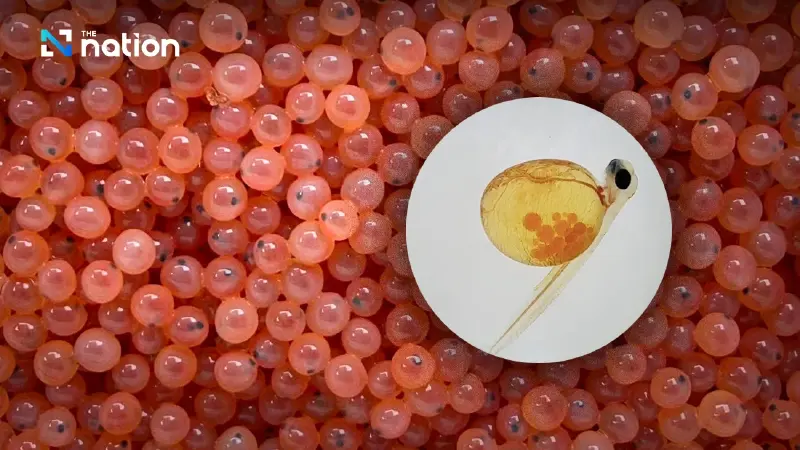


Kasetsart University partners with PTT LNG to hatch 20,000 imported eggs using advanced cooling technology and artificial intelligence
- Kasetsart University and PTT LNG have partnered with Chilean experts to hatch 20,000 imported Atlantic salmon eggs in Thailand for the first time.
- The project overcomes Thailand's tropical climate by using an advanced aquaculture system chilled with residual cooling energy from PTT's liquefied natural gas (LNG) process.
- Advanced technologies are being employed, including AI-powered monitoring, automated feeding, and natural biosecurity measures using plant extracts to minimize antibiotic use.
- The ultimate goal is to establish a commercially viable, domestic supply of salmon to reduce reliance on expensive imports and enhance the nation's food security.
Kasetsart University partners with PTT LNG to hatch 20,000 imported eggs using advanced cooling technology and artificial intelligence.
A quiet revolution is under way in the Thai seafood industry, as scientists attempt to breed Atlantic salmon in a tropical climate for the first time.
Reporting for Krungthep Turakij, journalist Panyalak Sriburin revealed that the Faculty of Fisheries at Kasetsart University has joined forces with PTT LNG Company Limited and leading aquaculture entities from Chile.
The historic research venture aims to establish a self-sustaining domestic supply of premium salmon, potentially reshaping Thailand’s food security landscape.
The ambitious initiative crossed a major milestone on 6 May 2026, when a shipment of 20,000 Atlantic salmon eggs arrived in Thailand from Chile.
Facilitated by ProChile, the Chilean government's export promotion bureau, the eggs have been placed into a high-tech facility to kickstart the initial phase of the research project.
The core objective is to determine whether premium-grade salmon can be successfully and economically produced locally under the "Made in Thailand" banner.

Defying the Tropical Heat
Breeding cold-water salmon in a tropical nation like Thailand presents severe climate barriers.
To overcome this, the research team has deployed an advanced Recirculating Aquaculture System (RAS). This closed-loop system is highly sustainable, requiring minimal water consumption and land area while mitigating the risks of disease and contamination.
The technological linchpin of the operation is the utilisation of residual cooling energy harnessed from PTT's liquefied natural gas (LNG) regasification process.
This innovative energy-recycling mechanism allows scientists to maintain precise, chilled water temperatures ideal for salmon growth all year round, bypassing the high electricity costs typically associated with industrial refrigeration.
Bilateral Innovation Shift
The baseline technology was further expanded during the Chile-ASEAN Business Summit 2026, held in Bangkok between 26 and 30 May.
A Chilean delegation—comprising top executives from Desert King Chile, Imenco Aqua Chile, and Sul and Beyond—met with Thai academics to share world-class aquaculture practices.

The summit highlighted several next-generation farming technologies designed to optimise the Thai project:
AI-Powered Monitoring: High-definition cameras integrated with artificial intelligence to analyse aquatic behaviour in real time.
Automated Feeding Systems: Precision machinery engineered to eliminate feed wastage.
Natural Biosecurity: Natural extracts derived from Quillaja and Yucca plants to boost the fishes' immune systems, drastically minimising the need for commercial antibiotics.

The Commercial Outlook
Asst Prof Dr Suriyan Tunkijjanukij, dean of the Faculty of Fisheries at Kasetsart University, stated that the research team is closely monitoring growth rates, nutritional development, and overall economic viability.
If the pilot phase yields positive results, the initiative could lay the groundwork for commercial-scale salmon farming across Thailand. By substituting expensive international imports with domestic production, the partnership seeks to elevate Thailand's aquaculture sector onto the global stage through a unique combination of biotechnology and clean-energy innovation.
