
Thailand faces severe transboundary pollution crisis from rare earth mining in Myanmar
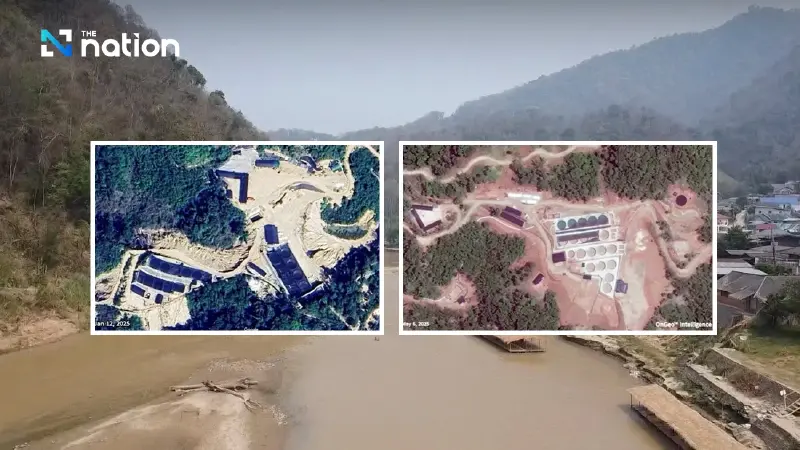


Thailand is facing one of its most serious environmental crises as toxic pollution from rare earth mining in Myanmar’s Shan State contaminates the Kok and Sai rivers. Arsenic levels far exceed safety standards, threatening ecosystems, public health, and livelihoods in northern Thailand.
The crisis originated from rare earth element (REE) mining operations conducted in Shan State, particularly in areas controlled by the United Wa State Army (UWSA). REEs are critical for green technologies and electronics, but their extraction and purification are complex and environmentally hazardous.
Mining activities have released toxic substances – particularly arsenic – into river systems flowing into Thailand, prompting widespread concern.
According to Krungthep Turakij, Pianporn Deetes, Campaign Director of the Southeast Asia Programme at International Rivers, said the issue gained national attention following a local protest in Thaton Village, Mae Ai district, Chiang Mai, on March 14.
Initial speculation pointed to gold mining due to the presence of dredging boats, but further investigations revealed the activity involved rare earth mining, raising further concern.
Contamination confirmed by Thai authorities
The Pollution Control Office 1 in Chiang Mai collected water samples on April 4, confirming arsenic levels above permissible limits in the Kok River. Follow-up biweekly testing revealed ongoing contamination downstream, affecting the Sai and Mekong rivers as well.
Residents in Mae Sai district have long reported discoloured water, suggesting the issue has persisted for years.
Satellite imagery from Google Earth has confirmed extensive open-pit mining activity near the headwaters of the Kok and Sai rivers. The extracted minerals are reportedly transported to China, with Chinese investors involved.
“Since the 2021 military coup, Myanmar has become a near-failed state with no law enforcement. Although the Chinese Embassy in Bangkok is urging Chinese businesses to comply with local laws, doing so has proven challenging in practice,” Pianporn said.
The pollution has already impacted fisheries, disrupted river tourism, and raised fears among rice farmers about potential arsenic contamination in agricultural products. There have also been reports of deformed fish, possibly linked to sediment disruption from mining.
Calls for immediate government action
Pianporn criticised the Thai government for its slow and inadequate response, limited so far to issuing only a diplomatic note. She urged the government to escalate the matter through direct negotiations with Myanmar, China, and the UWSA.
She also proposed several strategies, including diplomatic pressure, economic leverage, and food safety measures to push for a suspension of the mining operations.
Failure to act swiftly could result in long-term health consequences for communities in Chiang Rai, she warned, referencing the unresolved Klity Creek lead contamination case, which has lingered for more than three decades.
Expansion of mining in Mong Pawk
On June 19, the Shan Human Rights Foundation (SHRF) issued a statement highlighting the rapid and alarming expansion of rare earth mining near Mong Pawk in northern Shan State.
Satellite imagery analysis shows that the number of mining sites increased from three in 2015 to 26 by early 2025—an eightfold increase. Some of these mining sites are located just 3–4 kilometres from residential areas.
The mining operation uses in-situ leaching, which involves injecting chemicals into the ground to dissolve rare earth elements, which are then pumped to the surface. This method carries a high risk of groundwater and surface water contamination, threatening health and food security for downstream communities.
During Typhoon Yagi in September 2024, Mong Pawk experienced severe flooding, and runoff from the mountains likely carried toxic chemicals into residential zones.
SHRF reported that waste from Mong Pawk’s mining operations flows west into the Salween River and east into the Luay River, eventually reaching the Mekong near the Shan–Laos border. This poses potential transboundary impacts across Southeast Asia, although China remains unaffected directly.
Unregulated mining and international concerns
Many of the rare earth mines in Shan State do not appear on the official list of licensed operations issued by Myanmar’s State Administration Council (SAC), raising suspicions about informal or illicit mining agreements involving the UWSA and Chinese businesses.
Once a quiet agricultural village inhabited by Lahu and Shan ethnic groups, Mong Pawk has undergone a dramatic transformation over the past decade. It has become a hub for Chinese investment and was previously linked to human trafficking and scam call centres before a crackdown by Chinese authorities in late 2023.
SHRF’s latest report, Trapped in Hell, highlights the environmental and human rights abuses associated with unregulated rare earth mining in the region. The organisation has called for an international investigation and an immediate suspension of mining operations.
It warns that continued exploitation not only threatens regional ecosystems and public health but also exposes the fragile governance under armed group control, enabling foreign economic interests to exploit natural resources without accountability.
