
World loses Spain’s Trasllambrión glacier for good as warming takes its toll
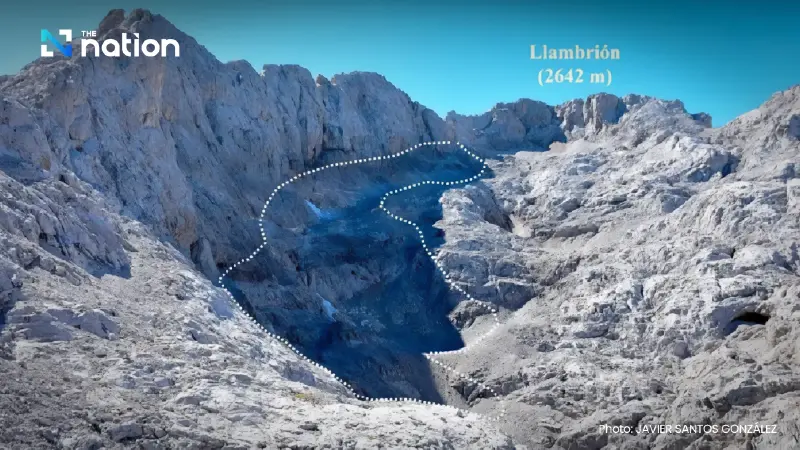


Trasllambrión, León’s last glacier, has effectively vanished after 700 years—an alarming sign of accelerating warming across southern Europe.
Spain’s Trasllambrión glacier—the last surviving glacier in the province of León—has effectively disappeared, bringing to an end more than 700 years of near-continuous ice in the Picos de Europa. Researchers confirmed its “death” in October 2025, describing the loss as a striking, visible consequence of a rapidly warming climate.
A survey led by Professor Javier Santos González and a research team from the University of León found that Trasllambrión—perched at around 2,400 metres—has been reduced to a small, shaded remnant of ice roughly 15–20 metres across, tucked beneath limestone cliffs.
With so little mass left, the ice can no longer move or behave like a living glacier. Scientists say it has effectively shifted status into static “fossil ice”—a leftover patch that will keep shrinking season by season until it vanishes altogether.

Geological evidence suggests Trasllambrión formed during the Little Ice Age (roughly the 14th to 19th centuries). At its peak, the ice once covered around 10 hectares (about 62 rai) and may have reached 400–500 metres in thickness, with a glacier tongue stretching for roughly 6 km.
Yet older records indicate that during a warmer period—such as parts of the Roman era—there may have been little or no ice in the same area, highlighting how sensitive the Cantabrian mountain range has long been to shifts in temperature.
Scientists describe Trasllambrión’s disappearance as “heat death”—a point at which rising temperatures destroy the balance between snowfall accumulation and melt, particularly as warming has accelerated since the 1980s.
Even heavy snow years can be misleading. Researchers say intense snowstorms between 2009 and 2020 may have briefly made the ice look stable, while deeper erosion continued underneath.
After repeated hot summers over the past five years, the already-thin ice could no longer withstand the heat, breaking into smaller fragments and losing any capacity to flow downhill under gravity.
Small glaciers at relatively low latitudes can act like highly sensitive climate “thermometers”, responding quickly to changes in temperature and precipitation. They also serve as natural archives, preserving evidence such as glacial deposits that help scientists reconstruct past climate behaviour.
Beyond the scientific loss, disappearing ice can increase geological risks. As long-frozen ground (permafrost) thaws, rock faces can become less stable—raising the risk of rockfalls that threaten hiking routes, shelters and visitors in mountain national parks.
Professor Santos González described a deeper sense of loss too—an erosion of identity and memory tied to the landscape—what researchers call “landscape mourning”, as a familiar element of the mountains disappears for good.
Trasllambrión’s fate is increasingly reflected elsewhere in Spain and southern Europe. In the Pyrenees, where glaciers have been shrinking rapidly, scientists note that the number of active glaciers has fallen sharply—from around 52 in the late 19th century to roughly 14 today.
One of the most closely watched is Aneto, often cited as Spain’s largest glacier, which has been losing substantial ice each season. Studies using LiDAR and drone surveys warn that, if current warming trends continue, most of Spain’s remaining ice could largely disappear within the next decade.
