
Phetchaburi marine farm showcases Queen Mother’s sustainable legacy
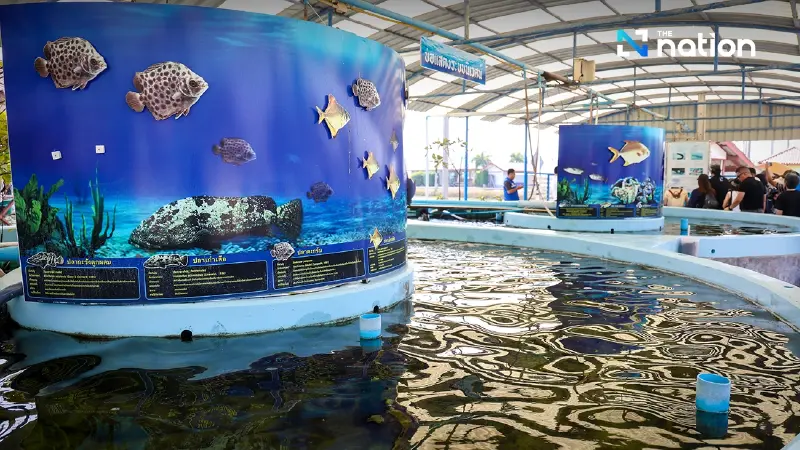


A model marine farm in Phetchaburi shows how an initiative under Her Majesty Queen Sirikit, The Queen Mother, creates sustainable income through integrated aquaculture and salt farming.
Aware of the need for rural communities to have more food sources for self-reliance, the late Her Majesty Queen Sirikit, The Queen Mother, initiated the establishment of model farms in various parts of Thailand to teach local villagers how to become self-sufficient in their food supply.
In Phetchaburi, a model marine farm was set up at Her Majesty’s initiative as a learning centre where farmers can exchange knowledge on fishery development and fishing practices suited to local environmental conditions.
The project’s key objectives are:
- to develop a model sea farm under the royal initiative on fisheries and aquaculture, while creating community jobs such as seaweed and aquaculture farming;
- to serve as a model with integrated management that works with natural food mechanisms and a continuous water-use cycle across varying salinity levels;
- to study improved methods of catching aquatic animals to achieve higher survival rates, including the “graduated catching” concept;
- to provide a venue for learning, training, sightseeing, and the exchange of experience.

Ease the hardships of local residents
The model marine farm is located in Bang Kaeo subdistrict, Ban Laem district, and was established in 2008.
Her Majesty Queen Sirikit sought to ease the hardships of local residents after learning of the significant decline in marine resources in Thai seas, alongside rising fishing production costs as fuel and other inputs became more expensive. As a consequence, seafood prices were increasing.
Her Majesty believed that hygienic, integrated aquaculture could offer an alternative way to produce marine animals, reducing the need to travel far for offshore fishing.
This led to the creation of the model marine farm project in Ban Laem under the supervision of the Foundation for the Promotion of Supplementary Occupations and Related Techniques (SUPPORT Foundation), established by Her Majesty.
Coastal marine farming also helps generate employment and income for local people, while helping to bring down prices of marine animals.

How the marine farm works
This zero-waste marine farm uses piping systems connecting sub-farms. Waste from sub-farms is used as feed for artemia, while artemia can also be used as food for young marine animals raised on the farm.
Hypersaline water from artemia ponds is transferred to demonstration salt farms, which will be further developed to produce powdered seawater to increase the value of salt production. The final stage of salt production generates waste that can be formulated into bio-organic fertilisers for tree planting.
The project also maintains seawater salinity in different sub-farms throughout the year. This supports the development of marine species through natural water circulation that transports nutrients and oxygen to seaweed.
A wide range of marine species can be raised across farms, including giant freshwater prawn, white shrimp, sea bass, milkfish, mullet, clownfish, giant grouper, short mackerel, spiny lobster and green mussels.
The development aims to reduce food loss and waste along the supply chain and prevent disruptions to the food system. Farmers can adopt knowledge from the model marine farm to improve operations on their own farms.
Innovative aquaculture devices have also been developed at the integrated site to reduce reliance on imports. These include protein skimmers, boats and tanks for transporting fish, solar aerators, automatic fish feeders, and portable fish cages.

Learning centre for aquaculture and salt farming
Beyond promoting sustainable aquaculture, the model marine farm provides opportunities for education, study visits, and the exchange of knowledge and experience, as well as eco-tourism. Each year, more than 10,000 tourists visit the farm.
Major activities at the learning centre include demonstrations of aquaculture, seawater salt and powdered seawater production, seaweed farming, a marine hatchery, and marine processing.
Examples include processing milkfish products and operating a “blue swimming crab bank”, in which baby blue crabs are distributed to local people for rearing and releasing to help restore aquatic species in natural water sources.
Among the highlight products are fresh and processed sea grapes and sea lettuce. Sea grapes have been selected as a geographical indication (GI) product in Phetchaburi, as the province is Thailand’s first producer and largest source, generating about 2 million baht in annual income. A transportation business has also been established to deliver sea grapes to locations across Thailand.

By combining aquaculture, salt farming, product processing and community training in a single integrated system, the Phetchaburi model marine farm continues to demonstrate how royal-initiative projects can strengthen food security, create local jobs and add value to coastal resources—while serving as a practical blueprint for sustainable marine farming nationwide.
