
Almera offers a cheap ride


Play
Nissan's eco-car may make up for its lack of power with fuel economy, eco-friendliness and a price that's reasonable
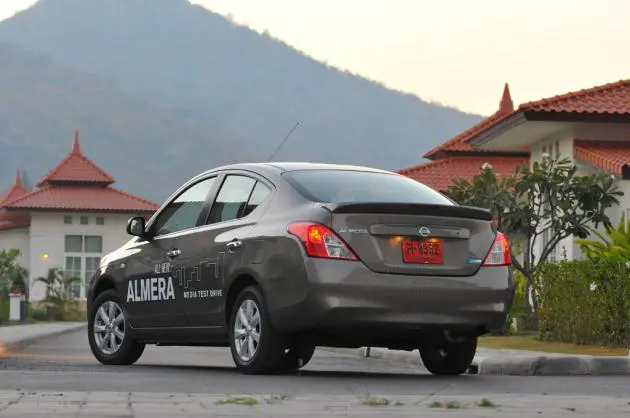
Nissan is pinning its hopes on its new Almera Eco Car to win customers from the B-segment.
Why is that?
Although the Almera is powered by a small 1.2-litre engine like the diminutive Nissan March, its first eco-car launched last year, it isn’t a small car at all. The Almera measures 4,425mm in length, 1,695mm in width and 1,500mm in height, while the wheelbase is 2,600mm (150mm longer than the March). These are dimensions that are comparable to subcompacts, in fact it is as wide and even longer than the Mazda2.
While the design of the March hatchback is rather retro-looking, the Almera boasts sleek modern looks. There is not much similarity with the March in terms of exterior design, despite both cars sharing the same platform.
The Almera comes with the same 1.2-litre 3-cylinder engine with the March, which is capable of producing 79 horsepower and 106Nm of torque. While the engine seems to be punchy enough for a small car like the March (which is about 60kg lighter), anyone who drives the Almera will feel that a car of this size should have more oomph.
In fact a car of this size should have a larger engine with more output and torque, but then it would not qualify for the eco-car status due to the engine size (1,200cc) and fuel economy (20km/l).
There’s no problem when driving the Almera in the city, but once you get on the highway, it is clear that the performance is far behind subcompacts that usually have 100 to 120 horsepower under the bonnet. There is not enough torque for high-speed overtaking, and you will suddenly feel the urge for a more powerful engine. But after all, the selling point of the Almera is not the engine power, but rather excellent fuel economy and eco-friendliness.
Like the March, the top version of the Almera also comes with the Idling Stop function which also contributes to lower fuel consumption when driving in traffic conditions.
The CVT (Continuously Variable Transmission) is another factor that helps the Almera to achieve eco-car fuel economy with its low power loss, and performance is also enhanced compared to regular automatic transmissions. There are no shift points so acceleration is seamless, although it is nowhere sporty as the revs remain at the ceiling until you start to ease off the gas pedal. Kind of boring if I must say.
Nevertheless, there’s some sporty element to the Almera such as the driving dynamics. The electrically-powered steering may be too light at low speeds (which makes it easy for female drivers to manoeuvre) but the weight gradually builds up to a more satisfactory level as road speed increases.
I found that if you drive the car in a straight line and jiggle the steering a bit, there is considerable body sway, which isn’t a good sign for road-holding. This kind of suspension setting is usually aimed at maintaining ride comfort when travelling over poor road conditions. However, during hard cornering, the Almera seems to stick to the road pretty well, and surprisingly the steering precision is also better than expected.
In my point of view, the selling point of the Almera can be seen and felt when you step inside the car. The large dimensions result in plenty of cabin space, and the long wheelbase (2,600mm) provides surprisingly generous legroom for rear passengers. The only setback is the lack of rear headroom, especially for tall passengers, due to the slanted roof design.
The interior design is also quite appealing, considering that this is a low-priced eco-car with price starting at Bt429,000. But the model tested is the top VL CVT that comes with all the goodies, including multi-display onboard computer, automatic climate control, multi-function steering wheel, CD/MP3 player with AUX IN, Smart Entry with Start/Stop button, and the above-mentioned Idling Stop function.
Within the first two months of the launch of the Almera, more than 10,000 orders have been placed, and this is no surprise considering the equipment level offered by Nissan.
Before driving the Almera, I didn’t expect much. It was supposed to be a low-priced car for first-car owners that wouldn’t have much appeal in terms of ownership experience. It turned out that the Almera exceeded my expectations by a long margin.
In conclusion, I’d say that for those who are looking for a fuel-efficient passenger car with attractive pricing that is as large as a subcompact but perhaps doesn’t need the same amount of engine power, the Almera is definitely a highly interesting choice to consider.
What you can expect to pay
According to Nissan, the low maintenance cost for the Almera is another highlight. Below is an accumulative chart of what customers can expect to pay during the first 100,000kms of driving (Bt11,848 for the first 100,000km/60 months).
Mileage Parts cost (Accumulative cost)
10,000km/6 months – Bt585 (Bt585)
20,000km/12months – Bt585 (Bt1,170)
30,000km/18 months – Bt585 (Bt1,755)
40,000km/24 months – Bt1,085 (Bt2,840)
50,000km/30 months – Bt585 (Bt3,425)
60,000km/36 months – Bt585 + 420 labor fee (Bt4,430)
70,000km/42 months – Bt585 + Bt420 labor fee (Bt5,435)
80,000km/48 months – Bt1,715 + Bt924 labor fee (Bt8,074)
90,000km/54 months – Bt585 + Bt420 labor fee (Bt9,079)
100,000km/60 months – Bt2,055 + Bt714 labor fee (Bt11,848)
Nissan Almera VL CVT specifications
Engine: 3-cylinder DOHC 12-valve with CVTC
Displacement: 1,198cc
Bore and stroke: 78.0x83.6mm
Compression ratio: 10.2:1
Max power: 79ps/6,000rpm
Max torque: 106Nm/4,400rpm
Transmission: Continuously variable transmission
Ratios: 4.006-0.550
Final drive ratio: 3.753
Suspension (f/r): McPherson struts, stabilizer/torsion beam, stabilizer
Steering: powered rack-and-pinion
Turning circle: 10.4 metres
Brakes (f/r): vented discs//drums
Dimensions (mm)
Length: 4,425
Width: 1,695
Height: 1,500
Wheelbase: 2,600
Track (f/r): 1,480/1,485
Weight (kgs): 1,027
Wheels: 15-in alloys
Tires: 185/65 R15
Fuel tank capacity: 41 litres
Price: Bt599,000
Distributor: Nissan Motor (Thailand) Co Ltd
