
Captiva captivates


Play
The Nation's Kingsley Wijayasinha takes Chevrolet's upgraded SUV on a 1,500km test-drive and comes away happy with its performance and ride quality
The Chevrolet Captiva has been gracing Thai streets for many years, going on to become a bestseller for the American brand, with more than 35,000 sold in the country.
But amid strong competition, Chevrolet has introduced an upgraded version: the 2014 model comes with a good number of improvements that help maintain its attractiveness in the SUV market.
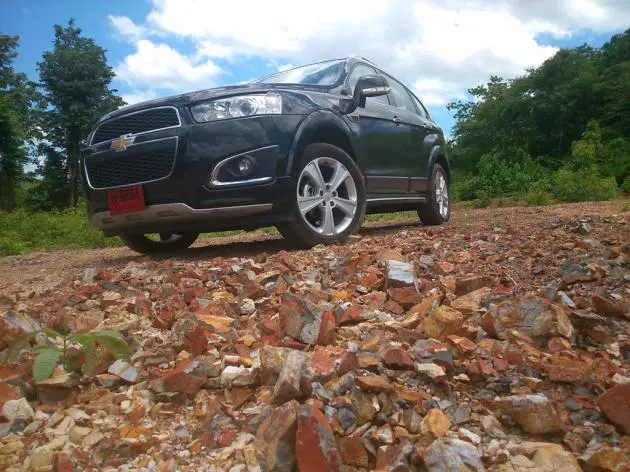
The exterior has received a welcome facelift with a redesigned front bumper and fog-light covers that have a more up-to-date look. At the rear there’s a new bumper, chrome exhaust and redesigned tail-light clusters that are sharper-looking than the outgoing model.
I drove the range-topping 2.0 diesel LTZ variant, priced at Bt1,719,000, that also features stainless steel side steps and new five-spoke 19-inch alloy wheels that give this SUV a stronger, more confident look. The four-cylinder common-rail turbo diesel engine is basically the same, with an output of 163 horsepower and 400Nm of torque (from 1,750rpm-2,750rpm), but it gets an improved 6-speed automatic transmission featuring Driver Shift Control. The engine offers good torque delivery and performs smoothly, while the gearbox also provides smooth shifting and a continuous flow of power.
Apart from the 200-kilometre media test-drive event in Phuket recently, I borrowed the Captiva diesel for a longer drive – covering more than 1,500km – and was pretty happy with the performance and ride quality. The turbo diesel engine had enough power and torque to get the two-tone SUV accelerating effortlessly, without too much noise or vibration. The front strut and rear multi-link suspension held on to the road nicely while maintaining commendable ride comfort. It features a “self-levelling system” as well, so you don’t have problems when carrying heavy loads.
I didn’t fancy the bulky steering wheel much and preferred something crisp and sportier like the Mazda CX-5’s. But the Captiva’s multi-function steering now comes with illuminated control buttons for all sorts of stuff ranging from audio to cruise control and climate control (it wasn’t there in the past and it was a nightmare to use in the dark).
Meanwhile, there are plenty of driver-assistance systems including HAS (Hill Start Assist) and HDC (Hill Descent Control), which makes life much easier when driving down steep and slippery terrain. There’s also traction control and ESP (Electronic Stability Programme) that helps maintain traction on slippery surfaces. The ARP (Active Rollover Protection) system also provides peace of mind when driving a SUV with high ride height, but if things go wrong there are still dual front and curtain airbags to help protect the occupants. The ABS brakes come with HBA (Hydraulic Bake Assist) and EBD (Electronic Brake Distribution), offering firm stopping performance.
I did run into a situation that required emergency braking on an upcountry road but luckily escaped from an accident – as well as a heart attack.
The Captiva climbed pretty well on rocky surfaces, thanks to the generous torque, and when going down the HDC kicked in, which drove any anxiety out of my mind, although the vehicle went down a little faster than I expected before the brakes started to engage.
Comfort is pretty good in the Captiva, and I completed the 1,500km drive without any back pains.
The vehicle features a navigation system that prevents you from getting lost when travelling upcountry, but the outdated audio system (the radio looks like it’s from the ’80s) and Bluetooth is difficult to operate – well, it seems no one can operate this without an owner’s manual. Perhaps a more updated front-end like the MyLink system (available in the Trailblazer and Sonic) should have been offered considering the higher retail pricing of the Captiva.
Also not available are automatic windshield wipers and headlights. Nevertheless, this SUV still gets improvements in other areas such as smart entry and a dual-zone climate-control system with air vents for second- and third-row passengers. With the seats down, cargo space is increased to 930 litres, so you can buy and carry a lot of stuff back home.
And if you’re worried about the reliability of the Captiva – the previous models have had only one recall for a seatbelt bolt that just needed inspection and tightening where necessary – I talked to a Chevrolet official about the numerous recalls the brand had announced in the past year ranging from airbags to transmissions, and he said customers should be even more confident because the company is doing everything it can to ensure the safety of its customers. The official claimed that other brands often do not announce recalls but secretly carry out the repairs/replacements when the customer brings the vehicle in for servicing.
“But for us, it’s a global policy to make announcements and ensure the safety of our customers,” he said.
Thumbs up for that, but making sure all the parts are defect-free through improved quality control procedures would be even better. Then no more recalls would be required – and that goes for all brands.
Chevrolet Captiva specs
Engine: 4-cylinder DOHC 16-valve with variable geometry turbocharger
Displacement: 1,998cc
Bore and stroke: 86x86mm
Compression ratio: 16.3:1
Max power: 163ps/3,800tpm
Max torque: 400Nm/2,000rpm
Transmission: 6-speed automatic
Ratios: 4.584/2.964/1.912/1.446/1.000/0.746
Suspension (f/r): McPherson strut, stabiliser/multi-link beam
Steering: powered rack-and-pinion
Turning circle: 11.8 metres
Brakes (f/r): vented disc/disc with ABS, EBA, EBD
Dimensions (mm)
Length: 4,673
Width: 1,850
Height: 1,756
Wheelbase: 2,707
Track (f/r): 1,569/1,576
Minimum clearance: 200
Weight: 1,986kg
Wheels: 19-in alloys
Tyres: 235/50 R19
Fuel tank capacity: 66 litres
Price: Bt1.719 million
Distributor: Chevrolet Sales (Thailand)
