
Elantra - an attractive alternative


Play
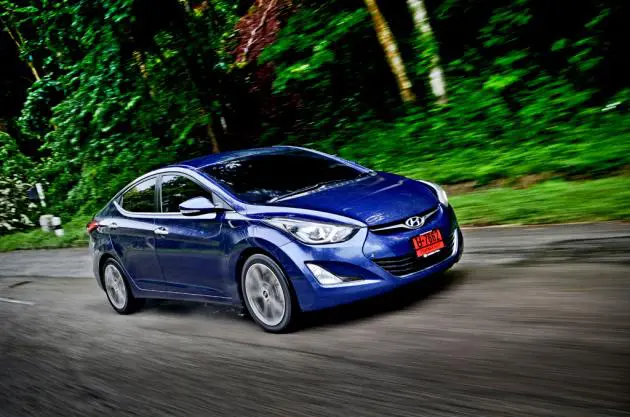
Hyundai's minor-change compact might not offer the refinement that the Ford Focus or Mazda3 does, but with its modern design, satisfactory performance, acceptable fuel economy and a host of equipment for its price, it could be a sedan worth considering
Hyundai has never made it big with sedans here, with most of the projected 6,000-vehicle annual sales coming from its H1 luxury van.
While all Japanese brands produce their passenger cars in Thailand, Hyundai has yet to start assembling vehicles here (except for the previous generation Sonata that was not very successful), meaning that all of its vehicles are imported.
But thanks to Afta, the Korean brand is able to sell Asean-made vehicles in Thailand without suffering from high import duty. This allows the automaker to lower the retail price to the same level as its Japanese rivals, and in the case of the Elantra compact car, even lower than that of Japanese compacts, especially when considering the goodies offered.
The minor-change Elantra, which is assembled in Malaysia, was launched here in early August with introductory prices ranging from Bt749,000 for the entry-level 1.8 GL model, Bt819,000 for the 1.8 GLE and Bt898,000 for the 1.8 GLS Navi, which is featured today. In addition, all three come with free first-class insurance for a year.
Judging from the retail price and what you get, the Elantra turns out to be a highly attractive package.
Two months after the launch, the price of the GLS Navi, which makes up more than 80 per cent of all Elantra orders, has been raised to Bt936,000 (the price remains the same for the other two cars), but it still is an attractive buy, considering the amount of equipment offered. Up to date almost 500 Elantras have been sold, more than double the planned 100 per month.
The GLS Navi has all the gadgets – ranging from smart entry with push start, navigation, Bluetooth, automatic headlights and windshield wipers, powered driver’s seat, foldable rear seat backrests, 4-way adjustable multi-function steering wheel, on-board computer with an eco-driving guide, automatic climate control, rear air vents, a one-touch turning signal, cruise control, rearview camera, and more.
After the official launch in August, Hyundai’s marketing department followed this up by staging a media test drive from Bangkok to Mae Sot (Tak province) and Myawaddy in Myanmar, allowing auto journos to get a feel of the car on various road conditions.
Apart from long, straight highways, there was also a good stretch of winding mountain roads into Mae Sot that forced the Elantra to unleash its full potential.
The 1.8-litre engine, with variable valve and intake system, develops 150 horsepower and 178Nm, and is mated to a 6-speed automatic transmission. Claimed figures include 10.2-second 0-100km/h acceleration, 190km/h top speed and an average fuel economy of 14km/litre, which is what you’d expect from a 1.8-litre car these days.
The engine is a tad noisy and harsh when revved up high, which is still a trademark for Korean brands. The priority here seems to be the fuel economy rather than performance or refinement.
A major highlight of the Elantra is the Flex Steer system that allows you to adjust the steering weight in three levels – comfort, normal and sport. In comfort mode, the steering become lighter and allows for easier manoeuvring in parking situations, while in sport mode the steering resistance increases, resulting in better feel and driving enjoyment.
On winding roads the sport setting worked just fine, lending the steering a beefiness, while the front strut and rear torsion beam suspension held on to the corners with more grip than you’d expect from a Korean car. In fact, the Elantra handled pretty well in the mountains, thanks to the sporty 215/45 tyres on 17-inch alloy wheels.
But compared to class leaders like the Ford Focus and Mazda3, the Elantra still lacks the refinement. There is considerable road noise and it doesn’t take up potholes very well. Nevertheless, there is VSM (Vehicle Stability Management) that controls the ESC (Electronic Stability Control) and the Motor-Driven electric Power Steering (MDPS), which can automatically provide 8Nm of counter steering if the vehicle pulls to one direction during sudden lane change or fast cornering.
The car’s brakes are also amply equipped with ABS, Brake Assist and EBD (Electronic Brakeforce Distribution).
Unfortunately only two front airbags are offered, with side and curtain airbags being left out from the Thailand-bound model.
Another strong point in the Elantra is the design. Both the exterior and interior designs based on Hyundai’s “Fluidic Sculpture” theme are stylishly modern. The materials used are acceptable and the 420-litre trunk is capable of storing up to four golf bags. If that’s not enough, you can also fold the rear seat backrest, which can be released right from the trunk area.
The Hyundai Elantra may not be perfect, but with loads of equipment being offered in this price range, it has established a strong attraction for buyers looking for a compact sedan with attractive styling and acceptable performance/fuel economy.
Hyundai Elantra 1.8 GLS Navi
Engine: 4-cylinder DOHC 16 valve
Displacement: 1.797cc
Bore and stroke: 81.0x87.2mm
Compression ratio: 10.3:1
Max power: 150ps/6,500rpm
Max torque: 178Nm/4,700rpm
Transmission: 6-speed automatic
Ratios: 4.400/2.726/1.834/1.372/1.000/0.774
0-100km/h: 10.2 secs
Top speed: 190km/h
Average fuel economy: 14km/litre
Suspension (f/r): McPherson strut/torsion beam
Steering: powered rack-and-pinion
Turning circle: 10.6m
Brakes (f/r): vented disc/disc
Dimensions (mm)
Length: 4,550
Width: 1,775
Height: 1,445
Wheelbase: 2,700
Track (f/r): n/a
Weight: 1,230kg
Wheels: 17-in alloys
Tyres: 215/45 R17
Fuel tank capacity: 48.5 litres
Price: Bt898,000
Distributor: Hyundai Motors (Thailand)
