
Hip and historic: the spirit of a city


With parks, palaces, chocolates and cafes and world class beer, Brussels makes for a wonderful escape
Brussels, the capital of Belgium and home to the headquarters of the European Union, is too easily dismissed as a passe holiday destination. And that’s a shame, as this small city has much to offer the visitor from charming places, fine cafes, world-class chocolate, great beer and fabulous food.
After a light lunch, a glass of cold local beer and a macaron, we are ready to explore the city.
Our first stop is Parc du Cinquantenaire, or Park of the Fiftieth Anniversary. Most buildings of the U-shaped complex, with the huge triumphal arch Arcade du Cinquantenaire in the middle, were built in 1880 during the reign of King Leopold II to celebrate 50 years of Belgian independence. Now it is best know for its cluster of museums: The Royal Military Museum, Cinquantenaire Art Museum and the AutoWorld Museum.
We then move to the upper town around the Royal Palace of Brussels, the official palace of the King of the Belgians. The palace is not the royal residence though, as King Albert II and his family live in the Royal Castle of Laeken. The Royal Palace of Brussels has welcomes thousands of visitors each year since 1965.
Fine architecture meets cafe culture in the Place du Grand Sablon, home to houses from the 16th to the 19th century. It’s alive with art and antique shops, restaurants, chocolatiers, and trendy bars. Outdoor tables are great spots to feel the vibe of the city while enjoying a cup of coffee in the warm sunlight, which tends to last for only a short time before being replaced by rain. Every weekend, the antiques market on the church side adds more colour to the Square.
From Place du Grand Sablon, we march to visit Brussels’ most famous boy - Manneken-Pis or the urinating boy. The 61 centimetre-tall bronze fountain statue may be Brussels’s oldest citizen. The archives of Saints-Michel-et-Gudule Cathedral shows that the stone Manneken-Pis served as a public fountain in 1388 with the bronze statue installed in 1619.
The crowds around the statue are busy taking pictures while children are climbing the fence to get the best view of the statue.
“Before we get closer to the boy, please be informed that you have to take good care of your belongings. Pick-pockets are doing their jobs in the crowded street and in crowded attractions like this one,” says our guide before leading us to the statue.
You can hardly call this piece “majestic” but we prefer the little boy to the giant statue fountain the size of Eiffel Tower. The locals are very fond of the boy so they have many stories and ways of celebrating festivals with him.
The most famous legend says that the statue represents a heroic deed of a young boy who saved Brussels. It was during a war, the story goes, and the enemy was about to bring down the city walls with gunpowder. Fortunately, a little boy, desperately needing to relieve himself, extinguished the fuse and saved the city.
Manneken-Pis sometimes sports a special costume, such as on September 11, when he is dressed as a fire-fighter. The tradition started in 1698 when Maximilian II Emmanuel, Governor of the Spanish Netherlands, gave him his first set of clothes. Now he has more than 800 outfits in the Museum of the City of Brussels.
To mark some very special occasions, Manneken-Pis even fills his basin with beer or wine.
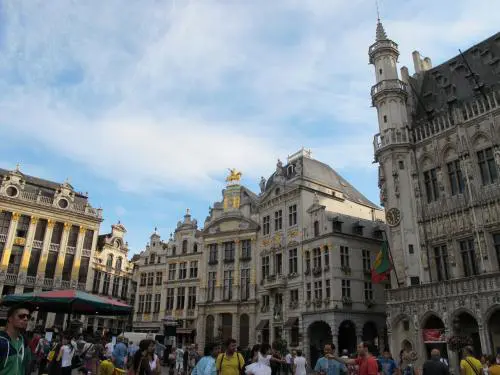
A short walk from the boy takes us to the jewel in Brussels’s crown, the Grand Place. Originally known as Nedermarckt or Lower Market, the Grand Place is located on former marshland on the right bank of the River Senne. The present rectangular outline has developed over the centuries and did not take up its definitive form until after 1695.
By the end of the 11th century, it was an open-air marketplace. At the beginning of the 13th century, three indoor markets were built on the northern edge of the Grand Place; a meat market, a bread market and a cloth market. Later, the gothic Brussels City Hall was built on the south side of the square and made the Grand Place the seat of municipal power. The Duke of Brabant countered this symbol of municipal power, by building the King’s House, although no king has ever lived there, on the site of the first cloth and bread markets as symbol of ducal power. Wealthy merchants and the guilds of Brussels built houses around the edge of the square.
With its architecture and its outstanding quality as a public open space, the square fully deserves its Unesco world heritage status.
Before leaving the Grand Place, some spare a moment to touch the reclining statue of Everard’t Serclaes located on Charles Buls street, just off the Grand Place. Locals believe that the statue brings luck and grants the wishes of all who touch it.
For a good hearty food with a genuine taste of Belgium we head to Chez Leon, situated in a bustling street off the Galeries Royales Saint-Hubert - the first shopping arcade in Europe - a 19th century shopping gallery covered with a magnificent domed glass ceiling.
The bustling restaurant is full of families and groups friends. The sounds of cutlery mingle with hearty laughter and the dangerously strong Belgian beer makes the mussels and pommes frites seem tastier than ever.
IF YOU GO
- Thai Airways International will launch Bangkok-Brussels direct flights on November 17. The flights operate on Tuesday, Thursday and Saturday on Boeing 777-200ER craft. Call (02) 356 1111 or visit www.ThaiAirways.com.
(The writer travelled as a guest of Thai Airways.)
