
The enemy within


Play
A visit to Corregidor Island is a stark reminder of the atrocities humans are capable of committing in the name of war
Although Corregidor Island in Manila Bay is less famous than Thailand’s Death Railway in terms of Japanese savagery during World War II, this last US stronghold in the region was also testimony to what a Filipino historian calls “the Japanese contempt for life”. The sense of history is strong on Corregidor and the courage as well as the suffering of the men who died here is almost palpable.
Today, of course, Corregidor is open to all. However, if you’re a Japanese visitor, your Filipino guide won’t mix you with other nationalities. He will tell the story of Corregidor based on Japanese history, a tale of gallantry, victory and banzai. On a different bus, the story is one of patriotism, sacrifice and valour.
Cultural sensitivities run deep on the Corregidor tour. On one occasion, an elderly Filipina stopped a visiting Japanese couple. “You took my husband away. I will not forgive you,” said the woman.
Her husband was killed during the Japanese capture of Corregidor. The couple decided to leave without taking a tour. But the Filipinos do try to make Japanese tourists feel comfortable, guiding them to the Japanese Garden of Peace.
Corregidor is a must-see for any history buff.
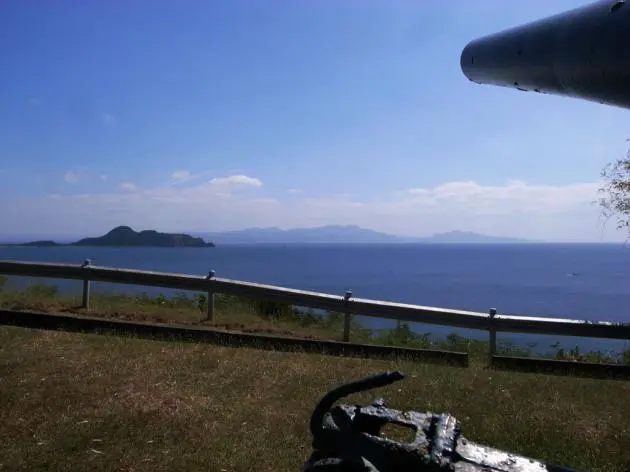
About 48 km west of Manila and strategically located at the entrance of Manila Bay, this island fortress was one of Asia’s last defences against the overwhelming number of invading Japanese forces. It’s home to military barracks, an army hospital, officers quarters, gun emplacements, a YMCA building, the Malinta Tunnel and other military structures.
These buildings are in ruins, the result of heavy bombing by the Japanese. We visit the hospital, which is exactly a century old. The concrete looks new, but the structure is scarred with shrapnel and riddled with bullet holes. Our guide tells us he was once surprised to find out that one of his visitors had actually been born in the facility.
The fully restored Malinta Tunnel, in which 2,000 Japanese soldiers blew themselves up with dynamite just prior to the recapture of Corregidor by the American forces, still has a somewhat spooky atmosphere even during a daytime tour. The bombproof structure used to house a 1,000-bed hospital, General Douglas MacArthur’s headquarters and other facilities.
Corregidor suffered relentless pounding by the enemy. The saturation bombing and shelling of May 5, 1942, just one day before its surrender, was one of the worst of the whole war. The very face of the island was radically changed, and even the jungle became a desolate place with not a single blade of grass left.
Also known as “the Rock”, it was a key bastion of the Allies during the war. When the Japanese invaded the Philippines in December 1941, the military force under MacArthur’s command carried out a delaying action at Bataan. Corregidor became the headquarters of the Allied forces and also the seat of the Philippine Commonwealth government. It was from Corregidor that Philippine President Manuel Quezon and MacArthur left for Australia in February 1942, leaving Lt Gen Jonathan M Wainwright in command.
At Battery Way I come across a plaque commemorating Major William “Wild Bill” Massello Jr. His story is a heart wrenching one. Corregidor surrendered at noon on May 6, 1942. That morning Massello lay seriously wounded on a stretcher, having refused to be evacuated. Around him, the battle for Corregidor was reaching its climax. Now only Battery Way could continue to fire: from his stretcher Massello pulled the lanyard of his serviceable mortar while his men remained under cover. After firing over 90 rounds of the 700-pound projectiles at Japanese forces on Bataan and Corregidor, the breachblock of the last remaining mortar froze solid.
“The old mortar had finally quit on us,” Massello recalled, “but it lasted long enough to be the last big gun on Corregidor to fire on the enemy.”
Finally Corregidor fell, and Massello was taken into Japanese captivity. In November, he was loaded, along with many of his fellow captives, onto what was to become known as a “hell ship”. He spent the next three and a half years in Japanese POW camps in the Philippines and Japan. He was liberated by the American occupation troops in September 1945.
That hell ship is portrayed in one of the paintings on display at the Filipino Heroes Memorial. All kinds of torture are shown here but none is more appalling than the painting of a Filipino baby thrown into the air and bayoneted by Japanese troops. The caption notes that in the Philippines, the Japanese bayoneted children in mid-air to show their power and lack of fear.
How you deal with the atrocities on Corregidor will depend on your own view of the Japanese during World War II. Filipino historians like Teodoro A Agoncillo think the Japanese soldiers were beasts, but he also sees angels among them.
I have to admit that I didn’t glimpse even one angel during my trip to the island.
The writer travelled in the Philippines courtesy of the Department of Tourism in Manila and the Philippine Airlines.
IF YOU GO
Philippine Airlines flies from Bangkok to Manila twice daily. For more information, visit www.PhilippineAirlines.com.
A scheduled tour departs from Manila daily at 8am and arrives in Corregidor an hour later. The return ferry departs the island at 2.30pm. For bookings, call (+63 2) 831 8140.
