
Eco-tourism -- as in fun


The Philippines' Bohol Island has three terrifyingly exciting ways to enjoy nature
Eco-adventure tours are the new buzzword in Catigbian, a town on Bohol in the Philippines, 35 kilometres northeast of the island capital Tagbilaran. But our media group wasn’t inundated on arrival with talk of nature trails, zip-line rides, jungle treks and bird watching.
Instead, Catigbian Mayor Roberto L Salinas mesmerised us with a speech about how the eco-adventure tourism boom owes less to an influx of tourists than it does to the power of “Lord Jesus Christ”. They thank God for that.
Catigbian hosts religion-oriented agricultural communities, and it’s these institutions that are now tapping into eco-tourism. And the mayor wants to keep things devout, no matter how much impact tourism has on his municipality.
His Worship treated us to a video presentation that earned a few yawns, but his “GREAT Catigbian” concept is indeed great. GREAT stands for Green Recreational Eco-Adventure Tour. We also totally enjoyed the terrific local dessert, which is wrapped in banana leaves.
The visiting journalists shared a sense that Catigbian is following rural Chiang Mai’s example – minus the blatant greediness. There’s an old-world charm to the island, as embodied in the buffalo-drawn carriage that ferried us to DATE Park.
DATE stands for Dagook Adventure Tour Experience. This is the hub of Catigbian’s eco-adventure tourism.
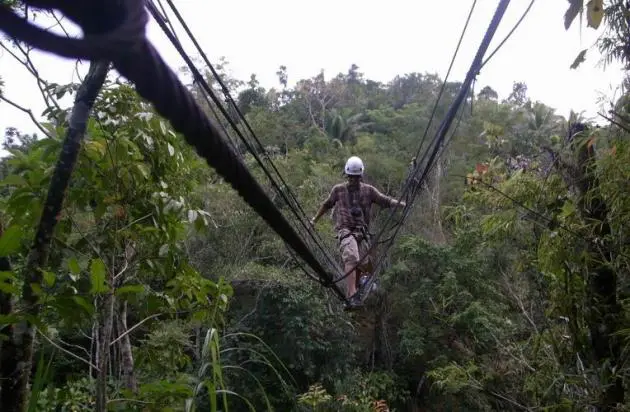
Set in mountainous terrain a kilometre and a half from the nearest highway, DATE Park offers various tests of courage and stamina. Thrill seekers flock to the three main activities: the Canopy Walk, which is a swaying 60-metre-long footbridge just under the treetops; the Monkey Bridge, a 40-metre stroll on a suspended cable; and the Mountain Slide, a 200-metre dash on a zip line.
Together they cost 700 pesos (Bt510).
Only two women in our media group declined the chance to star in their own personal episode of “Fear Factor”, despite the arduous hour’s trek up and down the hills. The rest of us spent 30 minutes gearing up and were ushered by a young lady to the Canopy Walk.
At the first step, the footbridge just above the palm trees waddles like a pendulum. But a firm grip on the hand-cable stabilises it enough to afford a refreshing and spectacular view of the forest, blessed with the cacophony of insects and birds. Fear of the bridge collapsing soon disappears.
It’s a short walk through the woods to the Monkey Bridge – a single-cable tightrope better suited to circus daredevils than guests on holiday. One cable for both feet – but there are four more cables to cling to as you stagger across, high above a waterfall, a stream and a mountain pass. And, anyway, a harness tied to an overhead cable guarantees your safety.
Still, you feel very much like that daring young man on the flying trapeze. The shimmy of the “tightrope” means it’s quite difficult just putting one foot in front of the other. My mind leapt back to Mount Everest Base Camp a few months ago.
Of course, real daredevils carry a camera across and stop midway to capture the landscape. Regardless, having made it to the other side, you have officially mastered the fear factor.
Only one challenge remaining.
It’s a hike uphill to the next station, which offers a lot of fun. People stop along the way to catch their breath before reaching the Mountain Slide, perched atop a hill and ideal for speed freaks. For our group, this was the most fun.
Propelled by gravity, the slide across the rapids of the Abatan River is so fast that it’s impossible to operate your camera. None of us had any idea how to stop, a question that cropped up midway through.
The inability to answer the question turns into alarm as you near the other side. But two men are waiting. One of them stops the wheels and the other one stops you.
It’s a whole lot of excitement, but you still manage to feel hungry soon after. Back in the capital we headed straight for Giuseppe Pizzeria, the only Italian restaurant on the whole island that’s actually operated by an Italian.
After a lifetime of hopping from one luxury hotel to another, Giuseppe decided a few years back to settle on Bohol. He flies in all the ingredients and wine he needs from the homeland.
“On Bohol everyone knows each other,” he said. “When you walk down the street, you get people smiling at you. You don’t get that elsewhere.”
There are quite a few people like Giuseppe who are determined to spend the rest of their lives in the quiet embrace of nature on Bohol. They’ve found their idyllic home away from home.
The writer travelled courtesy of the Philippines Department of Tourism and Philippine Airlines. The Bohol Tourism Office hosted his visit there.
OFF YOU GO
Bohol is in the central Philippines and can be reached by air and boat. Coming from abroad, you can fly to Manila or Cebu. Via Manila, you need a connecting flight to Tagbilaran, which takes about 75 minutes. Philippine Airlines flies daily to Tagbilaran. Get the details at www.PhilippineAirlines.com.
