
The wild and the wonderful


Play
Photographers, both amateur and professional, will find the shots they've only dreamt about at these Chinese beauty spots
The colours of autumn are not always red and gold; Instead, there is a spectrum of choices for the traveller with a camera. Here are the places that offer the most picturesque sites in China for the tourist who wants to take away lasting impressions.
TAIHANG MOUNTAIN
“The road that hangs on the cliff” – that is how locals describe the precarious winding route up Taihang Mountain on the border of Shanxi and Henan provinces.
It is a long channel carved from the mountainside and is almost a deep tunnel-cave. When the road was being cut in the 1970s and 1980s, it was the only way in or out of the mountain and served villages that had been isolated from the outside world for many years
In the southern part, the Loess Plateau dramatically morphs into the China Plain, creating a significant change in landscape and scenery. Deep gullies and steep mountains suddenly open out into a vast greenness soothed by the gentle splashing of waterfalls.
Getting there: Visitors can take the bus from Changzhi, Shanxi province to different scenic spots at Taihang Mountain.. It’s about 8 hours driving from Beijing to Taihang Mountain through the Beijing-Hong Kong-Macao Expressway. There are some affordable guesthouses in the scenic area, which cost about 100 yuan (Bt490) a day for a double room.
CHISHUI RIVER
Good liquor is brewed where there is good water, and China's most famous white spirit Moutai is helped by the water of the Chishui River. The name means “red water” and the river runs through the north of Guizhou province.
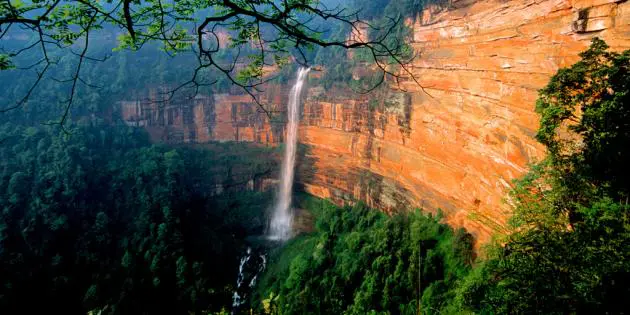
The particular geographical form that gives rise to the river and its name is known as the danxia landform, characterised by red riverbeds fringed by steep cliffs and formed more than 200 million years ago. It looks like stacked pancakes and evokes memories of the stark landscapes in the “Star Wars” series.
Trees grow out of crevices in the rocks, and falling cataracts of water carve out gullies in the red rocky slopes.
The flora is especially noteworthy, and there are many ancient plants deep in the primeval forests. It is easy to find Asophila, a kind of fern, which has populated the region since the Jurassic age. Chishui, once an inner land lake, used to be a hub for dinosaurs.
Getting there: Beijing and Guangzhou have direct flights to Zunyi, Guizhou province. It will take about 5 hours on the bus from Zunyi to Chishui with a ticket at about 80 yuan ($12). There are some chain hotels in the town where a double room will cost about 200 yuan a day.
JIUZHAIGOU
This is setting for fairytales. Jiuzhaigou in the north of Sichuan province is well known for its peaceful pools of water coloured a chalky blue that reflects the hue of an azure sky. These crystal-clear lakes are indeed a gift of heaven, thanks to the karst landscape, and the high density of calcium carbonate crystals in the water.
Jiuzhaigou is listed as a world natural heritage site by Unesco and is one of the best-preserved wetlands in the region. Animals and plants abound, thanks to an eco-system that has been kept carefully intact.
Getting there: Beijing, Shanghai, and other domestic cities offer direct flights to Jiuzhaigou. Taking a taxi for the 90-km ride from the airport costs about 200 yuan. Admission to the park is 220 yuan for a day, plus 90 yuan for a bus pass. Accommodation ranges from family-run inns to luxury hotels.
PANJIN
China’s “red sea”, by the shore of Panjin, Liaoning province, is created by Suaeda salsa, a kind of seagrass. It has spread over the seashore shoals and expanded at the rate of about 50 metres a year deeper into Bohai Sea.
Walking along the 680-metre-long trestle bridge right into the centre of this sea of red is an amazing experience, especially when the tide is at ebb and flow.
These wetlands, among the country’s best preserved, are also the southernmost habitat of the red-crowned cranes, as well as the refuge of more than 200 species of birds.
Getting there” One hour's drive from Shenyang, Panjin has regular shuttle buses to the red sea shore. Admission tickets to the pier and the bird park to watch the cranes are both 40 yuan. There are many budget hotels in the city, charging between 100 to 200 yuan for a double room a night.
KANAS
Kanas, a nature reserve and geological park, is part of the Altay Mountains in the Xinjiang Uygur autonomous region, also known as the China Alps.
This highland region boasts a diversity of plants and protected animals living in areas ranging from glaciers and snowfields to rivers and grassland. It is also dotted by pockets of civilisation represented by pretty yurts or villages inhabited by various ethnic groups.
Local Kazak horses are known for their pleasant personalities and gentle dispositions. Take a ride out to Kanas Lake, more than 180 metres deep and believed to be home to a cousin of the Loch Ness monster. Look up and you will see more familiar creatures, such as majestic condors soaring above to the mountains that average about 1,500 metres above sea level.
Getting there: It takes about 12 hours to drive from Urumqi, capital of Xinjiang Uygur autonomous region. There are several resorts and hotels around the lake, but some may close when the peak season ends after the National Day Golden Week and will reopen only in May. Visitors can also choose to stay in youth hostels costing about 300 yuan a night.
