
Thai–Cambodia border clash exposes expanding arms pipeline
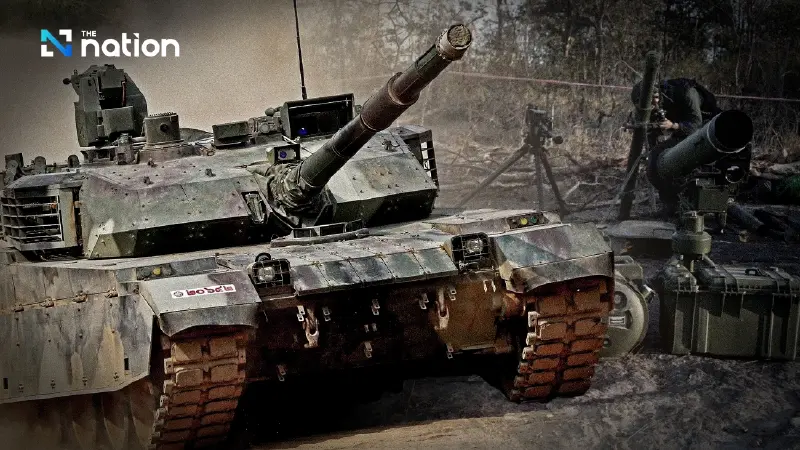


Cambodia’s decade-long arms build-up, mostly from China, is reshaping the Thai–Cambodia battlefield—now with “5G-era” guided missiles.
Cambodia has spent the past decade steadily expanding its arsenal, fuelling confidence in Phnom Penh that it can stand up to any neighbouring country.
Much of that build-up has been linked to deepening military co-operation with China, including annual joint drills—most notably the large-scale “Golden Dragon” exercises, typically held each May.
The co-operation extends beyond ground training: Cambodia and China have also staged land-and-sea drills focused on counter-terrorism and security, with Chinese naval vessels calling at Ream Naval Base and taking part in live-fire activity.
Each round of joint training has reportedly involved China providing weapons and equipment to Cambodia—seen by observers as a form of payback for access and strategic space, especially around Ream, as Beijing expands its footprint in Southeast Asia.
As a result, around 90% of Cambodia’s accumulated weapons are said to have come from China, with the remaining 10% sourced from Soviet-era suppliers.
The stockpile cited in the account includes systems such as the SH-1 self-propelled howitzer, with a stated range of 30–53km and the ability to fire laser-guided rounds.
Cambodia is also described as fielding multiple rocket launcher systems—Type 90B/RM-70/BM-21—with ranges of 20–40km, which have been used during the current fighting to strike both military and civilian targets, including Kantharalak district in Si Sa Ket.
Longer-range systems cited include the PHL-03, with a stated reach of 70–130km, potentially covering multiple Thai provinces while monitoring Thai military movements.
Air defence has also become part of the equation. The KS-1C system, with a stated range of 70km, is described as capable of tracking and locking on to Thai fighter aircraft such as the F-16 and Gripen when they conduct missions requested by the army and navy.
The development that has most unsettled Thai forces, however, is the reported seizure on December 14, 2025 of multiple units of a Chinese-made “fifth-generation” anti-tank guided missile system—identified as the GAM-102LR—left behind by Cambodian troops at Hill 500 after Thai forces retook the position.
The system is described as a modern guided missile platform that can be used not only against armoured vehicles but also other military equipment, with a standard range of 6–10km and a mix of precision and operational flexibility.
The report says it was unveiled earlier this year and produced in China by Poly Defence (GAM/Bolas line), with both infantry and vehicle-mounted deployment options.
Questions over Chinese arms transfers are not new.
During the first round of ceasefire talks on July 24–28, 2025, The New York Times published an article on October 2, 2025, claiming China shipped a large batch of weapons—including rockets, artillery shells and mortar rounds—to Cambodia on six Chinese military flights in June 2025, shortly before fighting erupted along the Thai–Cambodia border.
The report broadly aligned with the timeline of China–Cambodia joint drills in 2025, including the 7th Golden Dragon ground exercise held on May 14–28, 2025 in Kampong Chhnang province.
It also coincided with a planned live-fire naval drill on June 11–13, 2025 between the Cambodian and Chinese navies near Poulo Wai and Tang Island, in waters close to Ko Kut in Thailand’s Trat province.
China later cancelled the live-fire segment as the border situation began to heat up, while Thai naval vessels were reported to have moved to monitor the exercise area.
After The New York Times report, Army commander Gen Phana Klaewplodthuk assigned army chief of staff Gen Chaiyapruek Duangprapat to travel to China to meet senior Chinese military leaders and seek clarification over the allegations.
China insisted that since border clashes began in late July 2025, it had not delivered any weapons or military equipment to Cambodia, and said Cambodia’s existing stock had been provided during joint drills before the fighting began.
During the discussions, China also presented a detailed list of all weapons and equipment it had supplied to Cambodia—itemised by type and by delivery date—as evidence for the Thai side.
Attention has now returned to the GAM-102LR seized at Hill 500. The Thai military has not been able to confirm when Cambodia obtained the missiles, and says both scenarios remain possible—either they were received from the Chinese military during recent joint exercises, or acquired through illicit channels outside normal procurement processes, allegedly with support from “grey” Chinese networks.
Transport could have occurred by air or sea, officials say, while one indicator cited is a reported lack of proficiency among Cambodian troops, as such weapons generally require months of training to use effectively.
Col Richa Suksuwanon, deputy spokesman for the Royal Thai Army, said the seized anti-tank missiles remain in Thai custody under standard procedures.
He added that while the military is concerned about the weapon’s sophistication—and believes it has been used to some extent—field reports show no Thai armoured vehicles have been damaged or successfully hit, suggesting possible factors such as operator skill or Thai tactics.
If China’s main objective in supplying weapons to Cambodia was national defence, the escalation into a Thai–Cambodia border conflict may not have been anticipated.
The report argues that when weapons are used on any battlefield, their performance can become a form of advertising—boosting demand and supply—while third parties profit quietly from the fighting.
