
Emperor, concubine and priest


Play
China's first capital Xi'an is steeped in history but much of it is being denigrated through a surfeit of hawkers and Vegas-style theme parks
In 215BC, when Qin Shi Huang ordered the construction of his own tomb and an army of Terracotta Warriors to be buried with him in Xi’an, it’s doubtful he was thinking of turning his mausoleum into tourist attraction. Yet, today, some two millennia later, more than 65 million Chinese alone visit his funeral art every year.
After sampling noodles, steamed dumplings and the local Maotai rice wine, I’ve learned that Qin Shi Huang is not the only famous person in town. If the City Walls could whisper the other names, Yang Guifei and Xuan Zang would also be on their lips.
“In Tang time, when the caravans of the merchants were returning to Xi’an from their long journeys on the Silk Road, the emperor would stand on the city wall,” says Stephen, our English-speaking guide, leading us to South Gate then up the steep staircase to the top of the City Wall.
Just by Nanmen Roundabout is a live-sized sculpture of an ancient trader and his two camels, a reminder that Xi’an was the beginning of the Silk Road. A few metres from the sculpture, a public bus pulls away from the lights, almost flattening a careless jaywalker. Volkswagens, Mercedes Benz, Toyotas and Chinese-made cars such as the Hongqi follow, adding to the polluted air. In the distance, the Xi’an skyline disappears in plumes of smoke.
Known as Shang’an prior to the Ming Dynasty, Xi’an is located in central China. It was the capital of China and the seat of power for the Qin, Han, Tang and other dynasties.
Xi’an’s best days ended with the Tang Dynasty more than a millennium ago though the former capital now draws more than 50 millions of tourists annually to see the “ghosts” of its glory days. There in early winter, we’re introduced to some of Xi’an’s most famous people and place.
The first is Qin Shi Huang, China’s first emperor and not a nice ruler. Torching hamlets, ransacking small towns and taking captives were part of his One-China campaign. The emperor built many sections of the Great Wall at the cost of numerous lives, and gave an order to burn scholars alive.
The formidable emperor was afraid of nothing, save his final destination.
“Qin Shi Huang was terrified of vanquished spirits awaiting him in the afterlife,” says Stephen, as we look over the infantry of 6,000 Terracotta Warriors. “He wanted to take the army with him into the grave.”
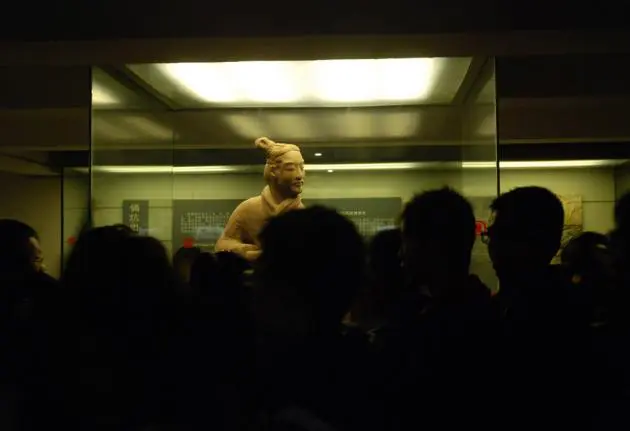
In Pits 1 to 3, we meet the generals, mid-ranking officers, cavalrymen and archers unearthed from the rice paddies. At Pit 2 it’s worth braving the army of tourists to meet the terracotta soldiers up close. Amazingly, no two faces are alike. The expressions, hairstyles, armour and even the treads on the footwear are all unique.
“What you can’t see here is the emperor,” says the guide. “We know where his tomb is, but it’s not excavated yet.”
The hawkers obviously work faster than the archaeologists. They offer us a complete set of terracotta complete with the unearthed emperor.
Travelling in Xi’an meaning slipping back and forth between different eras and dynasties. One moment you’re in 200BC with the soldiers, the next, you’ve travelled 1,000 years into the future. Leaving the mean emperor, I find myself at Huaqing Hot Springs watching Chinese tourists taking turns to pose with the statue of Yang Guifei.
Any Chinese city with a sense of imperial history has a dramatic story of an emperor and his concubine, and the tale of Emperor Xuanzong and Yang Guifei is the juiciest.
Yang lived in the middle of the eighth century – about 500 years before Sukhothai Kingdom appeared on traders’ maps. Famed for her beauty, Yang’s face made beautiful flowers fold in shame.
The Tang prince was the first to find Yang and ask for her hand. Princess Yang dreamt of life in the Tang imperial palace and hoped her husband would become the emperor. But when the emperor visited his son, he fell madly in love with his daughter in-law.
“The emperor wanted Yang as his consort,” says our Chinese guide. “He took her from his son, and made her his favourite concubine.”
Huaqing Hot Spring was once the favourite winter retreat of Emperor Xuanzong and Yang Guifei. Today it’s full of Chinese tourists posing for photos in front of a naked Yang Guifei.
If the dusty royal bath at Huaqing Hot Spring doesn’t give you enough hints of the luxurious life at Tang Palace, help is at hand courtesy of the Tang Dynasty Dinner Show. Set in the former royal garden, Chinese capitalists have reinvented the Tang imperial palace with pavilions, lake and garden for tourists. It’s the most famous dinner theatre in the city, offering an over-the-top spectacle with Vegas-style costumes, traditional dance, music and singing.
After a few days exploring Xi’an’s mystical and juicy sides, there’s hope that the old city will reveal its spiritual one.
Standing high against the modern buildings in the city is the Big Goose Pagoda. Completed in 652, the monastery houses the Buddhist sutras brought back from India by the monk Xuan Zang.
“Xuan Zang was a great monk, translator, scholar and traveller,” says Stephen, as we stand in the large courtyard facing the seven-storey pagoda. “After 17 years of travelling, he settled here to translate the scriptures.”
Made of dammed earth, the five-storey pagoda stood 50 years before collapsing. Rebuilt and renovated several times over the centuries and reaching 10 storeys, the massive earthquake in 1556 knocked three stories down, leaving it at its current height. It survived the Cultural Revolution campaign, but probably won’t make it through the new wave of capitalism.
To earn tourist money, the Chinese have dreamt up a wealth of cultural heritage schemes and theme parks and the Big Goose Pagoda has not escaped. Don’t expect a monastic moment here. T-shirt outlets, throngs of souvenir shops and a hefty entrance fee denigrate the 1,360-year-old pagoda. To escape the noisy tourists, I find a peaceful garden to the pagoda’s west, sit on a small bench and imagine a team of Chinese monks trying to crack the Pali scriptures.
“The translation wasn’t completed because of a language problem,” says Stephen, as we walk slowly to see Xuan Zang’s statue in front of the monastery.
“So Xuan Zang set off on a second journey to India to learn the language.”
If you go
AirAsia operates a daily flight between Bangkok and Xi’an.
