
Yangon awash for Thingyan


Play
Myanmar's Rakhine community shares its New Year water festival
Like several other countries in Southeast Asia, Myanmar celebrates the start of the new year with a traditional water festival. Known as Thingyan, the four-day festival coincides with Songkran and involves splashing water, exchanges of best wishes between the elderly and the young and family get-togethers. Buddhists believe water washes away bad luck and ushers in prosperity and happiness.
Just as in Thailand, the festival has evolved over the years. Gangs of youths now go on the rampage armed with water pistols, buckets and hoses, causing watery havoc. It’s a festival of fun, dance and wild music, but one that’s also rife with booze and sleaze.
Yangon’s Rakhine community, however, continues to preserve its cultural heritage and celebrates Thingyan in its most traditional form. The Rakhine Water Festival kicks off on Saturday for a three-day run at the Thuwanna Stadium in Thingangyun Township.
Dating their first kingdom of Dhanyawaddy in western Myanmar to 3325 BC, the Rakhine, also known as the Arakanese, love music and literature and practise Theravada Buddhism in much the same way as the Kachin, Kayah, Karen, Chin, Barma, Mon and Shan.
The Rakhine are credited with inventing Thingyan. A legend has it that in 568 BC, the Buddha visited Dhanyawaddy and bestowed his own Mahamuni image upon King Sandar Suriya. Blessed by the Buddha himself, the statue was worshipped by locals, who developed a practice of pouring perfumed lustral water on it. They used the remainder in the bowls to splash each other for fun. Thingyan was born.
Three traditional events occur during the Rakhine Water Festival.
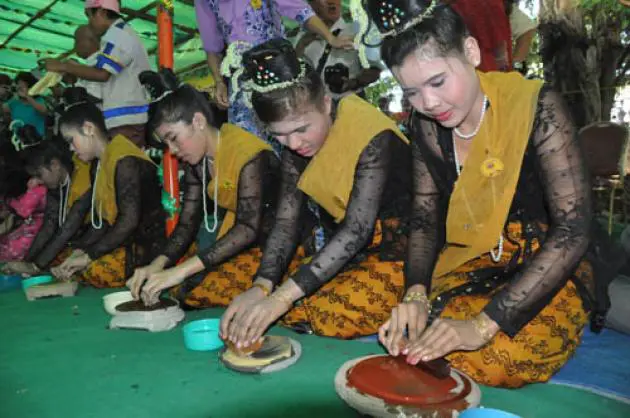
The first is a thanaka-making competition, in which revellers grind the bark of the fragrant sandalwood tree. Thanaka is yellow facial powder that women and children smear on their faces to keep cool. This powder is dissolved in holy water to make a runny paste that the locals gently pour over the heads of Buddha images.
The water-splashing takes place in Buddhist monasteries following a clean-up campaign on the new year’s eve and a thanaka-producing chore done by a group of Rakhine ladies in a pavilion. The men entertain outside with music and dance.
The first day of Thingyan begins with a ceremony to bathe Buddha images with thanaka. A sermon follows. Only then do the locals switch into the automatic water-splashing mode as a good way of using up leftover liquid.
Given the Rakhine’s coastal origins, early celebrations involved a big boat housed a bamboo pavilion. It’s filled with water and adorned with gum kino flowers (locally known as padauk), which are in full bloom in April.
The ladies did the splashing from beside the boat while the men enjoy music and dance outside. Guys have fun pairing up with their favourite chosen ladies as they splash and dance.
IF YOU GO
The Rakhine Water Festival has taken place exclusively in Rakhine State for generations, but since 2004 it’s been also held in Yangon – at two different venues for security reasons.
The thanaka-grinding ceremony and the bathing of Buddha images for the new year’s eve (April 13) in the Rakhine Religious Hall at the Shwedagon Pagoda. The splashing kicks off Thingyan on April 14 at the Thuwanna Stadium in Yangon’s Thingangyun Township.
