
Cosying up to Mother Nature


Play
Phuket's East Coast opens up to eco-tourism with a decidedly agriculture flavour
For most tourists, a holiday in Phuket is synonymous with sun, sea, sand and nightlife. Few venture off the beaten track to Bang Rong, an off-beach community on the island’s East Coast.
Leaving the minivan at Bang Rong Pier from where local commuters board the passenger boat to Koh Yao Yai and other smaller islands, you quickly realise you are in a different world, or perhaps a different century. There are no palm-fringed beaches let alone a stylish boutique hotel. Here, you’re more likely to have an encounter with a group of long-tailed macaques than bump into tourists. Every once in a while you can see a Muslim fisherman rowing a small sampan upstream in search of the catch of the day. Forget hip music, too. The only sound apart from the wildlife is the Hazan call to prayers.
Phuket’s western coastline, famed for beaches like Patong, Bang Tao and Mai Khao, offers tourists laid-back sunbathing, beer bars and wild parties. The eastern side at Bang Rong, with monkeys, mangroves, waterfalls and fishing communities, promises visitors a rustic retreat.
“You are going to eat fish, lots of fish, and durian,” begins Prasert Rithirak, our local guide, moving his bananas out of my reach. “You’ll also do some sea kayaking, hike to the waterfall and make peace with the gibbons. If you’re lucky, you will learn how to milk a goat.”
That all sounds very promising to this hungry traveller though I refrain from mentioning to Prasert that I would prefer to eat the goat rather than milk it.
Tucked away on Phuket’s East Coast, where the hilly terrain is blanketed with rainforest falling away to the mangroves on the shore, Bang Rong is a land of abundance for its Muslims residents, not to mention the monkeys. Heading westwards from the Heroine's Monument, you see local farmers plying their durian, rambutan, mangosteen, jackfruit and parkia. Unlike the western coast with its competitive lifestyle, the communities of Bang Rong pursue a slow, sustainable life. The locals are not dependent on “tourist money”, as they eat what they grow and grilled what they fish.
Now, the villagers are gradually welcoming visitors with their community-run green tourism.
The pre-lunch programme takes us to Bangpae Waterfall – a cascade that sweeps through the evergreen forest of Khao Phra Thaeo National Park. It demands a hike from the entrance to the waterfall into the jungle, where the water rushes down 10 metres from the higher overhang stone to the lower pool. You can “go exotic” and take a refreshing dip in the drop pool, which makes the infinity pool at a boutique hotel look rather than a fish tank.
“You can hike from this side of the mountain to the other side,” says the guide , grinning at the look or horror on my face. “But it involves a great deal of uphill walking for half a day.”
I’ll stick to the fish and durian.
Bangpae Waterfall is also home to the Gibbon Rehabilitation Centre. Here, every gibbon has a name suggesting that it once lived with a human as a pet. But gibbons do not make good pets and as soon as they evolve from cute babies to aggressive adults, they get dumped at a temple. The Wild Animal Rescue Foundation of Thailand saves these poor monkeys and brings them to the rehabilitation centre to teach them to forget domestic life.
“We teach them to live like wild animals,” says a volunteer from Ireland, who is spending his holiday sweeping the ground at the centre. “When these gibbons can survive on their own, they’re released into a sanctuary in the wild.”
Green travel, at its best, should reward the host as much as the visitors and the Gibbon Rehabilitation Centre is a great place to stop. You can walk around the cages, listen to their eerie calls, share stories with the volunteers, and donate some money or purchase some keepsakes to contribute to the project.
We retrace our steps to Bang Rong local pier for lunch. The floating restaurant is run by the local community, and the menu offers Muslim home-cooked delicacies including grilled white snapper and sea bass soup. Primed for perfect fish, my fork flashes forwards to the white flesh. Aromatic and sweet, I eat more than I deserve. The fish soup is not that sensational and lacks enough bird's eye chilli and lime juice for my taste, but it keep my friends drooling for more.
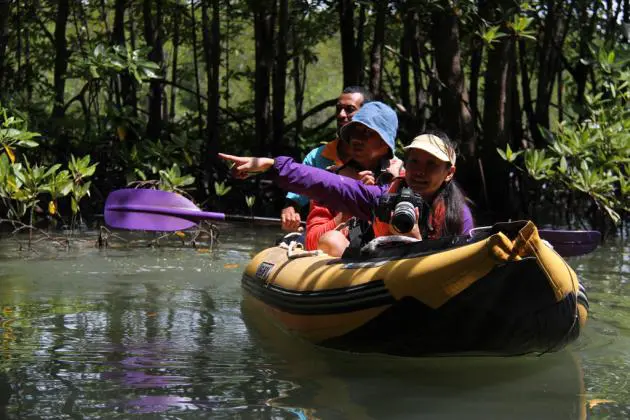
After lunch, we take a sea kayak through the network of mangroves. The villagers take a good care of the mangrove, I observe, making it a veritable Eden for schools of baby fish. Here, in Bang Rong, you experience the sustainable way of life without hearing the word “sustainable”.
“We have agreed upon a regulation when it comes to the wise use of the mangrove,” says the 30-something Muslim, who is showing me around. “For example, you can take a fair share of mangrove vegetation for home repairs, but you cannot cut it for money.
Back on land and with aching arms, we wake up the durian farmer from his afternoon nap. Bang Sem, as he tells us to call him, is happy to have visitors and directs us to his backyard – a sloping durian plantation that stretches all the way to the foothills.
“Take as many as you want,” says Bang Sem, as we look in amazement at the volume of fruit.
This is indigenous durian, recognisable by its tall trees, big seeds, super strong aroma and sharp sweet meat. Unlike the fine monthong and kanyao varieties, this indigenous type is leave to ripen on the tree and fall to the ground on its own. Walking through the durian plantation is an adventure in itself as you have no idea if you will be knocked to the ground by an errant fruit. The best part, though, is trying to break the durian. The last time I tried was perhaps 15 years ago and then only under threat from my girlfriend.
Our last stop is a goat farm where we are supposed to have a go at milking the goats. Unfortunately, when we arrive, the farmer isn’t there. He’s apparently gone to a goat competition at a farmer’s fair. Like the durian farmer, the goats are happy to welcome visitors, immediately tucking into our pants, bags and shirts.
Much to their disappointment, we call it a day and leave, wondering if the denim they’ve chewed will add extra flavour to the milk.
If you go
Bang Rong is about 35 kilometres from Patong Beach and 20km from Phuket’s Old Town. For more information, call (084) 309 9131, email [email protected] or visit www.BangRongPhuket.com.
