
Playing with the pachyderms


Play
Myanmar's white elephants are not just a tourist attraction
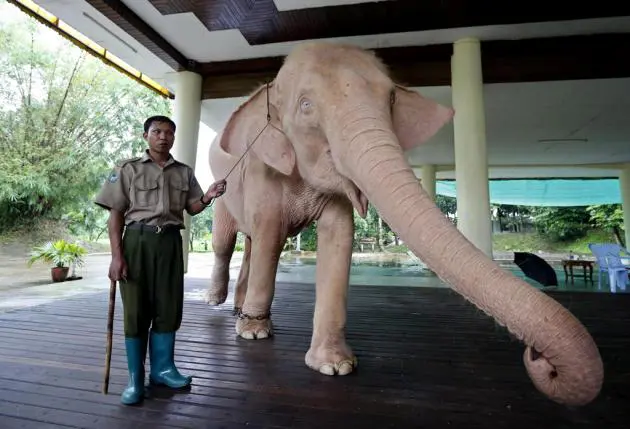
The Royal White Elephant Garden, hidden away in a suburb of northern Yangon, is no common tourist attraction.
Hsin Ppyu Daw Park, off a busy road in Yangon's Insein district, is the pastoral home of three white elephants kept separate from ordinary “black elephants” more easily visited at Yangon Zoo.
The pinkish pachyderms enjoy a bath at 7am and a short perambulation before putting in nine hours a day chained to a stake in a pavilion on public display for tourists. Admission is free.
“Besides people from Myanmar, most of the tourists who come here are from Thailand,” says Khin Maung Win, the park’s chief veterinarian. “Europeans are not so interested.”
For centuries the appearance and capture of a white elephant was deemed auspicious for the rulers of the kingdoms of Southeast Asia and South Asia.
The creature’s rare appearance held religious significance for Hindu or Buddhist kingships.
“White elephants were thought to be one of the attributes of a Chakravartin (a universal ruler),” says Toe Hla, vice-chairman of the Myanmar Historical Commission. “We believe that with the appearance of a white elephant comes peace, stability and prosperity.”
In fact, instead of heralding peace, white elephant envy has prompted several wars between kingdoms, including the Myanmar destruction of Thailand’s ancient kingdom of Ayutthaya in 1767.
Myanmar King Bayint Naung initiated the war when he asked the king of Ayutthaya for two of his white elephants. “When the king refused the request, Bayint Naung invaded,” Toe Hla says.
Given this Myanmar-Thai history, observers were somewhat shocked when Thai Foreign Minister Surapong Tovichaikahaikul asked his Myanmar counterpart for the loan of a white elephant to be put on display at Chiang Mai Zoo in northern Thailand to commemorate the 65th year of the two countries’ diplomatic ties next year.
Last month, the Myanmar government politely turned down the request, while offering to arrange flights for the people of Chiang Mai (Surapong’s hometown) to come to Yangon or Nay Pyi Taw to see the country’s white elephants on their home turf.
“Maybe this will lead to the revival of the elephant wars,” says Toe Hla of Thailand’s diplomatic disappointment with a smile.
Myanmar's former junta (1988 to 2010) and the current pro-military government are known to take their white elephants seriously.
An image of a white elephant, elaborately costumed, adorns the recently minted 5,000 kyat bill.
The picture looks remarkably like Theingi Marlar, one of the three pachyderms residing at the Royal White Elephant Garden in Yangon.
There are altogether seven white elephants in captivity in Myanmar, three in Yangon, and four in Nay Pyi Taw, where they are kept in a similar exclusive garden.
Male tusker Yaza Gaha Thiri Pissaya Gaza Yaza was the first to be captured in 2001 in the Rakhine state, followed by the capture of two female and more much obviously albino pachyderms in the same state in 2002 and 2005.
Not all so-called white elephants are real albinos. Yaza, for example, looks like an ordinary elephant except for his white eyes and pinkish forehead.
Determining which elephants are white is an arcane art, involving the colour of eyes, toenails, tail and genitals and the slope of the back, among other attributes.
Since 2008, three more white elephants have been captured and one was born in the Nay Pyi Taw Zoo.
The former ruling junta organised two military-run operations to hunt down more white elephants in 2008 and 2010 to boost the auspicious collection, according to a Myanmar Forestry Ministry official who asked to remain anonymous.
The pachyderm pact is arguably paying off in terms of political propaganda for the military, still a powerful political force in Myanmar which held its first election in two decades in 2010.
The polls were won by the pro-military Union Solidarity and Development Party (USDP), which is packed with ex-military men.
“Since a white elephant was first captured in 2001, Myanmar has been heading in the right direction,” says veterinarian Khin Maung Win. “Under former strongman Ne Win (1962 to 1988), no white elephants were caught so he was not performing his kingly duties.”
With an election looming in 2015, the ruling USDP has good reason to trumpet its success in amassing pink pachyderms.
“This government is very proud of possessing white elephants,” says Myanmar historian Toe Hla. “It is good advertising, especially among uneducated people.”
