
Charity and the 1,000 cakes


Play
An example of Muslim charity, apem have been distributed to the poor for 150 years
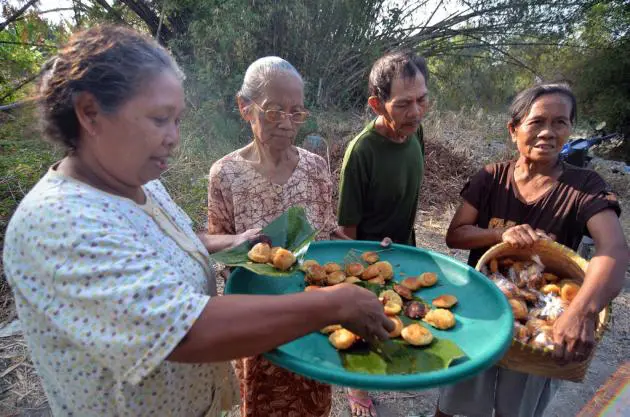
An elderly woman walks along the banks of the Solo River in Kampung Beton in Surakarta, Central Java. She, along with several friends, are on their way to Taman Tempuran and are carrying woven bamboo trays laden with about 1,000 apem, or round rice-flour cakes, and offerings of flowers.
On arrival, the woman, Amung Hartono and her group arrange the apem and flowers beside Tugu Apem Sewu, a demarcation marker on the river bank.
It’s a quiet moment, broken only by the sound of water flowing downstream. The residents joining Amung squat to face the river and the 73-year-old starts to say a prayer.
“It’s a prayer asking for the safety of the people throughout the village,” Amung explains.
The woman then take some of the cakes and throw them into the river. The remainder are grabbed by those watching the procession or given to the residents of nearby Sewu subdistrict.
Kampung Beton is close to the centre of business in the bustling city of Surakarta, often called Solo, and the town is just a few kilometres from the city’s Sebelas Maret University. The apem ritual, which has been handed down through the generations, continues to be observed every 10th day of the month of Zulkaidah, according to the Javanese calendar.
According to Amung, the Wilujengan Apem Sewu (Thousand Apem Distribution Ritual) has been practised for the last 150 years. It was supposedly introduced by Kyai Ageng Gribig, believed by local people to be the founder of Sewu sub-district.
“Before leaving the area, Kyai Ageng Gribig asked residents to perform the tradition on every 10th day of Zulkaidah,” she says. Another participant, Nina Sarwo Sri, 55, adds that every member of the Sewu subdistrict community joined the apem ceremony in the old days.
Gradually, however, the number of participants has declined. The latest observation of the ritual last month involved fewer than 20 people.
Nina is undeterred. “Although few people follow the ritual, it should be preserved,” she says firmly.
People in Kampung Beton dip into their own pockets to make the 1,000 cakes needed for the ritual. “Apem is made of rice flour, palm sugar and fermented cassava,” Nina tells me.
The cakes are renowned as a typical snack of Kampung Beton and the Sewu subdistrict is famous as an apem production centre. According to historian Tundjung W Sutirta at Sebelas Maret University, the tradition is inseparable from the cultural influence of the Mataram kingdom of old. It was introduced by Kyai Ageng Gribig, the son of King Brawijaya V, the last Majapahit monarch, who was himself close to Sultan Agung, the leader of Mataram.
The story, says Tundjung, is that Kyai Ageng Gribig, who was born in East Wasibagno, was on his way to spread Islamic teachings along the Solo River when he reached what would become Sewu subdistrict.
Stopping, Ageng Gribig built a small mosque on the spot and began to tell the local residents about the Muslim religion.
Ageng Gribig gave cakes to the people, telling them that Muslims should give alms to the poor and share their fortune with the less fortunate. The apem symbolised an expression of gratitude to God and a plea for God’s mercy. "The word apem was derived from affan in Arabic, meaning forgiveness," Tundjung says.
The use of apem began to be required by Javanese custom for the ritual – not only in Sewu subdistrict, but in nearby Klaten, Central Java, as well.
There the ceremony is called Yaqowiyu and carried out in the Javanese month of Sapar, as taught by Kyai Ageng Gribig in his sojourn in Klaten.
Meanwhile in Solo, the municipal administration pays particular attention to the ritual. Widdy Srihanto, who heads the local culture and tourism office, says that the Wilujengan Apem Sewu in Sewu subdistrict is part of Surakarta’s intangible cultural heritage. He wants to preserve the practice of the ritual in years to come.
Preservation of the annual event, according to Widdy, is in line with the development of the city, where Solo’s future is reflected in its past glory.
To that end, the Apem Sewu tradition has been livened up by a carnival, although not on the date chosen by Kyai Ageng Gribig.
The carnival was expected to make the general public more familiar with the Apem Sewu tradition, while attracting more tourists to Solo.
“Festivals and ceremonies in subdistrict areas of the city can hopefully promote Solo’s tourism sector,” Widdy says.
“With its multiplier effect, tourism promotion will positively affect local citizens’ economic improvement and empowerment.”
