
Amazing grace


Play
Spending time with the three ladies who make Southern China so special
Over the past few years, I have visited China more times that I care to count and have thoroughly enjoyed new experiences, interesting cultural encounters and, of course, a wide and seemingly endless array of food on each trip.
I think of Hong Kong, Macau and Guangdong, as three ladies sitting gracefully on the Pearl River Delta in Southern China. The first lady is vibrant and fair with more than a hint of British about her, The second lady is contrary, a combination of old grace and modern charm. The third lady, meanwhile, is humble, generous and proud of her culture.
While each is distinct, they are bound together by the Cantonese language and culture. Historically, Hong Kong and Macau were parts of Guangdong before becoming colonies of the United Kingdom and Portugal respectively.
The bustling streets, high rise buildings, neon signs, fashionable shops and the pervading aroma of mouth-watering snacks make Hong Kong a heaven for food lovers and shopping divas. Now, though, she is digging deeper into her local history and arts.
“In the morning, you should walk along the Wan Chai historical trail to explore the local architectural style of Hong Kong. It is quite close to our hotel. Just follow the map and make sure that you have my number in case you need my help,” says our guide, Wing.
Wan Chai is one of Hong Kong’s earliest settlements and was once home to several rich European merchants.
The Wan Chai historical trail was established in 2009 to promote the local culture, history and architectural style of Hong Kong. The trail starts at Mallory Street and ends at Wing Fung Street near Admiralty Station and takes in buildings of historical, architectural and cultural interest. It features 15 historical sites, including the Blue House, Pak Tai Temple and Wan Chai Market.
The highlight is the Blue House, so-named because of the bright blue paint that covers its external walls. It is one of the few remaining examples of Tong Lau, a balcony-type tenement building for residential and commercial use in Hong Kong.
After a self-guided along the Wan Chai trail, we meet up with our group to visit Comix Home Base, a comic museum and the hub for Hong Kong comics.
Wan Chai has long been intertwined with Hong Kong's comic history and prominent artists Tony Wong Yuk-long and Seung-gun Siu-bo actually grew up in the area in the 1960s and 1970s. Comix Home Base marks Wan Chai as Hong Kong's first art community for home-grown comics and animation.
For lunch, we try Dim Sum and Yum Cha, which literally means “drinking tea” and refers to the brunch typically enjoyed by family or co-workers. Cantonese people tend to avoid fried foods early in the day, so steamed dishes dominate the menu and pair perfectly with the hot tea.
“These dim sum have been specially prepared for your group. We have both authentic dim sum and special menus for Muslims and vegetarians, so please enjoy,” Wing instructs us with a smile.
The next morning we say farewell to Hong Kong and board the ferry to meet up with the second of the ladies.
Macau seamlessly blends Portuguese and Chinese culture and its cuisine pays testament to this mix. During the 16th century, the Portuguese established a sea route to the East, paving the way for merchants engaged in the spice trade in Africa, India and the coast of Malacca and bringing in these spices as well as their own culture. Many unique dishes resulted from the spice blends that the wives of the Portuguese sailors mixed in with their cooking in an attempt to replicate European dishes.
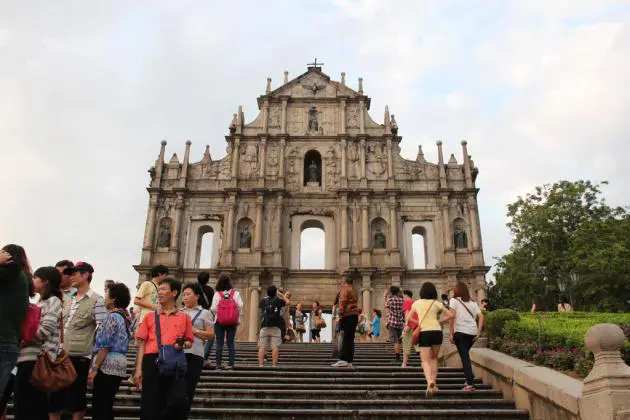
After a satisfying Indian lunch with plenty of vegetarian choices, Esther, our guide for this leg of the journey, leads us to the central area to visit the Ruins of St. Paul's, St. Dominic's Church.
The 16th-century complex including what was originally St Paul’s College and the Cathedral of St Paul was built in 1580 but damaged by fire in 1595 and 1601. Reconstruction started in 1602 and was completed in 1637 and the complex stood up to the elements until it caught fire for the third time when a violent typhoon hit Macau in 1835. The front facade and the grand stone stairs are the only remains of the biggest Catholic Church in East Asia at that time.
A short walk takes us to the late 16th-century Baroque-style St Dominic, the oldest church in Macau
Walking to the end of the wave-patterned mosaic pave way, we arrive at Senado Square, the largest plaza in Macau and surrounded by beautifully preserved historic Western-style buildings.
“This place serves the best Macanese food in town,” says Esther guiding us to the table at a estaurant in the town centre. As seafood, beef and pork are brought to the table, I enquire about the promised vegetarian fare. Esther informs me that there are no vegetarian dishes in Macanese cuisine and quickly places an order for spaghetti.
As a plate of spaghetti in tomato sauce and unflavoured steamed vegetables is placed in front of me, I find myself longing for the scrumptious vegetarian Macanese dishes that were served during my last visit. Still, I assure myself, a new experience is always welcome.
Macau to mainland China is literally a block away and we walk through immigration building leaving Macau behind us and board the bus for the Unesco World Heritage Centre of Kaiping Diaolou and Villages,
Diaolou are high building serve as housing and as protection against bandits and floods. They display a complex and flamboyant fusion of Chinese and Western structural and decorative forms and are a reflection of the significant role played by the migrant Kaiping people in the development of several countries in South Asia, Australasia and North America during the late 19th and early 20th centuries. These Chinese immigrants headed to foreign lands to seek their fortunes and after they became successful contributed to the wellbeing of their ancestral village by building these conspicuous tower houses.
These buildings take three forms: communal towers built by several families and used as temporary refuge, residential towers built by individual rich families and used as fortified residences, and watch towers.
Another 15-minute ride leads us to Li Garden, a landscaped residential estate was built in 1926 by Chinese American, Xie Wei Li. The garden blends harmoniously the elements of Chinese traditional gardening, Southern China water-town style landscaping and Western architecture and is divided into three main areas: grand garden, mansions and small garden. Each area is carefully separated by man-made canals and connected by footbridges and pathways.
The long day ends with dinner with the deputy chairman of Guangdong’s Tourism Administration, Mei Qijie. He seems embarrassed by keeping me waiting for vegetarian dishes and compensates for the oversight by pouring me a copious glass of wine.
Sitting back and supping the fine imported nectar, I swear I can see three beautiful and completely distinctive ladies of Southern China smiling at me.
