
Bays of beauty


Play
A junk holiday offers an intimate brush with Vietnam's remote northern coast
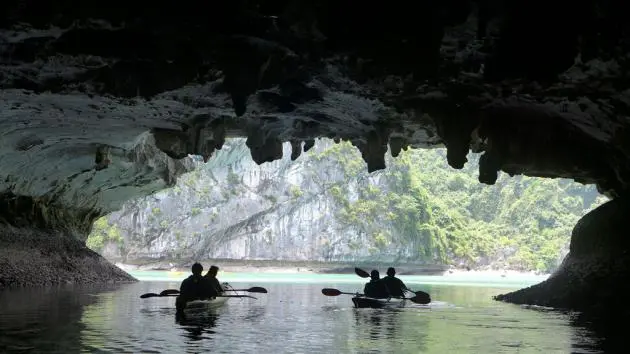
Carefully steering the kayak, we glide close to limestone pinnacles and enter a hidden lagoon where we bob gently, entranced by the magnificent scenery that surrounds us.
I am exploring Bai Tu Long Bay just north of its more glamorous sibling Halong Bay, a Unesco-listed World Heritage Site since 1994.
Both bays belong to the same sunken limestone plateau that stretches to the Chinese border up north – and they are equally beautiful.
Earlier today our 15-cabin cruise ship, the “Treasure Junk” cruised through Halong Bay to the untouched Bai Tu Long Bay, where we will enjoy two days of leisurely kayaking.
Our first day sees us hopping into double-seater kayaks and moving swiftly over the jade-green water.
Kayaking for a couple of hours on placid waves, with breaks, is fairly easy, especially since my paddling partner is a strong Kiwi woman.
Kayaking melds sight, sound and sensation. I love the changing scenes of fantastical limestone spires and islands all around, the incessant sound of waves and crickets, and the sense that we have slipped across a watery border into an Asian myth.
We take a break at a secluded beach and our guide Ngo Trong, 28, starts to tell us stories about dragons and Chinese invaders.
Halong means “descending dragon” and the legendary liberator defended Vietnam from its perpetual enemy, China.
Though China looms over the horizon, it seems far away in isolated Bai Tu Long, which translates, Ngo Trong tells us, as “the dragon parts from its offspring”.
By the time we leave our small island, it is misty in the distance and the evening light has a soft luminosity.
Still, it is not a total idyll here for guests, who include a policewoman and a sheep farmer from Invercargill in New Zealand, and a pianist and lawyer from London.
While the water looks like liquid emerald, swathes of it are polluted. Because our tour operator, Handspan Travel Indochina is community-minded, they ask guests to fish out floating marine debris flowing from the river, shipping vessels or, as some Vietnamese like to allege, from China.
We are industrious and pick up dirty styrofoam, plastic bottles, slippers, toys, sweet wrappers and woefully more, stashing the junk in nets or strapping the chunkier pieces to our kayaks till they look like floating garbage trucks.
Handspan, which has operated in Bai Tu Long for five years, also organises volunteers to do annual clean-ups of this bay, since the authorities focus on scouring famous Halong Bay. The Vietnamese company has si far built 30 schools in Bai Tu Long.
At the break of dawn on the second day, our ship starts its voyage to the centre of Halong Bay and moors there. Again we do not linger in touristy Halong to kayak – a smaller support boat deposits us further south in Lan Ha Bay.
A trio of scenic, shallow bays – Halong, Bai Tu Long, where we kayak the first day, and now Lan Ha – make up the Gulf of Tonkin. Three thousand limestone islands and islets dot the gulf.
Today, in Lan Ha Bay, we glide between some of these sheer, grey limestone cliffs that are splashed with the intense green of creepers and clinging plants.
In many places, the cliffs frame the landscape like colossal doorways. We paddle towards these portals, wondering what other dramatic, drowned peaks lie beyond.
The islands have fanciful names like Frog and Teapot, labelled by local fishermen for their passing resemblance to creatures, objects and phenomena that fill their life.
Caves and secret lagoons abound. Our experienced guide has scrutinised the tide tables, so we will not be marooned inside when the tide changes.
We strap on headlamps to enter our first cave. It is 200-metres deep, but too shallow to paddle beyond 100m or so. We enjoy the silence.
A few minutes later, we hear the voices of locals who have walked deeper inside the cave to collect oysters.
On our third and final morning, we are rowed instead into Vung Vieng, a floating village nestled in a lagoon and under immense cliffs. The fisherfolk live in wildly scenic corners of the bay, sheltered from typhoons.
Vietnamese villagers, thin and strong, row us in bamboo boats under the towering cliffs and out to the blustery sea. We also stop by their floating houses set on plastic barrels and styrofoam.
Neighbours relax over morning tea served in ceramic cups, while dogs patrol each shack. Even the toddlers are sure-footed as they play on the planks.
Our group has come prepared with gifts of exercise books, crayons and snacks for the children, who accept them shyly, one sign that the place is not yet over-run by candy-bearing tourist hordes.
Boats from the mainland collect the fishermen’s catch every day. The villagers also farm shrimp, clams and oysters.
At a little centre run by Vinapearl, a pearl company jointly set up by Vietnam and Japan, we get a primer on cultured pearls.
While I know the basics already, I can now observe how oyster nets are submerged in 1 to 3m of water where plankton is densest.
Only a fraction of pearls meet jewellery standards. Imperfect pearls may be ground into powder for medicine or cosmetics.
Apart from kayaking, we have fun activities on our ship, or close to it. It is squid season so we fish for our calamari at night.
Attracted to lamps on our boat, the squid rise to the bait like tiny apparitions, all silvery, shimmery and elusive. Many times they tug at my fishing line, flail as I pull them in, and plop right back into the water.
We dine on spicy seafood soup fragrant with herbs, steamed shrimp served with sea salt and a squeeze of lime, and Vietnamese drip coffee.
Often, we gaze at the mobile tapestry of pinnacles and waves from the deck or through huge windows in our spacious, air-conditioned cabins. The Treasure Junk cruises at a relaxed pace of 7 to 8kmh.
The bay is full of mystique, and with its legends about a dragon and its babies, allows us to enter a less-known Vietnam.
If you go
_ Ha Long Bay is in northern Vietnam, 170 km east of Hanoi. The bay is famous for its scenic ocean karst topography and is often included in lists of natural wonders of the world. The best time to visit Ha Long Bay is from March to June.
_ For more information, check out www.Handspan.com.
