
An ageing diva in splendid garb


Play
Once the most powerful Greek city in the Mediterranean, Syracuse in the southeast of Sicily if a joy to behold
“Stupido!” comes the first, still pretty harmless curse from Teresa’s mouth. Then, such a cascade of expletives rain down upon the wrong-way driver in front of her eatery that the man forgets to keep driving.
His offence: he nearly ran over her puppy, Billy Boy, and now he’s paying for his inattention with a ravaging by hurricane Teresa.
A good nickname for her would be Dame Etna. Like the volcano Mount Etna, about 100 kilometres north of Syracuse, stocky Teresa, who seems to be round about 60, spews fire and smoke occasionally, but is otherwise rather agreeable.
In her tiny, one-woman shop she fries fish for the tourists who squeeze in to the tables and prepares an excellent caffe freddo, a straight espresso kept in a freezer and served as icy slush, ideal for visitors to the beach at Syracuse when the heat gets too much.
The narrow alleyways of Ortygia, an offshore island that is the oldest part of Syracuse, are a biotope for characters like Teresa.
Scarcely a paddle’s length from each other, the charmingly crooked little houses sprawl over the heritage-protected port quarter, lending each other shade from the scorching Sicilian sun.
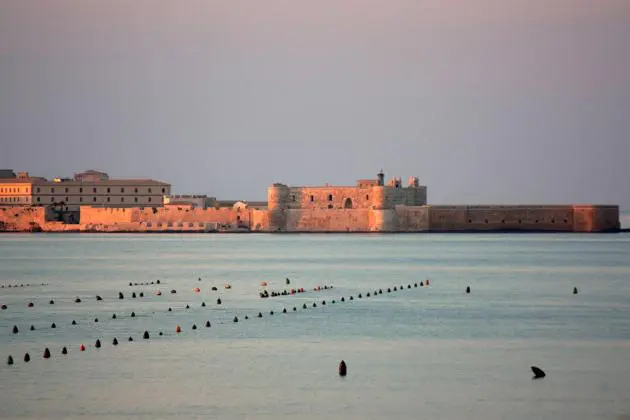
Here in Ortygia, between the massive castle walls of Castello Maniace in the south and the two docks in the north, the Italian way of life wears the splendid but slightly threadbare garb of an ageing diva.
The appropriate ambience for an opera – or an ancient drama.
Visitors to Syracuse can enjoy more staged dramas from May to the end of June in the ruins of the ancient Teatro Greco, an open-air theatre that has the largest seating area in the entire ancient world, around 15,000 seats.
Syracuse was once one of the most important Greek-speaking cities of the Mediterranean.
Traces of the erstwhile greatness of the city can be found everywhere.
The Parco Archeologico della Neapoli, houses, in addition to the Teatro Greco, the Altar of Sacrifice of Hiero II where up to 450 animals were sacrificed on festival days and an amphitheatre.
Another highlight is the “Ear of Dionysius,” a long tunnel carved into the rock. Because of its almost perfect acoustics, the legend is that the 64-metre-long and 20-metre-high artificial grotto was built by the tyrant Dionysius to eavesdrop on his prisoners inside if they should utter any of their secrets.
In the old city, the baroque Cathedral, the Castello Maniace and the Fonte Aretusa are among the tourist magnets. The latter is a fresh water source that gushes only a few metres from the salty Mediterranean beach.
On the beach, Paolo strikes a pose, turning his striking profile to the sun.
Paolo is as proud of his appearance as of the beach, though this is not exactly St Tropez.
Despite his tiny swim trunks, snow-white mane and bronze complexion, he does not look quite like the typical beach-goer. And indeed he is not: He is mingling among the bathers for business reasons.
He operates a few vacation apartments nearby and keeps an eye out for new short-stay tenants.
“A year ago, we built the stairs,” he boasts. “Now we’re bringing the beach back into shape.”
The beach. That’s a bit of shoreline with breakwater boulders, perhaps 50 metres long, at the foot of the imposing city wall. Previously the place, on the east side of Ortygias, not far from the castle, was used as a dump for the rubble from condemned houses.
Now locals and tourists mingle here in the afternoons to take a quick dip or spend half an hour topping up their tans.
Paolo and his public-spirited friends endlessly pick up litter and coloured shards from broken tiles that still poke up from the beach gravel, a reminder of the strip’s previous use. Little by little, Paolo’s beach is becoming more attractive to global travellers.
