
The hidden treasures of Fujian


Play
Known for its clean air and cultural diversity, the province is also home to quaint island getaways, historical neighbourhoods and lively food markets
Though it may not have internationally renowned metropolises, Fujian province in southeast China is filled with cities reputed for their cultural richness and year-round clean air.
According to the China National Tourism Administration, Xiamen, Quanzhou and Fuzhou are the province’s most popular cities this year, with Xiamen the most visited city in the region.
Much of Xiamen’s appeal lies in Gulangyu Island, a 1.87-square-kilometre romantic retreat a ferry stop away from the city’s downtown area. Gulangyu, also known as the “Piano Island”, is home to a number of celebrated Chinese pianists and has the country’s only piano museum, which houses more than 30 antique pianos from around the world.
Tourists will also find historic Western consulates and mansions that served as financial institutions when the island was a leased territory in the early 20th century. The diversity of historical buildings has garnered the island its other nickname, the “Museum of Architecture”.
Cars are forbidden on the island, which allows for a more leisurely walk on the alleys dotted with boutique stores and quaint hotels. At some secluded nooks, it is common to see couples posing for their pre-nuptial photo shoots.
The one drawback is that Gulangyu is nearly always packed with tourists, though there are great spots off the beaten path.
Zengcuo’an, a former fishing village with a laid-back lifestyle, is an ideal getaway to avoid the tourist hordes. Located on the southern coast of Xiamen, the area is filled with quaint alleyways, souvenir shops, pubs and a food market that is reminiscent of the Taiwan night markets.
Must-try dishes include the sausage within a sausage, the oyster omelette and the tusundong, or sea worm jelly. The sea worms are boiled and then cooled to form a jelly. Soy sauce, vinegar and mustard are often added before serving.
Tourists looking to do more than eat and shop can take a stroll on the beachfront boardwalk and experience the gentle breeze.
A city in close proximity to Xiamen that is usually off the traveller’s radar is Quanzhou. Radiating with lovely historic charm, it is famous as the starting point for the Maritime Silk Road and as the largest port in Asia during the Song (960-1279) and Yuan (1271-1368) dynasties.
During the peak of its ancient glory, the city hosted a number of legendary travellers that included Marco Polo and Moroccan explorer Ibn Battuta, who compared Quanzhou to the Egyptian port city of Alexandria.
One important group of foreigners who came to Quanzhou via the Maritime Silk Road during the Tang Dynasty (AD 618-907) were Muslim merchants. A testimony of their clout is the majestic Qingjing Mosque, also known as the Ashab Mosque. It was built to resemble a mosque in Damascus, Syria, in 1009, and it is one of the oldest Arab-style mosques in China.
The 20-metre-high arched gate is made of green granite. Its domes are carved with lotus plants and Arabic scripture. When Islamic preachers followed their trade contacts to Quanzhou, the Ashab Mosque’s worshipping hall became the centre of Islamic prayer in the region.
Although the hall’s large dome collapsed in an earthquake, the open-air, grassy field dotted with gigantic pillars evokes an awe-inspiring sense of solemnity.
For a closer glimpse into the city’s historical and cultural past, take time to see the Wudianshi neighbourhood, aka “Five Shops District”. A 30-minute car ride from the city’s downtown area, the district includes more than 100 traditional buildings from the Song and Ming (1368-1644) dynasties. The buildings were renovated and relocated into the area, part of a project launched in 2012 to resurrect and protect the city’s cultural heritage.
The neighbourhood gets its name from a Tang Dynasty legend that boasts of the first-class dishes and impeccable service of five restaurants owned by a family surnamed Cai.
Walking among the buildings is like walking down the city’s memory lane. Almost all of the traditional houses were built with huge granite slabs mixed with red brick in what seems like an irregular pattern, but which is a distinctive style of southern Fujian architecture. The architectural craftsmanship is illuminated by the Cai Family ancestral hall, the centrepiece of the district.
In honour of the family who operated the five restaurants, the hall has a graceful swallowtail roof ridge that is dotted with intricate carvings of flowers and birds. Vivid brick sculptures of people and time-honoured couplets are inscribed on pillars featuring vigorous cursive script.
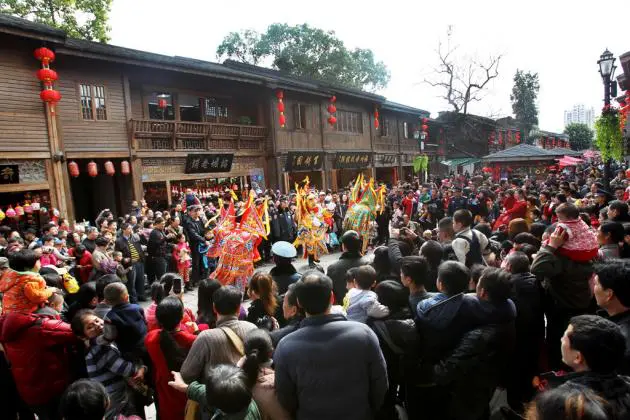
A trip to the provincial capital of Fuzhou would be incomplete without visiting the Three Alleys and Seven Lanes, a century-old neighbourhood criss-crossed by ancient lanes and alleys.
Featuring the architectural complexities of the Ming and Qing (1644-1911) dynasties, the area is known as the “living fossil of ancient city street system”. With Nanhou Street as the neighbourhood’s axis, there are three historic lanes to the west and seven alleys to the east.
The area boasts more than 150 ancient buildings and a majority of them were former homes for prominent historical figures. Qing Dynasty imperial envoy Lin Zexu, regarded as a national hero because of his fight against the British opium trade in Guangzhou, and Yan Fu, a Chinese scholar and translator, all resided in the area.
Fuzhou is one of the hottest cities in the country, so try not to visit in the summer. If you find yourself in Fuzhou under a searing sun, teashops on Nanhou Street serve the local jasmine tea to help you beat the heat.
