
When the cold wind blows


Play
Despite icy winter conditions, no trip to South Korea is complete without visiting some of the country's Buddhist temples
NO AMOUNT of chilly Bangkok weather prepares you for the South Korean winter. It’s not only extremely cold but there’s little moisture in the air, leading tour guides to stress that 30 minutes outdoors really is the limit.
Even full winter accessories, hot drinks and lashings of moisturiser do little to fight counteract the mind-chilling numbness.
It’s trying to snow as we set off on a two-hour journey from Seoul to the Phoenix Park Ski Resort in Pyeongchang in Gangwon province, which is preparing to host the 2018 Winter Olympic Games.
Here, the slopes are full of winter sports enthusiasts as well as snow virgins like us who are happy to put the proffered ski suits on and pose for photos.
“It will be warmer if you ski because you use so much energy. But if you just want to walk around, make it short or you will freeze,” Ju, our guide, warns.
Phoenix Park Ski Resort has become one of Korea’s most famous resorts since it appeared in the popular TV drama “Winter Sonata” in 2002. With a total of 17 slopes, four of which are approved by the FIS (International Ski Federation), the resort is always crowded.
Even with the warm ski suit, I tolerate the cold for less than 30 minutes before heading inside into the warm and the convenience store though for some reason, I end up buying an ice-cream bar.
Our next trip outside the capital takes us to Waujeongsa or Wawoojongsa Temple in Gyeonggi-do. Hidden in the beautiful valley of Yongin, the temple is a serene place surrounded by beautiful scenery and is home to a gigantic Buddha Head, known here as Buldu. Standing eight-metres high, it holds the Guinness World Record for the world’s largest wooden Buddhist sculpture.
Established in 1970 by High Priest Haedeok, a former resident of North Korea, the temple is all about praying for reunification, Waujeongsa is the head temple of the Korean Yeolban Order and home to more than 3,000 sculptures collected from various Buddhist nations. One of the highlights is a three-metre-high and 12-metre-long Reclining Buddha Statue or Wabul made from Indonesian juniper wood.
Walking uphill, the wind is stronger and the weather is getting colder. I shove my hands deep into my pockets and tuck my nose under my scarf as I walk along the temple walls looking at the murals depicting the Lord Buddha’s story. The view from the top is magnificent with heavily wooded forests blanketing the mountains. As I stop to savour the glorious panorama, I think I can hear the biting wind whispering to the shy persimmon trees and suddenly I feel at peace.
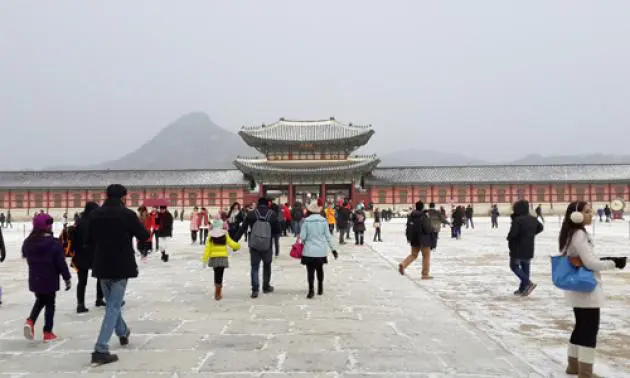
Back in Seoul, we visit the Gyeongbokgung Royal Palace, the biggest of the five grand palaces erected during the Joseon Dynasty. Built in 1394 when the dynasty’s founder, King Taejo, relocated his capital to Hanyang, as Seoul was originally known, the Gyeongbokgung was expanded continuously during the reigns of Taejong and Sejong the Great.
After 40 minutes of sightseeing, we all seek refuge in a coffee shop around Samcheong-dong where traditional hanok-style buildings fraternise with modern art galleries, comfortable cafes and restaurants. After arming ourselves against the elements with coffee and cake, we make our way to Bongeunsa or Bong-eun Temple.
Bongeunsa is a 1,200-year-old Buddhist temple located on the slope of Sudo Mountain in Samseong-dong. The temple, which was originally named Kyongseoungsa, was founded in 794 CE by Yeon-hoe, the highest-ranking monk of the Silla Dynasty during the reign of King Wonseong.
Buddhism in Korea was repressed during the Joseon Dynasty, as the government supported Confucianism. Bongeunsa temple declined but was reconstructed in 1498 under the patronage of Joseon Queen Munjeong. She is also credited with reviving Buddhism in Korea. Bongeunsa became the main temple of the Korean Seon (Zen) sect of Buddhism and remained so from 1551 through 1936.
A fire in 1939 destroyed most of the buildings, and other parts of the temple were destroyed during the Korean War in the early 50s. The temple has undergone many repairs and renovations, and is once again a large complex.
We burn the evening hours away at Myeongdong shopping street, a mere five minutes from our hotel. By now the temperature has fallen well below zero but it doesn’t deter the girls in our group from stocking up on consumer goods.
I have just one item on my shopping list: five eyebrow pencils for a friend’s mother. Soaking in the shopping-crazy atmosphere with two gentlemen in our group, I make tracks towards the street vendor at the end of the strip, my nose twitching at savoury fragrance of boiling rice cake. Tteokbokki, as it’s known, is boiled in Gojujang, spicy chilli paste, and is a perfect for fighting the cold.
IF YOU GO
There are more than 14 flights per day between Bangkok and Incheon. Flight time is around 5 hours 15 minutes.
Taxis and most shops, even |convenience stores, in Seoul accept credit cards. You’ll need to pay cash at the street stalls.
