
Hidden jewel of the Hindu Kush


Play
Chitral in Pakistan's far north offers lush green valleys, snowy peaks and a friendly welcome
WHEN I READ an article in the New York Times last year about the historical valley of Chitral and its inhabitants, a minority tribe known as the Kalash, I knew that I would have to go here and discover it for myself.
The Kalash of Chitral in Pakistan’s Khyber-Pakhtunkhwa province, the Times article informed me, shared DNA fragments with an ancient European population, possibly Greek in origin.
Statistical analysis suggests that this has resulted from interracial mixing between the local populace and Alexander the Great’s army well before 210 BC.
The Kalash, who believe in multiple deities, live in Chitral’s Rumbur, Bumburet and Birir valleys, and speak the Kalasha language, which is derived from the Dardic family of the Indo-Iranian branch.
We chose December for our visit to Chitral, a month well out of the tourist season but one that shows off the mountains at their very best, and travelled from Lahore, a journey of almost 800 kilometres that takes between 11 and 12 hours.
We were joined at Sialkot by a group of young adventurers and almost 24 hours later, entered the small town of Ayun from where we rented jeeps for the bumpy ride ahead. Soon, we were on our way to the mountainous areas of magnificent Chitral.
The scenery, which welcomed us at the break of dawn as we reached the valley, was positively breathtaking with everything covered with a thick blanket of pure white snow.
In contrast to the bitterly cold weather, the Kalash were warm and welcoming and despite being so close to the Afghan border, at no point did we feel unsafe. Indeed, it is considered one of the safest districts in Pakistan and in recent years has become a popular summer destination for local, and often well-heeled, tourists.
After checking in and leaving our baggage at the Foreigner Tourism Inn in Bumburet, we headed further into the valley and at every step were greeted by the locals of the village; all happy to see us and eager to engage us in conversation.
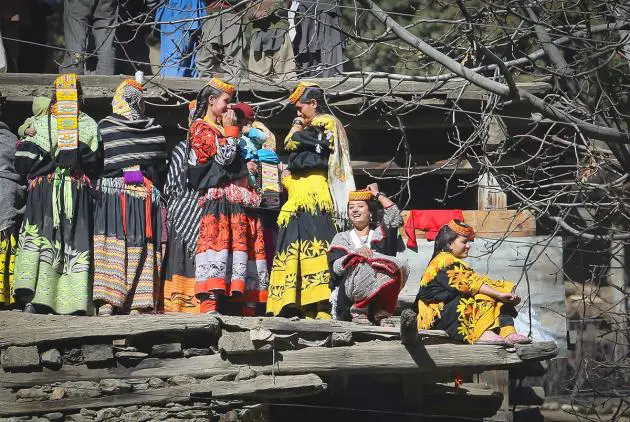
We were particularly entranced by the costumes of the Kalash women – long, black dresses, usually embroidered with cowry shells in vivid colours and which serve as a unique symbol of identity.
The people of the neighbouring Nuristan, a province of Afghanistan, once practised the same polytheist religion as the Kalash minority though by the late 1800as, most had converted to Islam. While this has also happened to a certain extent among the Kalash, those who convert tend to remain in the area and stay faithful to the ancient customs.
We also trekked into a valley from where we could see the Afghan mountains covered with thick sheets of snow. The view was magical and it was hard to imagine how much more beautiful the valley would look in summer or spring, when everything turns a lush green.
Perhaps we will find out for ourselves one day – the visit to Chitral will surely not be our last.
(Umair Siddiqui is a Lahore-based digital designer with a passion for travel and photography.)
IF YOU GO
<Chitral Valley is located in Pakistan’s northwest corner, hemmed in by the Hindu Kush mountains and sharing a long border with Afghanistan. It’s a relatively isolated region, connected to the rest of the country by just two roads over the 3118-metre-high Lowari Pass from Dir and the 3810-metre Shandur pass from Gilgit. Like Pakistanis in general, the Chitral people are friendly and hospitable.
<Travel by road is possible though long.
<Pakistan International Airlines offers four flights a week between Islamabad and Chitral and four between Peshawer and Chitral.
