
Standing at the top of the world


Play
The border pass of Nathu La in Sikkim is well worth the long and often perilous journey up the mountain
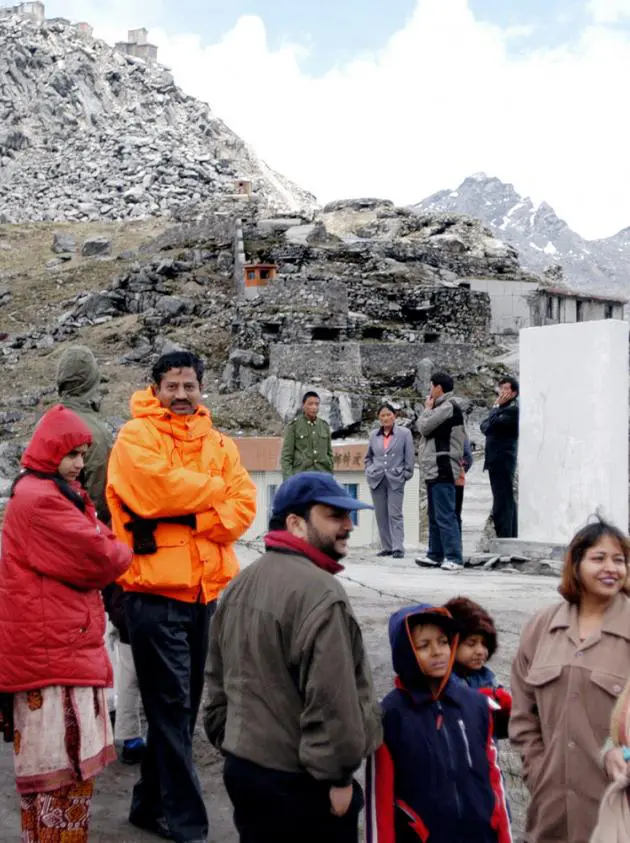
Visiting Nathu LA is nothing less than a pilgrimage, albeit not of the religious kind. At 4,395 metres above sea level, you cannot help but be struck by the history that surrounds this strategic mountain pass that connects the northeast Indian state of Sikkim to the Chumbi Valley in China’s Tibet Autonomous Region.
An off-shoot of the famous Silk Road, the “listening ears pass” or Nathu La is nature, history, beauty and sheer ingenuity all rolled into one.
No amount of preparation gets the visitor truly ready for travel to the historic pass. For an uninitiated visitor like me, it was a trip that opened my eyes wider. The overcast skies only added to the chill when we set off from Gangtok, the capital of Sikkim, in an SUV at 8.30am. The four hours that followed made for one of the most unforgettable trips I have ever undertaken.
Just 54 km from Gangtok, Nathu La was a nodal point for commerce and exchange of knowledge between India, China and rest of the world. If history isn’t what draws attention, the sights are enough to captivate your imagination.
As the stomach churning drive began, the Himalayan mountain range quickly presented its sheer imposing complex edifice. Soon, the roads meandered to sights that made us cling even more tightly to our seats.
At some hairpin bends, the valley below looked like it was good dozen kilometres down. At another turn, a pristine waterfall awakened our visual senses.
Sealed by India after the 1962 Sino-Indian War, Nathu La was re-opened in 2006 following numerous bilateral trade agreements.
Nathu La is one of the two open trading border posts between China and India, the other being Shipkila in Himachal Pradesh.
With the opening of Nathu La as the second route for Kailash Mansarovar Yatra pilgrims in June, the two countries have taken a step ahead in strengthening confidence-building measures.
Our driver, Sonam, told us that the new route has given him more business this year.
A visit to Nathu La is strictly monitored by the Indian Army and it’s open five days of the week, barring Mondays and Tuesdays.
Just as the gorges, valleys and streams began to overwhelm our senses, Sonam made a much-awaited pit stop at a quaint monastery.
With a few shops selling woollens and a few curios, the break from the back-breaking road came as a welcome relief.
Waving good-bye to the old couple there, the journey that resumed was one of sheer awe. As the imposing Himalayas presented their grace, you couldn’t help but feel humbled though the bad road quickly jolted us back to the real world.
When we occasionally stopped to stretch our legs, we were amazed at the sheer silence. After a few more jaw-dropping turns, we reached the Tsomgo Lake (also called Changu Lake).
The azure blue water seemed to freeze time in its tracks. Capturing the skies and the mountains in its reflection, the water body, which covers an area of 60 acres, seemed like a vision from a scenic dream. The locals venerate the lake for its “power” to fulfil wishes.
Another sight that held my attention were the yaks, all lined up to give tourists a ride. Looking straight out of a page from JRR Tolkien, these beasts looked menacing but are actually very gentle. After clicking a selfie, standing at a safe distance from the animals, we began our final stretch to Nathu La.
Through the overcast skies, the glimpses of the Himalayan snowline were literally breathtaking. It was also then that the advice about thin air hit home and our driver warned that the air would get even lighter as we approached the pass.
When we finally reached Nathu La, where the temperature was minus three degrees Celsius, we were chilled to the bone and the camp house at the top provided some much-needed relief.
Champa and her friend who runs the lone tea stall attached to the camp looked like a vision from the heavens as they offered hot tea and momos.
I made it to the foot of the 90 steps that takes tourists to the border fence, with clattering teeth and numb with cold.
For the first time I saw Chinese soldiers in the flesh. They were however non-responsive to our “namaste” and “hello” but the Chinese tourists on the other side waved at us.
When I returned exhausted to my hotel at Gangtok later in the day, I was reminded that the same seven-and-a-half-hour journey I have just completed must have taken the traders using the Silk Route several days.
IF YOU GO
<The Nathu la pass lies on the Indo-Chinese border and is only open to Indian tourists. Special permission must be obtained one day in advance. |The pass is closed on Monday and Tuesday. It also closes in the winter and opens in May.
