
A long and open road


Play
There's no better time to visit New Zealand than the winter
Known in the Maori tongue as Aotearoa or “the land of the long white cloud”, New Zealand – and especially North Island – enjoys a wonderfully temperate climate even in the winter.
From now to September, winter in the Southern hemisphere, is the best time for “tropical plants” like Thais to escape the wet season at home and revel in the exceptional landscape for which the country is justifiably famous. Adding to the pleasure is the fact that the summer’s pricey attractions are quiet and the ticket prices low so you get to experience a range of highlights that the summer holidaymaker never sees.
The best way to explore New Zealand is through a self-drive holiday. With postcard-perfect views all around, renting a car allows you to enjoy scenic stops on your own terms.
One of the most unforgettable driving routes on North Island is the Pacific Coast Highway, which as the name suggests, takes you along the Pacific Ocean for 1,170 kilometres from Auckland to the eastern port of Napier. The trip offers majestic coastal views and several must-stop locations for you to take photos to share with your friends.
Jumpstart your trip from Auckland on State Highway 2, connecting to State Highway 25 towards The Coromandel. This region is a centre of tourist attractions and outdoor activities much loved by Kiwis.
Here are some of most famous stops for you to visit.
Cathedral Cove – a symbol |of The Coromandel
Put Cathedral Cove on your bucket list when you visit The Coromandel, as this is one of the most photographed locations. An arched cavern standing majestically against a backdrop of white sandy beach and clear water, it makes for a distinctive sight. There are two ways to get here, by foot or by boat. The roundtrip walk takes around one-and-a-half hours but the stunning view is worth every step. Otherwise you can enjoy Cathedral Cove from a sea kayak, which is a highly recommended activity while you’re in New Zealand.
Hot Water Beach – a natural hot spa on the beach
A 10-minute drive from Cathedral Cove, naturally heated mineral water bubbles up from within the earth to emerge through golden sand at the appropriately named Hot Water Beach. The air temperature may be cool in winter, but the water is always hot. Bring a spade or shovel, or rent one from a store, to dig your own spa pool in the sand when the tide is low while enjoying the sea view and listening to the ocean waves.
Once your batteries are recharged, head back on the road to State Highway 25 for the Bay of Plenty. This region is home to spectacular beaches and New Zealand’s only active marine volcano.
Mount Maunganui – second-most-shared spot on Instagram
Mount Maunganui has long been the Kiwis’ favourite beach town and was listed as the second-most-shared spot on Instagram in 2015. If you want a legendary shot of the town, take a hike up “Mauao”, a peak 232 metres above sea level. The walk to the top takes around 30-45 minutes depending on your fitness. Huge views of the harbour, beach and Pacific Ocean will make the effort totally worthwhile.
White Island – thrills on a marine volcano
Only 87 kilometres from Mount Maunganui to the south towards Whakatane, you will reach the start of a journey to White Island, New Zealand’s only active marine volcano. Sign up for a walking tour of the island, which is about two kilometres in diameter and rises to 321 meters above sea level. Your experienced guide will lead you close to roaring steam vents, bubbling pits of mud and hot volcanic streams with a distinct smell of sulphur.
Gisborne – the first and the longest
Further south on State Highway 35 is the East Cape, the easternmost region of New Zealand. Gisborne, the largest settlement in the region, is home to “the first and the longest” spots for you to check in and share with your friends.
East Cape lighthouse – watch the sun’s first rays of the day
Gisborne is the first city in the world to see the sun each morning and there is no better place to watch the first light than at the historic East Cape lighthouse which stands 154 metres above sea level at the easternmost point of the country. The trek to the lighthouse is all uphill but worth every one of the 700 steps as you’ll be treated to an unbeatable view of the rugged surrounding coastline.
Tolaga Bay Wharf – New Zealand’s longest wharf
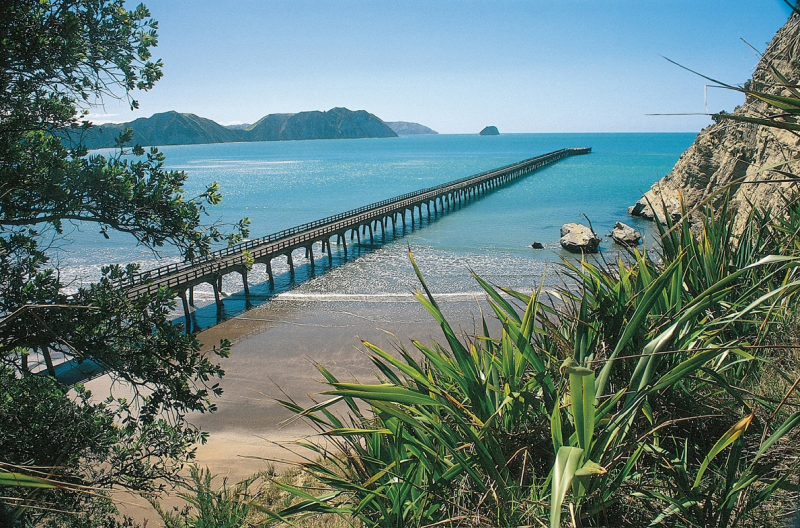
Another 114 kilometres down the road from the East Cape lighthouse is Tolaga Bay Wharf, stretching 660 metres in length, which makes it the longest wharf in the country. Allow half an hour to walk to the end and back and remember to take your swimsuit. Adrenaline junkies can jump off at the end of the wharf and swim back to the shore. This place is also an ideal spot for catching fish.
Hawke’s Bay – fine wine |and tasty food
Hawke’s Bay is a famous wine-growing region and also home to New Zealand’s oldest operating winery. With a climate similar to Bordeaux, the region is one of the country’s leading producers of wine, especially reds. More than 30 wineries are open for wine tasting with many offering restaurant-dining of fresh, locally grown ingredients.
Napier – a place where |time stands still
After a devastating 1931 earthquake destroyed buildings in the centre of Napier, the town was rebuilt in “Spanish Mission” and Art Deco architectural styles that focused on geometric shapes. This resulted in Napier becoming one of the cities with the highest concentration of Art Deco buildings in the world. Some iconic buildings you shouldn’t miss taking selfies against are the T&G Building and the National Tobacco Company Building. The time you spend absorbing the vintage beauty of the buildings will make you feel as if time is standing still.
IF YOU GO
Thai Airways International operates flight from/to Bangkok and Auckland – a gateway New Zealand’s North Island.
