
Take a Little Salt …


Play
Despite the violence in the deep South, Tak Bai in Narathiwat is well worth a visit if only to taste its threadfin
Tucked away in Narathiwat, Thailand’s southernmost province, the name Tak Bai has sadly become synonymous with the tragic incident in 2004 that claimed more than 80 lives. More recently, a bomb exploded in front of a school, killing two innocent people, one of them a child. Those events, as well as the ongoing violence in the country’s southernmost provinces, understandably keep the tourists away and that’s a shame as this coastal district of Narathiwat has a much more beautiful, not to mention flavourful, side to share with visitors.
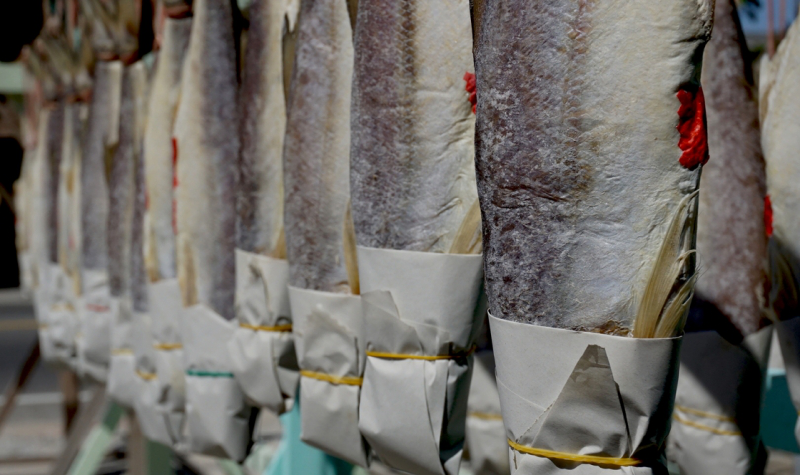
Take Tak Bai’s sun-dried salted threadfin fish, for example. It’s said to be the equivalent of bacalhau, a Portuguese speciality. A slice of deep-fried threadfin is delicious … and expensive.
“A small threadfin costs around Bt1,500 per kilogram, while a big fish can go up to Bt1,800 a kilo,” says Or, the owner of Or Yungthong Pla Ku Lao shop in Tak Bai.
That works out to a slice of deep-fried threadfin costing around Bt200. That’s insane, especially when compared to a bigger piece of sun-dried salted seer fish.
But then the threadfin is way more delicate than the seer fish.
Known as pla ku lao among fishmongers in Thailand, the threadfin can only be found in the Gulf of Thailand. The Andaman Sea side is out of luck. The fish is silvery grey and lives in brackish water. It was once found just south of Bangkok where Chao Phraya River flows into the Gulf but pollution in the estuary chased it away. Today you can find the threadfin along the East coast from Phetchaburi down to Songkhla and Narathiwat.
The threadfin has a firm flesh and a mild flavour. Westerners would almost certainly halve the fish and fillet it before pan-frying in olive oil and butter. The Chinese, on the other hand, leave the fish to dry in the sun.
Like Pattani, Yala and other parts of Narathiwat provinces, Tak Bai is home to a sizeable Chinese community, who made their home among the local and aboriginal Muslim people several hundred years ago. When the Hakka Chinese left their ancestral “circular houses” in Southern China in the 16th Century, and braved the South China Sea to start new lives in Southern Thailand, they brought their recipes along with them.
Tak Bai’s salted threadfins, though, are more of the Cantonese school of cooking. The fish is kept whole and the guts and entrails are removed delicately through the mouth using hooks. The fish is then stuffed with a handful of salt and left hanging upside down to dry in the sun for a week or two. And they look surprisingly beautiful.
“It’s not every threadfin that can be made into a salted fish as aesthetics play a part too,” says Manthana Phoothararak, director of the Tourism Authority of Thailand’s Narathiwat Office. “The locals sort out the fish and select only threadfins whose skin has been neither cut nor broken. Makes sense as otherwise the flies would find their ways into the fish.”
Families in Tak Bai have their own recipes and many of them are well-kept secrets.
“Usually they give threadfins a “massage” by rolling the fish with a bottle and sprinkling them with a condiment made of honey and other ingredients,” adds the director. “That makes Tak Bai’s salted threadfin more special than those found in other parts of Thailand.”
Nat Phop Yung Thong restaurant is the best place to enjoy the authentic sun-dried salted threadfins.
The restaurant is famous for Southern cuisine, boasting dishes like hot-and-sour “yellow curry”, pan-fried liang leaves with egg and young coconut shoots and shrimp in salty coconut soup. For the sun-dried salted threadfins, the cooks cut the fish into thin perpendicular strips before deep-frying. The brownish deep-fried threadfin is served with sliced shallot, bird’s eye chilli and half a lime. The fish is flavourful with a unique combination of salt, sweet and fermented insanely good! And as the fans of Southern food will know, fresh vegetables, fried egg and “boo doo” paste are the perfect accompaniment to the deep-fried salted threadfins.
“Threadfin is Tak Bai’s real delicacy,” says Manthana.
Buyers of salted threadfins don’t usually eat the fish themselves, say the folks in Tak Bai, and eaters of salted threadfins don’t usually pay for themselves. The salted threadfins are too delicate – and much too expensive.
IF YOU GO
< Thai Smile and AirAsia operate flights between Bangkok and Narathiwat. The southern province is noted for 300-year-old Taloh Manoh Mosque, Wat Cholthara Singhe, Chao Mae Tomo Chinese Shrine and the |pristine beach of Ao Manao.
