
Bangkok Noi Leads the Way in Waste Separation as Air Quality Concerns Rise
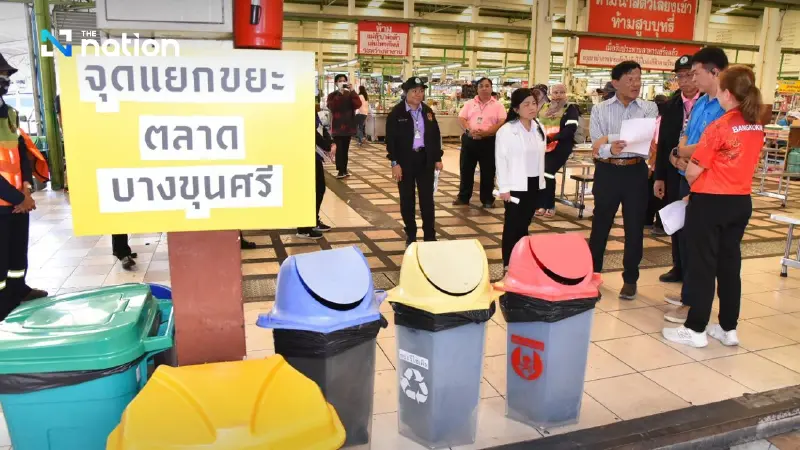


As Bangkok grapples with urban waste management challenges, one district is emerging as a model of environmental responsibility.
Bangkok Noi has transformed Bang Khun Si Market into a benchmark for waste separation, demonstrating how systematic efforts can significantly reduce waste generation. Meanwhile, local authorities are closely monitoring PM2.5 pollution from a major hospital construction site, highlighting the city’s broader environmental concerns.
On March 4, 2025, Deputy Bangkok Governor Chakkaphan Phewngamled an inspection of Bang Khun Si Market on Charan Sanitwong Road, a 3.1-acre commercial hub that serves 500-600 visitors daily. The market has been engaged in a structured waste separation initiative since 2018, classifying waste into four key categories:
- Organic waste – Collected separately and provided to farmers for livestock feed.
- Recyclable materials – Sorted and sold by vendors, offering an additional source of income.
- General waste – Collected on a scheduled basis by municipal services.
- Hazardous waste – Isolated and disposed of under strict safety protocols.
This initiative has yielded measurable improvements. Prior to implementation, the market generated 1,200-1,300 kg (2,645-2,865 lbs) of waste per day. Through effective waste separation, this volume has been reduced to 1,000-1,200 kg (2,200-2,645 lbs). Additionally, the initiative now recovers 10-15 kg of recyclable materials daily, 50 kg of organic waste per day, and 3-5 kg of hazardous waste per month.

Deputy Governor Chakkaphan commended the program’s success while urging vendors to further refine their sorting methods, noting that improved waste separation could help lower municipal waste disposal costs and enhance the city’s long-term sustainability efforts.
Beyond waste management, authorities are increasingly concerned about PM2.5 fine dust pollution emanating from the Piyavate 2 Hospital construction site on Wang Lang Road. The development, which includes two medical buildings of 10 and 12 stories with an underground floor, is subject to stringent regulatory oversight under Thailand’s Building Code Ministerial Regulation No. 4 (1983) and its updated Regulation No. 67 (2020). Additionally, the project must comply with environmental protection measures outlined in its Environmental Impact Assessment (EIA).

Deputy Governor Chakkaphan issued specific directives to mitigate dust emissions:
- Continuous operation of water spray systems to suppress airborne dust during construction.
- Regular replacement of water in tire-washing pits to prevent the spread of debris onto public roads.
- Installation of PM2.5 monitoring devices and real-time air quality displays at the construction site entrance.
- Routine inspections of construction vehicles to ensure compliance with national emission standards.

To further address these concerns, Bangkok Noi District has formulated comprehensive inspection plan targeting construction sites, landfill operations, and sand depots that contribute to air pollution. Public awareness initiatives are also being implemented to educate residents about PM2.5 exposure risks and preventive measures.
In addition to environmental monitoring, Deputy Governor Chakkaphan reviewed plans for infrastructure improvements and the regulation of street commerce within the district.
- Revitalization of Wang Lang 1 Alley: The district will undertake a major sidewalk and drainage system upgrade in Wang Lang 1 Alley, a high-traffic commercial corridor. The project, scheduled for April-May 2025, is designed to improve pedestrian safety and urban drainage.
- Enforcement of Street Vendor Regulations: With 376 licensed vendors operating in five designated trading zones, local authorities are reinforcing compliance with updated 2024 street vending policies. Meanwhile, unauthorized vending sites in 13 locations have already been cleared, with an additional five zones slated for closure in 2025 as part of the district’s ongoing urban management efforts.

The district is also accelerating efforts to expand public green spaces through its 15-minute park initiative, ensuring that residents have access to urban parks within walking distance. A key development in this initiative is the Phra Thep Road Park, which will feature landscaped gardens, walking trails, and recreational areas for public use.

Deputy Governor Chakkaphan has directed municipal officials to identify and assess additional vacant land parcels for potential park development, reinforcing the city’s long-term commitment to sustainability and urban livability.
As Bangkok Noi continues to modernize, city officials are faced with the challenge of balancing economic development with environmental sustainability. From pioneering waste separation at Bang Khun Si Market to enforcing stricter air quality regulations at construction sites, the district is taking proactive steps to address Bangkok’s urban challenges.

These initiatives underscore a broader vision for the city—one where urban expansion is accompanied by responsible environmental stewardship. Bangkok’s skyline may continue to rise, but its future depends on how well it manages the challenges on the ground.


