
Bangkok Bets on Pride: The City That Lets You Be Yourself


A grassroots movement born on a single Bangkok street three years ago has grown into a national coalition — and now a formal bid to host the world's largest LGBTQ+ celebration
- Bangkok has launched a formal bid to host WorldPride 2030, leveraging its reputation as a safe and welcoming city for the LGBTQ+ community.
- The bid originated as a grassroots movement following a successful 2022 pride parade and is now supported by a broad coalition of community organizers and government officials.
- Organizers frame the campaign as an effort to inspire LGBTQ+ rights across Asia, positioning the event as more than just a tourism opportunity.
- Bangkok is competing against Barcelona for the hosting rights, with the winning city to be announced in January 2027 after a vote by InterPride's global members.
A grassroots movement born on a single Bangkok street three years ago has grown into a national coalition — and now a formal bid to host the world's largest LGBTQ+ celebration.
For decades, people have been flying to Bangkok for the same quiet reason: to simply be themselves. They come from countries where being who they are carries a social cost — sometimes a legal one — and they stay for as long as they can before returning to more restricted lives.
It is this reputation, built not by government decree but by the accumulated welcome of a city, that now sits at the heart of Thailand's bid to host WorldPride 2030.
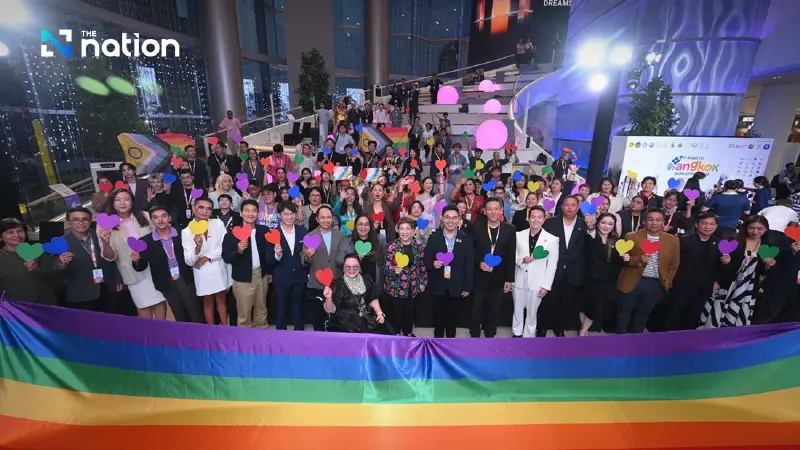
On Wednesday evening, a broad coalition of government ministers, city officials, civil society leaders, and community organisers gathered in Bangkok to formally announce the full weight of Thailand's campaign – and to make the case that the bid is about far more than tourism receipts.
"The goal is to inspire all of Asia to rise and fight for their rights," said Ann "Waaddao" Chumaporn, a prominent Thai LGBTQ rights activist and co-founder of Bangkok Pride who has been involved in the movement since its earliest days. "Until everyone's shackles are gone."

From a Street Parade to 42 Provinces
The story of how Bangkok came to be bidding for the world's most prominent Pride event begins not in a government ministry but on Silom Road on 18th July 2022, when the city held what many describe as its first truly successful Pride parade.
The energy generated that day did not dissipate. It multiplied.
What followed was the formation of the Pride City Network — a grassroots coalition that has since spread across 42 provinces. The network's organisers are not, for the most part, event professionals.
Many come from HIV/AIDS advocacy, sex worker rights organisations, and land rights campaigns. Their approach, which they describe as "Creativity as Action," fuses entertainment with protest in a way that has proven remarkably durable.
"We blend entertainment with protest," Ann explained, "to communicate in a way that makes it difficult to suppress."
It was this community energy — not a top-down government initiative — that eventually convinced Thailand's institutions to get behind the bid. Since Bangkok first announced its intention to pursue the hosting rights in March 2026, the campaign has assembled an unusually broad alliance.
Support spans multiple administrations and political parties, a degree of cross-party unity that speakers at Wednesday's event described as rare in Thai public life.

The Road to January 2027
Bangkok is not alone in the running. The city faces competition from Barcelona in what will be a closely watched contest decided by votes from InterPride's global membership.
The process is already under way. Thailand's committee has submitted its first formal proposal to the WorldPride Committee, which is currently reviewing it. Feedback is expected by 31st May 2026. The Thai committee will then revise and resubmit by 30th June.
The decisive moment will come in late October, when Bangkok and Barcelona will each present their final proposals at the InterPride World Conference – which Thailand is itself hosting in Phuket.
Two weeks after those presentations, voting will open globally. The result will be announced in January 2027. The Phuket conference is widely regarded as the bid's single most important strategic asset.
Dr Supawan Teerarat, director of the Thailand Convention and Exhibition Bureau (TCEB), described hosting the conference as a "proof of concept" – a chance to demonstrate, before the vote, that Thailand has the infrastructure, hospitality, and organisational capacity to deliver an event of WorldPride's scale.
Parallel lobbying efforts are also planned at WorldPride events in Amsterdam, where Thai representatives will make their case directly to InterPride members.

The Numbers Behind the Vision
The economic argument for the bid is substantial. TCEB projects that WorldPride 2030 would generate approximately 24 billion baht in economic impact, attract more than one million visitors, and create tens of thousands of jobs.
But Dr Supawan was keen to frame the event as something larger than a revenue opportunity.
"WorldPride is a platform to transform the city, the economy, and the industry," she said. "The best of the best experience of Pride is at Bangkok Edition."
Deputy permanent secretary Natthira Phaegkhun of the Ministry of Tourism and Sports outlined a three-pronged strategy to win the rights: raising global awareness of Thailand's recent legislative progress in order to position the country as a hub of diversity; leveraging Thai soft power to create shared cultural experiences; and implementing practical facilitation measures, including fast-track visas, airline partnerships, and specialist hotel rates.

"A 1% Gap" That Still Needs Closing
Waaddao was candid about the limitations of Thailand's current legal landscape. While the passage of marriage equality legislation was celebrated as a landmark achievement, she pointed to a "1% gap"—the absence of a Gender Recognition Act necessary to provide full legal protection and recognition for transgender and gender-diverse individuals.
Dr Anekchai Rueangrattanakorn, an adviser to the Minister of Social Development and Human Security, said his ministry's role in the bid was to ensure that "no one is left behind."
He acknowledged that the next four years must be spent building broader social understanding and conducting risk assessments — particularly regarding the intersections of LGBTQ+ identity with religion and ethnicity.
"This is not only about marriage equality," he said. "It is about a place where every love is accepted with dignity and equal rights."
Deputy Governor Sanon Wangsrangboon of Bangkok highlighted the city's recent Gold Award for Gender Equality from the United Nations Development Programme, noting that Bangkok's score on the relevant index had risen from 8.8 per cent to 94.8 per cent following recent legal and social progress.
He also outlined physical preparations underway in the city: AI-integrated CCTV systems being deployed in the Pathum Wan district, Universal Design initiatives to improve accessibility along transit corridors and in smaller residential alleyways, and work with the private sector to embed diversity, equity, and inclusion practices in hotels and tourist venues.
"Born as we are is not wrong," he said, quoting a Thai poem. "Do not be tired of pretending to be someone else. Be proud to be Bangkok."

Why It Matters Beyond the City
Beneath the logistical detail and economic projections, the bid carries a message that its architects clearly intend to resonate well beyond Thailand's borders.
The LGBT acceptance of a city or nation, several speakers argued, is not merely a social indicator — it is a measure of the health of its democracy.
"If the state can accept gender diversity," Ann said, "it will lead to the acceptance of diversity in culture, local identity, and social class."
Whether that argument is enough to secure the votes of InterPride's global membership over Barcelona remains to be seen. But for the hundreds of community organisers across 42 Thai provinces who built this movement street by street, the bid itself is already a kind of victory – proof that the city where so many people once came simply to breathe has decided to breathe a little louder.
The WorldPride 2030 vote will be announced in January 2027. Thailand's revised bid proposal is due to be submitted to the WorldPride Committee by 30th June 2026.
