
Legal Reform or Lost Opportunity: Bangkok Pride’s Heartfelt Plea to Government Over WorldPride 2030


Organisers say legal equality — not just a spectacular parade — is what will determine whether Bangkok beats Barcelona to host WorldPride 2030
- Bangkok Pride organizers are urging the Thai government to pass key equality laws, warning that the city's bid to host WorldPride 2030 is at risk without them.
- The success of the bid against competitor Barcelona is seen as dependent on substantive legal reform for the LGBTQIAN+ community, not just the spectacle of a parade.
- Three specific legislative priorities were highlighted: a gender recognition law, amendments to the Marriage Equality Act, and legal protections for sex workers.
- Advocates argue that while Thai society is progressive, its laws have lagged behind in protecting LGBTQIAN+ rights, a gap that could undermine the WorldPride bid.
- With the final decision against Barcelona set for October, there is an urgent call for legislative action as international assessors will heavily scrutinize the legal environment.
Organisers say legal equality — not just a spectacular parade — is what will determine whether Bangkok beats Barcelona to host WorldPride 2030.
Organisers of Thailand's flagship LGBTQIAN+ celebration delivered a pointed message to the government on Thursday: legal reform is not optional.
Speaking at a press conference in Bangkok to announce the Bangkok Pride Festival 2026, Waaddao — Ann Chumaporn, chief executive and founder of Naruemit Pride, urged legislators to accelerate a suite of outstanding equality laws, warning that without meaningful legal progress, Bangkok's ambition to host WorldPride 2030 could be undermined before it even reaches the finishing line.
"Countries competing against us are all making legal advances," Chumaporn told the press conference. "If we want to demonstrate our potential and generate economic returns and tourism for the country, the legislative dimension is crucial."

She pointed specifically to three priority measures: a gender recognition law, outstanding amendments to the Marriage Equality Act — which, while historic as ASEAN's first, still requires complementary legislation on parenthood and nationality — and legal protections for sex workers that would bring them within the framework of labour law rather than criminal statute.
The remarks carry particular urgency because Bangkok is currently in formal competition with Barcelona to host WorldPride 2030.
The final adjudication will take place in Phuket in October, and organisers are acutely aware that international assessors will scrutinise the legal, social, and infrastructural environment of the bidding city — not merely the spectacle it promises to deliver.

'Our Society Is Progressive, Our Laws Must Follow'
Sanon Wangsangboon, deputy governor of the Bangkok Metropolitan Administration (BMA), spoke candidly about the historic paradox that has defined Thailand's relationship with its LGBTQ+ community.
"Thailand has long run counter to the global trend," he said. "We have a society that is open and welcoming of gender diversity, yet laws that have lagged behind in protecting the rights and freedoms of those very people."
Quoting Shakespeare — "What is the city but the people?" — the deputy governor argued that a city's worth is measured by how well it cares for those who live within it.
He reflected on the shift that has taken place over four years of sustained advocacy, which culminated in same-sex marriage registration becoming a legal reality in January last year.
"That answered the question of whether Thai law was still falling behind. Our society is progressive, and now our law is too. But there is still much to do," he said.
Sanon identified a number of areas where inequality persists in practice despite legislative progress at the national level: school regulations that are not yet sufficiently inclusive, civil service rules that do not treat all genders equitably, and gaps in DEI implementation across both public and private sectors.
Surveys conducted within Bangkok, he said, had found that teachers still encountered regulations within schools that fell short of full equality — a finding that underscored the gap between law on the books and lived experience.
The BMA is now developing a DEI accreditation scheme to encourage private sector participation in equality efforts and is exploring plans for a dedicated Pride museum — a permanent institution to document the decades-long journey of Thailand's LGBTQ+ movement for the public record.
"WorldPride 2030 cannot succeed if this city is not equal enough," Sanon said plainly. "The BMA wants to walk this path together with everyone."

A Strategic Alliance to Build Bangkok's World Pride Bid
Alongside the calls for legal reform, Thursday's press conference marked a significant institutional development: the signing of a formal Memorandum of Understanding between Naruemit Pride, the Thailand Convention and Exhibition Bureau (TCEB), and King Mongkut's Institute of Technology Ladkrabang (KMITL).
The three-way agreement commits the parties to jointly developing a "Pride Digital Platform" — a data and innovation infrastructure that will serve as the technical backbone of Bangkok's WorldPride 2030 application.
The collaboration is a deliberate signal to international assessors that Bangkok's bid is grounded in institutional credibility rather than civic enthusiasm alone.
Assoc Prof Dr Chumphon Moorapun, Dean of the Faculty of Architecture, Art and Design at KMITL, described the platform as a vehicle for demonstrating Thailand's capacity on a global stage.
"This platform of diversity not only reflects the values of an open society, but presents an opportunity to generate economic power through the creative industries, tourism, and cultural activity," he said, noting that such tools could create sustainable income and a positive international image for the country.

TCEB's involvement is particularly significant given the agency's remit across Thailand's MICE sector — meetings, incentives, conferences, and exhibitions — lending the bid the weight of an established government body with deep experience in hosting large-scale international events.
Together, the three partners embody the "PEACE • PEOPLE • PRIDE" vision under which Bangkok's WorldPride ambitions are being pursued.
Waaddao framed the MOU in explicitly competitive terms.
"From our first steps as a movement on the streets, today we have leaped forward to become a global event leader," she said. "This strategic collaboration represents equipping ourselves with innovation to firmly place WorldPride on Thai soil and to prove that diversity is a true driver of economic and social progress."

Bangkok Pride Festival 2026: Five Days of Forum, Awards, and Parade
The practical centrepiece of all this ambition takes shape on Silom Road on 31 May, when the Bangkok Pride Festival 2026 — organised under the theme "Patch the World with Pride" — will transform one of the capital's most storied commercial thoroughfares into what organisers are billing as a historic celebration of equality.
A rainbow flag stretching over 300 metres will be laid the full length of Silom Road, a gesture that is as much a statement of intent to international observers as it is a moment of civic joy.
The festival, which runs across five consecutive days, is structured as an integrated programme spanning the full spectrum of advocacy, policy, culture, and celebration.
The Bangkok Pride Awards on 28 May will honour individuals and organisations that have served as exemplars of diversity and inclusion.
Running from 28 May through 1 June, the Bangkok Pride Forum will provide a policy-level arena for dialogue on rights and equality — a crucial element in demonstrating to WorldPride assessors that Bangkok's engagement with LGBTQIAN+ issues extends beyond the performative.

The centrepiece, the Bangkok Pride Parade on 31 May, will follow a 4.8-kilometre route from Khlong Chong Nonsi Public Park through Silom, past Sala Daeng Intersection and Henri Dunant Road, and on to Rama I Road — a route that traces the very origins of Bangkok Gay Pride in 2002 whilst meeting the distance standards set by international WorldPride events in cities such as New York and Washington, D.C.
The parade culminates at Thephasadin Stadium, where a Pride Stage will feature a landmark collaboration with Rabieb Wataslip, a celebrated molam troupe, fusing Thai cultural heritage with the human rights movement in a combination designed to leave a lasting impression on a global audience.
Attendance figures reflect a festival that has grown with remarkable speed. From 100,000 participants in 2023 to over 250,000 in 2024 and more than 350,000 in 2025, the organisers are anticipating yet another record turnout this year — and are targeting a place among the top ten Pride destinations in the world that people most want to attend.

Drag Bangkok Festival and the Rise of Thai Drag Culture
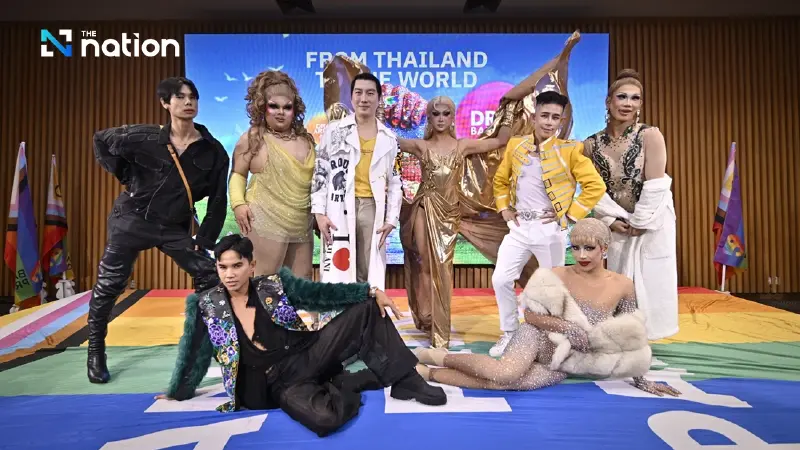
Running in parallel with the main festival, the DRAG BANGKOK Festival 2026 and Thailand's Drag Star 2026 — organised by Yellow Channel — will amplify the programme across the full month of June.
Phat Lertsukittipongsa, director of Yellow Channel, described a community that has evolved from domestic novelty to international recognition.
DRAG ARENA, the company's proprietary competition format, has already expanded to Taiwan and Malaysia, with events planned for the Philippines and Singapore. DRAG ARENA Asia will bring together contestants from eight countries across the region.
"All of this reaffirms the potential of Thai drag artists and marks another step forward in the growth of the drag community," Phat said, noting the expected ripple effect across the creative economy.

The Stakes: Bangkok Versus Barcelona
The backdrop to all of this is a competition whose outcome will be determined in Phuket in October. Bangkok's bid for WorldPride 2030 places it in direct contest with Barcelona — a city with an established international Pride tradition and the infrastructure to match.
For Bangkok to prevail, organisers and city officials are in agreement that the spectacle of one parade, however grand, will not be sufficient. Legal reform, institutional collaboration, DEI integration across public and private life, and a credible digital platform for event management must all be in place.
Sanon summarised the challenge with characteristic directness: "WorldPride 2030 will not happen if everyone does not come together. The BMA wants to be a small part of this great step forward."
