
Lat Phrao fire toll reaches 33 as engineers focus on ceiling insulation and smoke spread
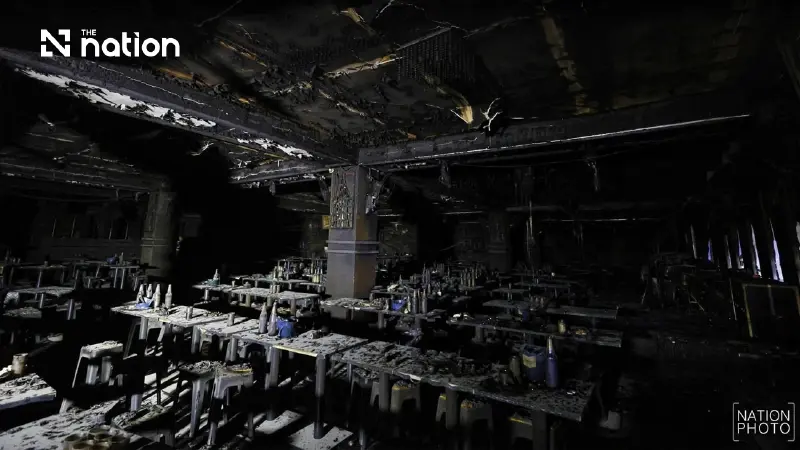


Fire-safety engineers are examining whether foam insulation above the ceiling contributed to the rapid spread of the Rong Beer Na Lat Phrao blaze, which has killed 33 people and left 16 patients in critical condition.
- The death toll from the Lat Phrao pub fire has risen to 33, with 16 injured people remaining in critical condition.
- Investigators are focusing on a thick layer of sprayed thermal-insulation foam found above the ceiling, suspecting it was the main fuel source that allowed the fire to spread violently.
- Evidence suggests a build-up of combustible gas and pressure above the stage ruptured the ceiling, leading to a high-pressure ignition.
- CCTV footage confirmed the rapid spread of the fire, showing smoke appearing 15 seconds before flames erupted and the blaze intensifying within approximately one minute.
The death toll from the fire at Rong Beer Na Lat Phrao pub and restaurant has risen to 33, while 16 injured people remain in critical condition, as police, forensic officers and fire-safety engineers intensify their investigation into how the blaze spread so rapidly.
At 5pm on July 15, Pol Maj-General Kiattikul Sonthinen, commander of Metropolitan Police Division 2, joined a meeting with relevant agencies at Phahonyothin Police Station to follow up on the fire, which left 33 people dead and more than 70 injured.

Kiattikul said the latest fatality was Mr Din, the lead singer, who died at 5.56pm at Rajavithi Hospital. Authorities have confirmed the identities of all 33 victims, while 31 bodies have already been returned to their families. A total of 71 injured people remain in hospital, including 16 critical patients, 12 in serious condition, and 43 in stable condition.
Police from Metropolitan Police Division 2 and Phahonyothin Police Station have so far questioned 96 witnesses, including the venue owner, staff, relatives of victims, officials involved in scene inspection, and structural and environmental experts.

Engineers examine ceiling foam
Busakorn Saensuk, chair of the Fire Protection Engineering Committee under the Engineering Institute of Thailand, inspected the scene and collected further evidence inside the burned venue.
She said that since engineers first entered the site on Monday, one key question had been why such a large amount of combustible gas appeared to have accumulated inside the building, causing the fire to burn so violently.
Initial checks found that decorative materials on the visible ceiling were not present in large enough quantities to be the main fuel source. However, when engineers examined the structure above the ceiling, they found a steel frame almost entirely covered with sprayed thermal-insulation foam about three inches thick.
Traces of fire damage were found on the foam during the first inspection.

Pressure build-up suspected above ceiling
Forensic officers and the Bangkok Metropolitan Administration’s Department of Disaster Prevention and Mitigation later opened the ceiling for further examination.
Investigators found evidence suggesting pressure had built up from below before rupturing parts of the ceiling. Burn patterns inside the ceiling space were also consistent with a high-pressure ignition of combustible gases.
Busakorn said the most severely damaged area was above the stage. Video footage from the time of the incident showed large volumes of smoke pouring out from that area. She explained that the smoke appeared to be combustible vapour, matching survivor accounts that they smelled a sharp, irritating odour before the fire spread.
When evacuation began and a rear door was opened, outside air flowed into the building, giving oxygen to the accumulated gases. This may have triggered violent ignition, with flames bursting out through ceiling gaps and areas where the foam had been cut or penetrated.

Foam samples to undergo lab tests
Busakorn said officials could not yet confirm whether the foam used inside the building contained fire-retardant additives. Samples must be sent for laboratory testing.
Initial inspection found that most foam was about three inches thick. However, the foam above the stage and bar area appeared to have a different coating from other sections. In some areas, the upper surface had burned away, leaving only soot, while parts of the foam body remained.
She said that even foam with fire-retardant additives can ignite if exposed to fire temperatures above its rated standard, eventually becoming fuel.
Busakorn warned that in Thailand’s hot climate, the use of sprayed foam as heat insulation must be considered carefully. Buildings should use materials that do not spread flame easily or are difficult to ignite.
Electrical systems should also be inspected alongside insulation, especially where the space above the ceiling is enclosed and poorly ventilated. Heat build-up can accelerate deterioration of electrical equipment and increase fire risk.

CCTV shows smoke before flames
Initial CCTV footage obtained from forensic officers showed smoke appearing near the ceiling above the stage area by the right-side door about 15 seconds before flames erupted. From the first sign of smoke to the fire spreading, the incident took about one minute, with smoke appearing at around 11.49pm before the blaze intensified at around 11.50pm.
Forensic officers are continuing to examine scientific evidence to establish the exact cause of the fire.
Police are also reviewing electricity-related records. The Electricity Authority reported that the venue owner had previously applied to increase electrical capacity from 30/100 amps to 200 amps, around two months after the venue opened, because the original system was insufficient. The upgraded system had not yet been installed, and related documents are under review.
Smoke ventilation urged for high-risk venues
Busakorn said simulations showed that buildings with low ceilings can become especially dangerous during a fire, as heat accumulates and radiates downward quickly, allowing flames to spread faster.
At the same time, smoke layers can descend to breathing level, creating serious danger for people inside.
She recommended that buildings with large amounts of combustible material install smoke-control systems that meet safety standards. These should include both natural smoke ventilation and mechanical smoke-extraction fans to reduce smoke and heat accumulation, improve evacuation chances, and lower structural temperatures during a fire.
On legal measures, Busakorn said safety requirements should not apply only to buildings registered as entertainment venues. They should also cover all buildings with similar usage patterns and large numbers of patrons.
She said such venues should be required to use standardised fire-safety materials and systems to raise public safety and reduce the risk of similar tragedies.
Licence and exit-door issues under review
Police are also checking the venue’s business licence. The premises had originally been authorised as a restaurant, and officials involved in issuing permits and inspecting the building have been summoned for questioning. Investigators are waiting for additional documents from the district office.
Regarding reports that exit doors may have been locked, police said the matter remains under investigation because media reports and witness statements have not been consistent. Key witnesses will be called in for further questioning.
A man referred to as “Lieutenant Nut”, who was seen dressed in clothing resembling that of an officer, has also been summoned as a witness. Police said they would examine his role during the incident in detail.
Authorities are keeping a 24-hour assistance centre open at Phahonyothin Police Station to receive complaints, return victims’ belongings, and assist relatives of the deceased and people affected by the fire. Police said evidence would be gathered quickly so legal action can be taken against all those found responsible.
