
Ministers reject insinuation that they joined hands with ‘dictators’


Ministers from the Pheu Thai-led government on Tuesday urged all parties to respect conflicting viewpoints, which they claimed was an essential component of a flourishing democracy, so as to lessen strife in society.
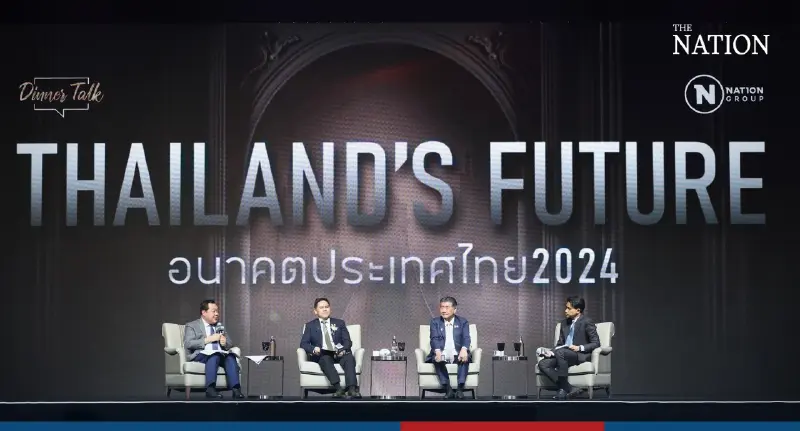
On Tuesday, several prominent politicians and business figures were present at "Thailand’s Future 2024" Dinner Talk, hosted by the Nation Group in Bangkok. Among the attendees was Thai Prime Minister Srettha Thavisin, together with his ministers.
During the event’s discussion, Deputy PM Phumtham Wechayachai said that controversy had pervaded Thai society for 50 years, ever since the 1973 Thai popular uprising, which left many dead.
Also, during the 1992 Black May tragedy, Thailand was divided into what was termed "Angels and Devils”, and since the 2006 coup, the discord in society was referred to as a “shirt colour” war, he pointed out, hinting at the yellow and red shirts.
Phumtham, who also serves as minister of commerce, said that society had become increasingly divisive over the past 20 years and that this had spread even to the family level.
He explained that Pheu Thai had decided to join hands with junta-backed parties after ditching Move Forward so as to pull Thailand out of recurring conflicts, which he labelled a “black hole” for Thailand.
“Some said we [Pheu Thai] joined hands with the dictator. I don’t think so. They competed under the same rules recognised by society, and got elected,” he said.
“We have to accept that they went through the democratic process. So, how can we call them a dictator?”
The deputy premier also urged all parties to respect differences in viewpoints among people, saying that "diversity is a beautiful aspect of a democratic society”.

Meanwhile, Social Development and Human Security Minister Varawut Silpa-archa said that it was normal for parties that share the same ideologies to collaborate in forming the government following an election, with opposing parties functioning as a check on the executive authority.
“We all ran the election campaign similarly, knocking on doors to solicit votes. Then, after the election, why is one side called a dictator while another is democratic?” he asked.
He added that most importantly, people in society needed to respect different views.

Justice Minister Tawee Sodsong expressed confidence that this administration could bring about long-lasting peace in the community after a protracted period of political conflicts.
He said: “We previously had yellow [shirt] and red [shirt], and we do not think these two sides could fuse together. I believe that this administration would foster harmony and peace in society.”
The ministers believed that amending the current constitution, except provisions related to the monarch, and granting amnesty to political detainees could help lessen social tensions.

