
Scholar suggests 10-point plan for Anutin to tackle Thailand-Cambodia crisis
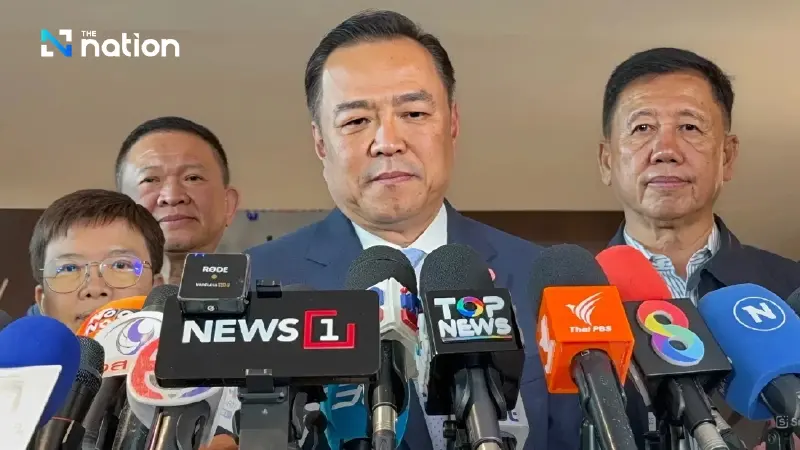


Prof Emeritus Surachart Bamrungsuk, a security and foreign affairs scholar, has written an article offering ten considerations to Prime Minister Anutin Charnvirakul, who must now act as the “captain” in guiding the Thai state vessel through the ongoing crisis with Cambodia.
His recommendations for the prime minister’s role include the following:
1. The prime minister should take the lead in formulating new policies and strategies, rather than relying on directional slogans such as the “separate marches, united strike” approach once favoured by the left. The country requires a coherent strategy to tackle the problem, as such abstract formulas fail to provide actionable policy guidance.
2. The prime minister must understand that the government holds the crucial role of setting the national strategy, while the military’s responsibility is to carry it out. It is not the army’s place to define strategy on its own, contrary to what the prime minister suggested at the National Defence College.
3. The prime minister should avoid fully embracing the wave of “nationalism and militarism,” as such sentiments could trap the government into pursuing nationalist solutions that may ultimately lead to war. It should not be forgotten that the 2011 Preah Vihear clashes ended with Cambodia appealing to the International Court of Justice, whose 2013 ruling resulted in Thailand losing ground.

4. The prime minister must recognise that in leading the government, he should articulate what strategists call an “exit strategy” — a roadmap for resolving the conflict and finding a way out of the crisis. Such a vision would give society hope that the tensions can ultimately be brought to an end.
5. The prime minister may also need to understand the “structure and operating system” of Thailand’s national security framework. This system rests on four key positions: the deputy prime minister in charge of security, the foreign minister, the defence minister, and the secretary-general of the National Security Council. These four figures form what could be called Thailand’s “security square” and must function as the machinery for managing the nation’s security issues. Yet a pressing political question remains: who currently holds the deputy prime minister’s security portfolio?
6. The prime minister should recognise that, while border disputes may appear to be a domestic issue confined to Thailand’s frontiers, they are in fact matters of international relations. Resolving them requires more than military tools; the responsibility cannot fall solely on the Defence Ministry or the armed forces. The Foreign Ministry must play a central role in addressing such challenges.

7. The prime minister must push for the four components of the state’s security apparatus to work in close coordination, under the policy direction and supervision of the government. These mechanisms must not be allowed to pursue policies independently. At the same time, careful consideration must be given to managing civil–military relations, ensuring a proper balance between the government and the armed forces.
8. The prime minister must be wary of media pressure, as coverage of Cambodian issues has taken on an “emotional” and sensationalist tone, comparable to the style of reporting seen in high-profile domestic crime cases. Media coverage that prioritises ratings through emotional storytelling and sensationalism plays a significant role in fuelling nationalist and militarist sentiment. Critics argue that the role of the media in this regard is little different in Thailand from that in Cambodia, even though Thai society’s media landscape ought to be of a far higher standard.
9. The prime minister should carefully consider the proposals of extreme conservative groups advocating for the cancellation of the 2000 and 2003 MOUs. Such a cancellation would benefit Cambodia by removing the "framework for negotiations" and would require the creation of a new agreement, which may not be as advantageous for Thailand. The prime minister is encouraged to read both documents personally and with an open mind, as they are not lengthy.
10. As the head of government, the prime minister must focus on two crucial strategic issues for the future: the strategy for Thai-Cambodian relations and the strategy for managing the Thai-Cambodian border.
In conclusion, Prof Emeritus Surachart remarks that these 10 considerations aim to provide direction in resolving the Thailand-Cambodia crisis of 2025, with the hope of achieving a positive strategic outcome for Thailand. Such an outcome would undoubtedly be politically beneficial to the prime minister and his government.
Prof Emeritus Surachart Bamrungsuk
