
Whither digitalisation in Japan, the land of innovation – and faxes?


Known as the land of the future for its bullet trains, robots, and cutting-edge mobile phones, Japan still lags the world in at least one area.
Digitalisation is proving to be the Achille’s heel of the world's third-largest economy – much of which is still hobbling along on analogue technology.
Take cashless transactions, where Japan’s regional rivals are leading the world.
Although cashless payments have more than doubled in the past decade to 36% of all transactions, Japan still lags far behind South Korea and Singapore.
The reason for the lag quickly becomes clear to visitors who arrive in futuristic Tokyo.
Azahi in the city’s historic Asakusa district is a typical example of Japan’s countless small restaurants – still stuck in the era of cash-only payment.
Ryuichi Ueki, the fifth-generation owner of this ramen joint, says he does not want to deal with credit card fees or worry about digital payment platforms like Apple Pay and LINE Pay.
"Some customers ask to pay with credit cards because they don't have cash. I tell them to go to a convenience store and withdraw cash from an ATM," Ueki told Al Jazeera in a recent interview.
And he doesn’t plan to switch to digital payment methods anytime soon: "Cashless payments are not essential because cash is convenient. If I were to change the payment system, it would seem strange. I have never even thought about it."
His family-run business has operated the same way for generations, and his satisfaction with this traditional business model is the norm among Japanese people.
Government services in Japan offer more proof of the digital lag. Many are not accessible online, instead requiring citizens to use paper applications or visit government offices.
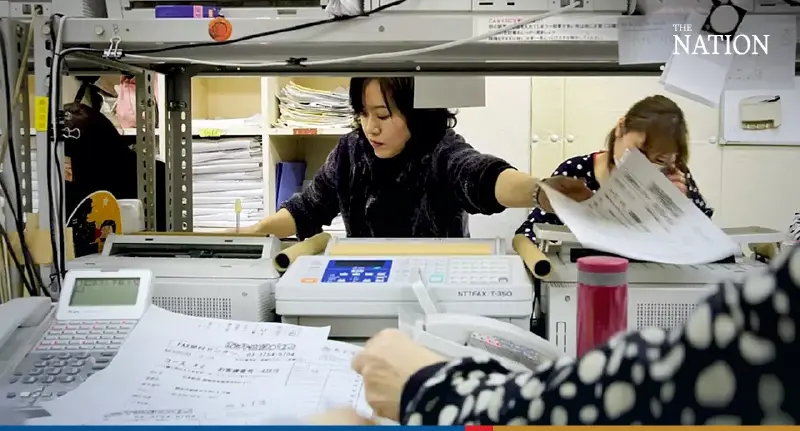
But perhaps the starkest evidence of Japan’s analogue addiction is fax machines. These remnants from a previous era are still prevalent in offices. Faxes are useful because contracts and official documents in Japan still use hanko, or official seals, rather than signatures. Faxes, which can be stamped with a hanko and kept as a paper record, are still more popular than emails and digital signatures.
The use of outdated data storage methods such as CDs and floppy discs will persist among the country’s 1,900 government organisations, laments the Digital Agency of Japan, which is responsible for the country’s online transition.
The creaking data system made headlines during the Covid-19 outbreak when Yamaguchi Prefecture officials sent floppy discs containing citizens’ data to local banks for distribution of financial aid. A glitch in the data saw 46.3 million yen (about US$11.5 million) in aid added to one resident’s bank account.
Japan currently ranks a lowly 29th out of 63 economies in the International Institute for Management Development’s world digital competitiveness ranking, behind regional rivals Singapore, South Korea, Hong Kong, Taiwan, and China.
Martin Schulz, a policy economist at IT giant Fujitsu, said: "Japan's reliance on traditional payment systems is partly a result of its success in achieving world-class efficiency with analogue technologies."
Schulz, an adviser to the Japanese government, added, "When it comes to business operations, they do it the same way family-run businesses have been doing it for generations. Conducting business in this way is typical for the Japanese."
Japan’s government has long been aware of the need to address the digital lag, which threatens efforts to foster innovation worth trillions of dollars and revitalise an economy still lagging behind 1990s GDP levels.
In a 2019 report, the Minister of Economy, Trade, and Industry (METI) warned that Japan was facing a digital crisis due to businesses failing to adapt to digital systems.
Then-prime minister Yoshihide Suga pledged to accelerate the digital transformation across the country.
Policies allocating a budget of 5.7 trillion yen were introduced to develop digital infrastructure in regions experiencing labour shortages as the population aged rapidly.
The pandemic also served as a warning sign for the country to leap over the gap to digitalisation.
Schulz said that while many countries have used the Covid crisis to explore new avenues for conducting business digitally, Japan has only just begun laying the foundation for the digital era.
