
World's oldest and most complete Hebrew Bible sells for $38.1 million
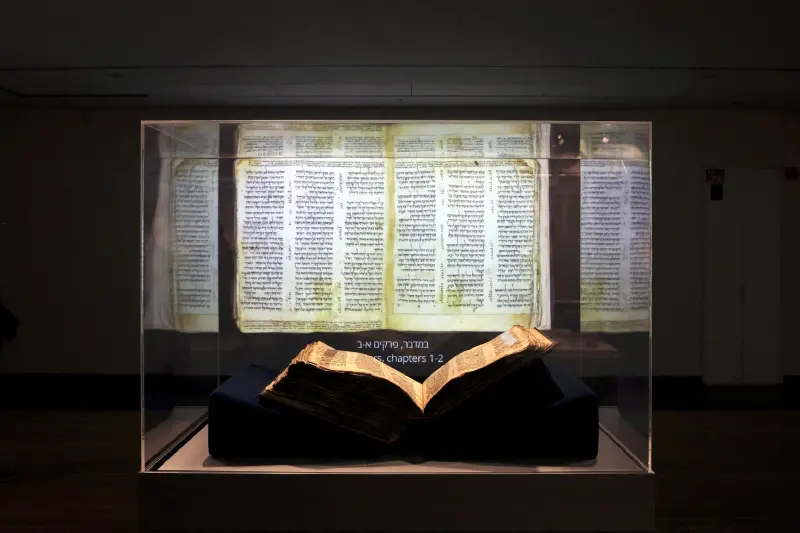


The world's oldest and most complete Hebrew Bible sold at auction for $38.1 million on Wednesday, Sotheby’s said, adding that it was the most valuable manuscript ever sold at auction.
The Codex Sassoon was acquired by Ambassador Alfred H. Moses of Washington, DC and the Moses family on behalf of the American Friends of ANU and was gifted to the ANU Museum of the Jewish People in Tel Aviv, Israel. The hammer reportedly fell after a 4-minute bidding battle between 2 determined bidders.
The price surpasses the 1994 sale of Leonardo da Vinci’s Codex Leicester manuscript, which achieved $30.8 million, Sotheby's said.
The Codex Sassoon is named after the previous owner David Solomon Sassoon, who acquired the Bible in 1929 and assembled one of the most significant private collections of Judaica and Hebraica manuscripts in the 20th century.
"This manuscript, Codex Sassoon, written around the year 900, contains all the books of the Hebrew Bible in one single format. It is the earliest time that we have an almost complete manuscript of the Hebrew Bible,” Sotheby’s book and manuscript department’s senior consultant of Judaica and Hebraica, told Reuters in an interview earlier this year.
The document offers a critical link bridging Jewish oral tradition to the modern Hebrew Bible. It was not until recently that the former owner, collector Jacqui Safra, had the Codex Sassoon carbon dated, confirming it was older than the Aleppo Codex and the Leningrad Codex, two other major early Hebrew Bibles, according to Sotheby's. Sotheby's said the Codex Sassoon had been dated to either the late 9th or early 10th century on both scientific and paleographic grounds and contains almost the entirety of the Bible. The oldest copies of Biblical text ever found were the Dead Sea Scrolls which were discovered in caves in 1947.
The Hebrew Bible contains 24 separate books organized into three parts — the Pentateuch, the Prophets, and the Writings. Starting with the book of Genesis and ending with Chronicles, the Hebrew Bible is foundational to Judaism, as well as Christianity and Islam.
Reuters
