
Taiwan dollar surges; Hong Kong intervenes to defend peg
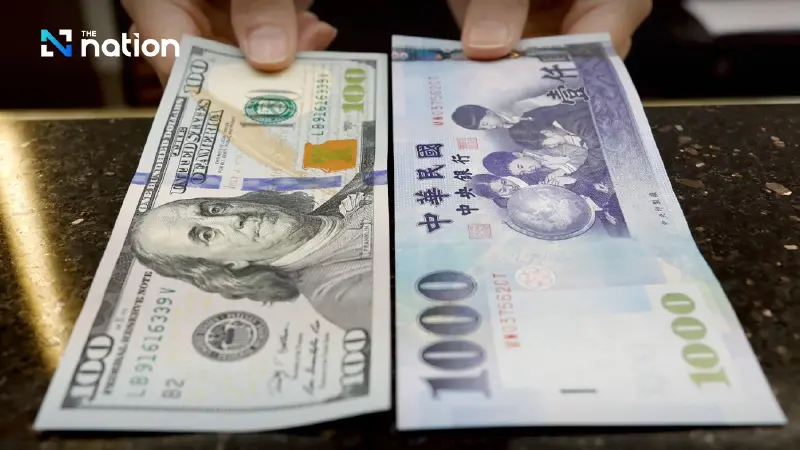


An unprecedented two-day surge in Taiwan's currency is the latest leg of a scramble out of the US dollar and a signal of disquiet in markets as US President Donald Trump's trade war rattles confidence and disrupts trade relationships.
Taiwan occupies one of the most valuable and vulnerable points in the global economy, as the dominant manufacturer of high-end computer chips and supplier to both the U.S. and China.
Its currency, usually controlled by a central bank with a mandate for stability, has leapt 8% in two days, with traders complaining of no buyers for US dollars that insurers, exporters and investors suddenly wanted to sell.
The precise trigger for the sudden rise was not clear.
Yet the move coincided with the end of US-Taiwan trade talks in Washington, which fuelled speculation of an agreement to weaken the greenback in return for trade concessions.
Such a deal has been repeatedly denied by the central bank, but not entirely believed by a market which sees the Taiwan dollar's jump having its tacit approval, as well as likely to be welcomed by the United States.
The scale of the rally suggests a big unwinding is under way and shines a light on one economy among many where years of big trade surpluses have built up large long dollar positions at exporters and insurers that are now under question and on edge.
"The Taiwan dollar is appreciating at a faster pace than I've ever seen," said one senior Taiwanese financial industry executive, on condition of anonymity as they were not authorised to speak to the media.
"Hot money is coming into Taiwan, and the central bank is allowing it. Many are saying that's due to pressure from the US. I would say that must be the case."
Taiwan's central bank said on Monday the US did not ask for a stronger Taiwan dollar and said the currency had been volatile lately because of foreign fund inflows and companies' expectations of a stronger Taiwan dollar.
Taiwan President Lai Ching-te on Monday also weighed in calling on people not to spread fake stories about foreign exchange rate talks with the United States.
Taiwan's office of trade negotiations said on Monday that the talks last week did not include the central bank or touch on the exchange rate. The currency notched its strongest close in more than two years on Monday, closing at 30.145 to the dollar.
HOW IT HAPPENED
The Taiwan dollar has been moving higher since early April, when Trump announced the heaviest of his tariffs and put a - since suspended - 32% import tax on Taiwan.
The trend seemed to start with a bump from the easing of US-China tensions, but started to feed on itself as unique features of Taiwan's capital markets drove desperate buying.
As exporters saw the value of their US dollar receipts dropping and insurers the value of their vast offshore holdings fall in Taiwan dollar terms, exporters rushed to convert and insurers scrambled simultaneously to hedge their currency exposure.
"The (U.S. dollar) selling interest originates onshore," said Tareck Horchani, head of prime brokerage dealing at Maybank Securities in Singapore.
That, in turn, he said, pushed foreigners with leveraged positions in the cheap-to-borrow Taiwan dollar to quit and the forced buying of Taiwan dollars turbocharged the moves.
To be sure, on both Friday and Monday, the currency stabilised after morning surges, and the central bank reiterated on Monday that it would do its best to maintain stability.
Still, the speed and size of the jump - in statistical parlance a 19-standard-deviation event - point to longer-term forces afoot.
"It ... underscores how a pileup of less-noticed financial imbalances can elicit sharp corrections when the underlying political canvas undergoes a seismic change," said Aninda Mitra, head of Asia macro strategy at BNY Investment Institute.
And those speculating on a broader shakeout as the Trump administration seeks to re-shape its trade relations see it as a harbinger of the next leg of dollar weakness in Asia.
"While the jury on whether (the Trump administration) can move manufacturing onshore is out, and we are unlikely to know for sure, a weak dollar is certainly an integral part of their strategy," said Sunil Kalra, portfolio manager at LC Beacon Global Fund.
"So the stars are aligned, and while so far most dollar weakness has been seen in the precious metals and G10 space, is it finally time for this to spread into emerging markets, especially Asian EM, which has lagged?"
Hong Kong's central bank intervenes to maintain currency peg
Hong Kong's de-facto central bank stepped into the foreign exchange market on Tuesday as the currency hit the top end of its band for a fourth time this month, spurred by a broader selloff in the U.S. dollar against several low-yielding currencies.
The Hong Kong Monetary Authority bought $7.8 billion (HK$60.5 billion) against the Hong Kong dollar on Tuesday, and has been intervening since May 2 as the currency repeatedly hit 7.75, the upper limit of its peg to the U.S. dollar.
The Hong Kong dollar is pegged to a tight band of between 7.75 and 7.85 versus the U.S. currency.
The surge in the Hong Kong dollar mirrors moves in other Asian currencies, particularly the Taiwan dollar which rose an unprecedented 8% over two sessions to reach three-year highs.
While analysts have found it difficult to determine a precise reason for the rally, they point to the progress in Sino-U.S. trade talks and a general loss of faith in the U.S. currency and its debt as possible triggers for investors rushing to unwind carry trades and buy back home currencies.
The Taiwan dollar's upsurge followed the end of U.S.-Taiwan trade talks in Washington, sparking speculation of some kind of soft agreement between governments to weaken the U.S. dollar in return for trade concessions. Taiwan officials have said currencies were not part of the talks.
The HKMA intervention to defend the peg has implications for monetary settings in the Hong Kong economy. The aggregate balance, the key gauge of cash in the banking system, will increase to HK$161 billion on May 7, nearly four times the HK$44.6 billion on Tuesday.
