
IEAT chair calls for Thailand Do Over to restore growth momentum


Thailand’s economy is stuck in a “no form” slump as weak growth, slowing investment and high household debt squeeze demand, he said, urging a shift to new industries, smarter infrastructure and faster state reform.
- The IEAT chairman argues Thailand's economy has "no form," citing low GDP growth, slowing investment, and fading advantages in trade and tourism, necessitating a complete redesign.
- He warns against relying on short-term fiscal stimulus, which he believes risks fiscal discipline and could lead to deeper structural problems like deflation and rising bad debt.
- The "Thailand Do Over" proposal involves building new industries (clean energy, advanced tech), expanding infrastructure to include digital networks and workforce skills, and attracting investment combined with technology transfer.
- A critical first step is reforming the state itself to be faster, more transparent, and less bureaucratic to enable the necessary changes and attract modern investment.
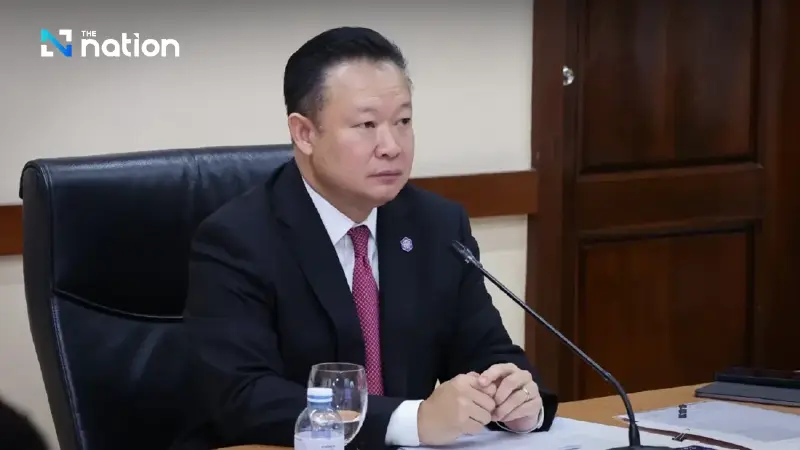
Yuthasak Supasorn, chairman of the board of the Industrial Estate Authority of Thailand (IEAT), said on Wednesday (January 7) that while many people see Thailand’s 2026 economy as a “lame duck” weakened and short of momentum, he believes a more accurate description is that it has “no form”.
He likened the situation to a footballer who has lost form, not because they lack talent, but because their body, system and environment no longer allow them to perform at the same level as before.
Economic forecasts, he said, underline this “no form” reality: GDP growth is low, private investment is slowing, and exports are trending negative, while domestic consumption is constrained by high household debt and weak purchasing power.
Thailand, he argued, is stuck in a position where “pushing forward is difficult, but retreating is risky.
A tougher world, and fading advantages
Yuthasak said global uncertainty is rising amid geopolitical tensions, trade protectionism and intensifying technological competition.
Thailand, which once benefited from freer trade and production relocation, is now losing its edge due to higher costs, low productivity and a business ecosystem that has not modernised quickly enough.
Tourism is no longer the same safety net
Tourism, once another key pillar, is no longer the reliable answer it used to be, he said.
Travellers worldwide increasingly prioritise quality, safety and sustainability, while regional competitors are upgrading aggressively.
If Thailand continues selling the same old image, it risks becoming a destination that is merely “good enough” but not the “first choice”.
The limits and risks of old-style stimulus
He warned that relying on familiar short-term fiscal injections increases risks to fiscal discipline and national confidence.
If the slowdown persists, threats to stability, including deflationary pressure, rising bad debt and greater financial-system fragility, could worsen and spill into deeper structural problems that are far harder to fix.
Time for a “Thailand Do Over”
Yuthasak said Thailand’s task is not simply to stimulate the economy, but to redesign the country.
Escaping the current trap requires more than attracting capital: it must combine investment inflows with the absorption of overseas capabilities, genuine technology transfer, and stronger domestic innovation, at the same time.
He said infrastructure should not be limited to roads and rail, but also cover logistics, digital networks, clean energy systems, environmental facilities and workforce skills.
In an era when capital moves easily, investors are looking beyond tax incentives to the quality of people and the agility of the system.
New industries and a new role for Thailand
Thailand, he said, must build “new industries” to replace disappearing advantages.
The circular economy, clean energy, advanced technologies and high-value services remain areas of opportunity if the public and private sectors move in the same direction.
At the same time, Thailand’s role on the world stage should be redesigned under a principle of “flexible balance”: not choosing sides, but placing national interest at the centre; maintaining relations with all major powers; and turning global conflict into opportunity rather than allowing it to become pure risk.
Reform the state before reforming anything else
None of this, he said, will happen if the state remains slow, bureaucratic and culturally resistant to change.
Thailand needs a “speed-focused” state, faster, more transparent and easier to do business with.
That means cutting steps, shrinking bloated structures and taking corruption seriously, under the rule of law, with a clear stance of “no grey, no black”.
He added that wasteful populism may win short-term popularity but leaves long-term burdens, especially in an ageing society where government spending will inevitably rise.
Thailand, he said, must refocus on fiscal discipline, professional management of state assets and investments that generate real economic returns.
“No form” does not mean “no way out”
Yuthasak concluded that while Thailand’s economy may currently have “no form”, that does not mean it has “no future”.
On the contrary, this may be the most important moment to reset the country, if Thailand is willing to think differently, act for real, and change the long-standing structures holding it back.
The key question, he said, is not how much Thailand can grow next year, but whether it can start designing a Thailand that will be ready for the next 20 years, beginning now.
