
China launches island-wide special customs operations in Hainan
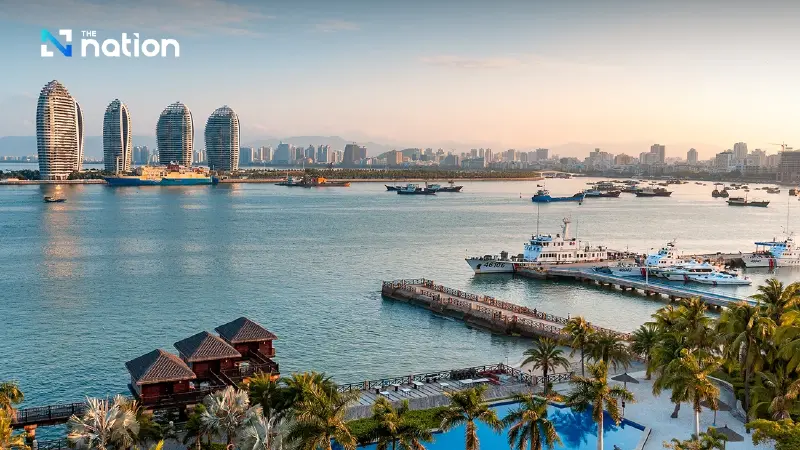


New Hainan Free Trade Port customs regime is set to cut costs for overseas trade and expand zero-tariff imports, with Thailand’s trade office in Guangzhou saying it could open a fresh gateway for Thai goods, while intensifying competition on island.
- China has launched "island-wide special customs operations" in Hainan, establishing it as a Free Trade Port positioned as "within the country but outside the customs territory."
- The system operates on the principle of "free import, control upon entry to the mainland, and free trade within the island," facilitating easier and cheaper trade between Hainan and overseas markets.
- A key feature is a massive expansion of "zero-tariff" import items, allowing goods processed in Hainan to potentially enter mainland China with tariff exemptions.
- The initiative is a strategic move to attract value-added industries, align with international trade standards, and signal China's continued commitment to economic opening-up.
Thailand’s Department of International Trade Promotion (DITP) under the Ministry of Commerce, citing a report by the Thai Trade Centre in Guangzhou, said China officially launched “island-wide special customs operations” across Hainan on December 18, under the Hainan Free Trade Port (Hainan FTP) framework.
China described the Hainan FTP as a step towards “higher-level opening-up”, with a clearly defined special customs zone, positioning Hainan as “within the country but outside the customs territory” to facilitate the flow of goods, capital, technology and services from around the world.
The Hainan FTP operates on the concept of “free import, control upon entry to the mainland, and free trade within the island”.
Trade between Hainan and overseas markets is expected to involve lower procedures and costs, while movements of goods into mainland China remain under strict supervision.
Within Hainan, the system is designed to allow freer circulation of production factors than elsewhere in the country.
A core element is tax and trade restructuring.
China expanded the scope of “zero-tariff” import items from about 1,900 tariff lines to roughly 6,600, or around 74% of all tariff lines.
Imported goods can circulate within Hainan without import duties, and if processed to meet value-added thresholds, they can be shipped into mainland China with additional tariff exemptions, reflecting a policy direction aimed at drawing processing, logistics and trade-in-services activities back onshore.
Structurally, the move signals China’s shift from reliance on volume-based manufacturing and traditional exports towards an economy driven by value-added activity, innovation and deeper institutional links with the global economy.
Hainan is being used as a pilot area for adjusting rules on investment, trade in services, finance and public administration to better align with international standards.
Against global pressure from trade protectionism, geopolitical tensions and supply-chain uncertainty, the Hainan FTP is seen as a strategic signal that opening-up remains a key policy, with institutional mechanisms to enhance competitiveness, reduce business costs and support production and investment relocation, particularly in high technology, medical services, premium tourism, the digital economy and cross-border trade.
The Thai Trade Centre in Guangzhou said the Hainan FTP presents both opportunities and challenges.
Hainan could become a key gateway for Thai goods into China, with lower tax costs and more business-friendly trade procedures, and could serve as a production base before entry into the mainland market.
At the government level, Thailand has maintained ongoing trade cooperation with China.
DITP signed a memorandum of understanding on trade cooperation with the Department of Commerce of Hainan Province on August 20, 2021, a mechanism to promote cooperation, develop entrepreneurs and create a more supportive environment for Thai–Hainan economic activity.
However, Thai businesses may face intensified competition from foreign products using Hainan as a production base.
Thai operators, therefore, need to raise product quality and standards and develop a deeper understanding of new rules, tax incentives and rules-of-origin requirements to fully benefit from the policy.
