
Health Ministry says no shortage of medicines, medical supplies or vaccines
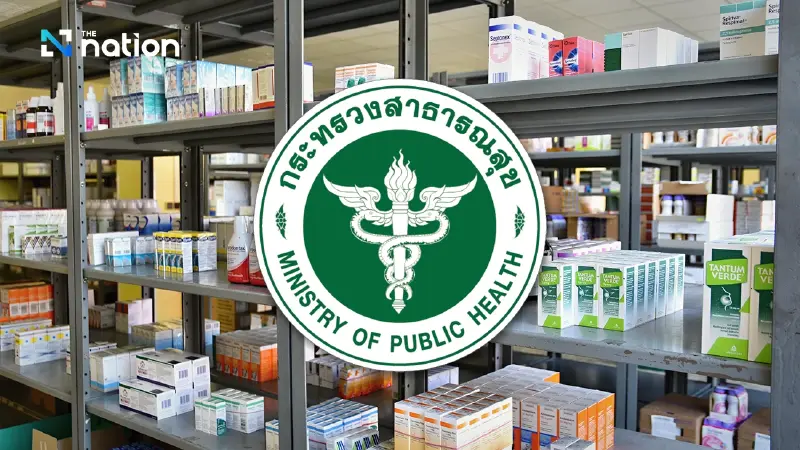


Hospitals have been told to save energy, medicines and medical supplies while keeping patient dispensing periods unchanged, the minister said.
- Thailand's Health Ministry has confirmed there is no current shortage of medicines, medical supplies, or vaccines despite the conflict in the Middle East.
- The risk of a shortage is considered low as Thailand imports most of its finished medicines from China, the United States, and Europe, not the conflict-affected region.
- While supplies are secure, logistical challenges and longer shipping times are anticipated due to the closure of sea lanes like the Strait of Hormuz and the Red Sea.
- As a buffer, private operators and medicine importers typically hold about two months of stock, and hospitals have been told to conserve resources.
Public Health Minister Pattana Promphat spoke after a meeting on Friday (March 6) about medical and public health preparedness to support Thai nationals in light of the fighting in the Middle East.
Discussions covered the security of medicines, medical supplies and vaccines if the conflict dragged on.
The initial assessment found that there would be no shortage of medicines, although logistics and transport would require close attention and could take longer.
A shipment that would normally take seven days might be delayed because routes had become longer following the closure of shipping lanes through the Strait of Hormuz and the Red Sea.
Thailand, however, does not import many medicines from that area. Most finished medicines come from China, the United States and Europe.
Pattana added that the Food and Drug Administration (FDA) would hold talks with associations representing the medicines and medical supplies sector to provide greater clarity.

‘At this stage, we understand there is no shortage. Private operators and medicine importers normally hold about two months of stock. Some medicines may be easier or harder to procure than others, but we do not want people to panic. I confirm that medicines, medical supplies and vaccines remain in a normal state. If the situation does not become more severe and does not worsen, there should not be much cause for concern,’ Pattana said.
Hospitals have been told to prepare and assess the situation, with the priority being to conserve resources, including energy, medicines and medical supplies.
They have also been urged to stay alert, as procurement could become more complicated, particularly in terms of delivery times and prices.
All units have been told to exercise caution, but the period for which medicines are dispensed to patients remains unchanged.
Pattana also noted that, over the past five to six days of fighting in the Middle East, the Ministry of Public Health (MOPH) had been holding ongoing discussions and preparations.
This covered both tourists and Thai citizens working or living in the Middle East who wished to return to Thailand, with disease-screening systems prepared for them.
Coordination has been carried out through the Ministry of Foreign Affairs, the lead agency.
Channels have also been opened for physical and mental health consultations through the Department of Mental Health’s online system and application, as well as the Mor Prom system, which can provide telemedicine.
‘If Thai workers are evacuated back to the country, preparations have been made for disease screening at six main airports: Suvarnabhumi, Don Mueang, Wing 6 (Royal Thai Air Force), Hat Yai, U-Tapao and Phuket. If an infection or illness is detected, treatment will begin immediately under protocol.
‘In addition, all hospitals have been instructed to prepare and to be careful in their use of resources and budgets for procuring medical supplies, which may become more complicated in the future,’ he added.
