
Suphajee challenges coconut aggregators; Commerce to launch central hub
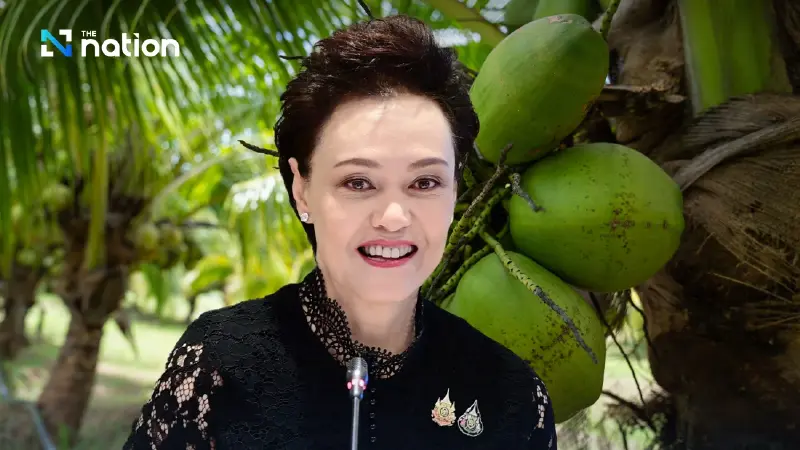


Commerce Minister Suphajee Suthumpun said the ministry would press ahead with a new purchasing model, set up a central collection point and expand market channels after reports that 239 coconut aggregators had suspended purchases to pressure prices.
- Commerce Minister Suphajee Suthumpun challenged 239 coconut aggregators who threatened a two-day purchasing halt over low prices, telling them to stop buying completely.
- In response to the aggregators' pressure, the Commerce Ministry will establish a "central fruit collection and packing centre" in five key provinces to create an alternative purchasing system.
- The new central hub is designed to restructure the market by purchasing only quality coconuts at fair prices, addressing the issue of low-grade produce dragging down overall prices for farmers.
- Lower-quality coconuts will be channeled through the new system into value-added processing for export, such as to the Chinese market.
Suphajee Suthumpun, Minister of Commerce, said at a Bhumjaithai Party seminar for MPs in Buriram province, regarding measures to address falling prices for aromatic coconuts, that Thailand is currently sending an average of more than 2 million coconuts a day to market, which is a very high volume.
Most produce aggregators buy whole clusters.
In reality, however, one coconut cluster contains around 10 coconuts, but after grading, only 2–3 are of sufficient quality to be sold at a good price.
More than 70–80% fall below standard, dragging down the average price and, in some cases, leaving farmers with only THB2–3 per coconut, making it impossible for them to sustain their livelihoods.
This problem has not emerged only recently, but has built up over many years.
As a result, many farmers no longer have enough capital to maintain their coconut plantations, which in turn has led to a decline in product quality and further reinforced the cycle of falling prices.
She added that some news coverage may at times reflect only part of the problem, leading the public to believe that agricultural prices have fallen sharply, when in fact factors such as product quality and moisture content are also involved.
Therefore, the handling of information must take into account the overall picture of the entire system.
As for solutions, the Commerce Ministry is preparing measures to restructure the purchasing system of produce aggregators, proposing a shift from buying whole clusters to purchasing only quality coconuts so that farmers receive appropriate prices.


Produce that does not meet standards will be channelled into value-added processing, such as “semi-husked coconut”, which can also be exported to the Chinese market.
“In some areas, there are reports that as many as 239 produce aggregators have joined forces and announced a temporary suspension of coconut purchases for around two days to pressure the market and see what Suphajee or the Commerce Ministry can do.
My answer is simple: there is no need to stop for two days, stop altogether, do not buy.
The Commerce Ministry will set up a ‘central fruit collection and packing centre’ together with entrepreneurs who are genuinely committed to improving product quality, while also supporting farmers with production inputs such as fertiliser and knowledge to raise the quality of output,” Mrs Suphajee said.
The ministry will begin in five main provinces that are key sources of aromatic coconuts, determining where such central fruit collection and packing centres should be established, while also surveying farmers’ needs in each area so that assistance can be provided in a targeted way, under the concept of giving farmers both the tools and the means to build lasting strength.

At the same time, the ministry is also accelerating overseas market expansion through business linkages.
Most recently, it organised a Business Matching event for Thai fruit products, inviting more than 90 overseas operators and more than 100 Thai operators to take part in over 600 business pairings.
This generated an immediate trade value of around THB1 billion, with further orders expected throughout the year.
In addition, a year-round fruit calendar is also being prepared, while contract farming is set to be promoted in order to link production directly with market demand.
Mrs Suphajee said that the agricultural sector remains at the heart of the Thai economy.
Although it currently generates only around 6% of gross domestic product (GDP), it accounts for as much as 30% of the country’s labour force.
Therefore, if the sector can be made more efficient, with stable incomes and a precise, sustainable production system, it will help strengthen the country’s long-term economic security.
The Commerce Ministry stressed that resolving problems in the agricultural sector requires cooperation from all sides, particularly information from local areas and coordination with representatives in each province, so that policy-making can genuinely address farmers’ problems.
